Note
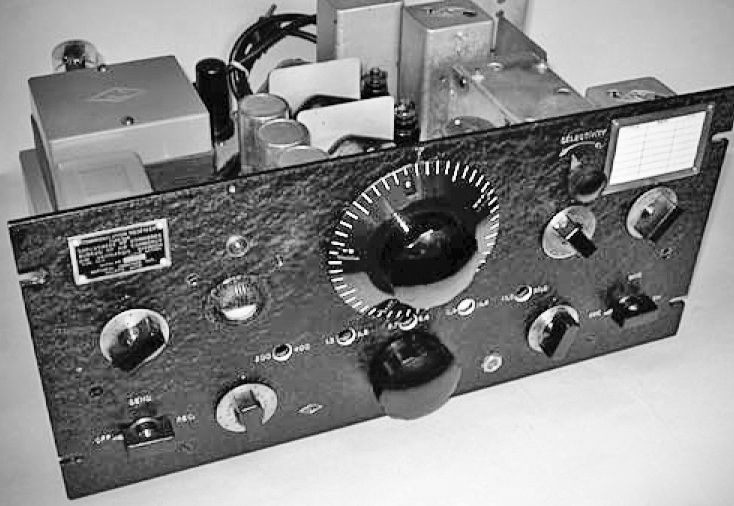
The RCD is a rare, 12-tube superheterodyne airport communications receiver (a variant of the NC-100) manufactured by the National Company of Malden, Massachusetts. It was used as an airways ground receiver, and was highly valued by government agencies, military aviation, and civilian airlines because it was less complex than National’s HRO model, more versatile, and lower in cost.
The RCD represents the very beginning of the government contract variants. Later government/CAA sliding-coil models (such as the RCE, RCF, RCK, RCL, RCP, and RCQ) phased out the dual-6F6 push-pull audio stage in favor of a simpler single-ended audio output. They also added circuit advancements like Inter-channel Noise Suppression (INS) and Carrier Operated Noise Suppression (CONS), which the early RCD lacked.
The sliding-coil design was announced by James Millen in October 1935, with initial production starting in early 1936. In early 1937, a small production run was manufactured under a CAA (Civil Aeronautics Administration) contract for the Department of Commerce, Bureau of Air Commerce, Air Navigation Division.
It features a massive, movable sliding-coil "catacomb" occupying most of the sub-chassis area, housing high-quality fixed inductances (three for each of its five bands).
Features
– It has a built-in power supply.
– Has a push-pull 6F6 audio output stage.
– Tuning is controlled by the famous National PW dial, which provides 12 feet of bandspread.
– It requires a matching "hot field" loudspeaker to operate, where the speaker's 500-ohm field coil acts as a power supply filter choke and completes the B+ circuit.
Relationship to the NC-100
The RCD is a direct, early variant of National's standard civilian NC-100 sliding-coil receiver.
– Nearly Identical Design: Physically and electrically, the RCD is almost identical to the first stock design of the NC-100.
– Shared Circuits: It retains the NC-100's crystal filter, 12-tube lineup, built-in power supply, and the dual-6F6 push-pull audio output stage.
The Differences
– Frequency Coverage: The primary difference lies in the frequency bands. While the stock NC-100 covered the standard broadcast band, the RCD replaced those broadcast-band coils with low-frequency coils covering 200–400 kHz (using National's "H" coils) to monitor airport beacons and weather.
– Panel Engraving: Because of the frequency range swap, the front panel of the RCD has different frequency engraving changes to reflect the 200–400 kHz range.