Note
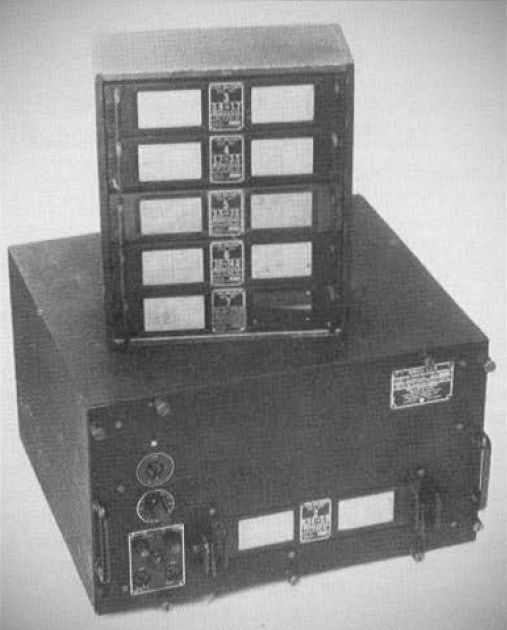
The Navy RDG (CNA-46ADU) is a specialized, little-known military offshoot of the metal-tube National HRO receiver line designed around June 1944. Unlike standard communications receivers meant for audio interception, the RDG was built strictly for spectrum surveillance and electronic intelligence (ELINT). Its sole purpose was to sweep a frequency band and drive an external oscilloscope display (such as the experimental panoramic dual display unit, model XCW, or modified Dumont 241 scopes) to visually show signal activity as a series of spikes. Once an operator spotted an unknown or suspicious signal on the display, a separate, conventional receiver and frequency meter would be used to identify and measure it.
The RDG is essentially a repackaged HRO Junior, but with significant modifications to optimize it for high-speed continuous sweeping and visual display output:
The RDG completely lacks manual tuning controls. Instead, a 1/20 horsepower synchronous motor continuously rotates the main tuning capacitor at 900 RPM via a worm gear.
Controls are highly minimal to support automated operation, featuring only power, motor, and plate switches, alongside fuses, a pilot light, and an RF gain control.
Because the motor rotates the tuning capacitor at 900 RPM, the receiver automatically sweeps its selected frequency band 15 times per second. With each rotation, a built-in cam switch sends a synchronizing pulse to initialize the external oscilloscope's horizontal sweep.
To ensure reliable tracking across rapid sweeps, it features an untuned antenna-isolator stage. The Intermediate Frequency (IF) stages are loaded with resistors to intentionally widen the bandwidth to 10 to 15 kHz (at 6 dB down).
The RDG utilizes a specialized split-stator tuning capacitor design with two sections in series to maintain mechanical balance during high-speed rotation.
Because it was not intended for traditional manual monitoring, standard HRO features such as the noise limiter, Automatic Volume Control (AVC), and Beat Frequency Oscillator (BFO) were omitted.
Unlike standard vintage HROs that relied on external power packs, the RDG has an integrated, built-in power supply. The audio/video output tube is triode-connected to function as a cathode follower.
Tube Lineup
The receiver utilizes an all-metal tube complement arranged as follows:
(3) 6K7: First, Second, and Third RF Amplifiers
(1) 6J7: First Detector
(1) 6K7: High-Frequency Oscillator
(2) 6K7: First and Second IF Amplifiers
(1) 6SQ7: Second Detector and First Audio
(1) 6V6: Audio/Video Output
(1) 5Y3: Power Supply Rectifier
Coil Sets and Frequency Coverage
The RDG uses dedicated, non-bandspread coil sets specifically aligned for a 455-kHz IF. These blocks are marked with distinct nameplates identifying them as part of the RDG system. The frequency coverage is divided into six ranges that vary slightly from a standard civilian HRO:
0.54 to 0.9 MHz
0.9 to 1.7 MHz
1.7 to 3.5 MHz
3.5 to 7.0 MHz
7.0 to 14.0 MHz
14.0 to 29.0 MHz