Note
Abstract: The National Company RH-Airport Receivers
During the economic hardship of the Great Depression, the emerging aviation and electronics sectors became key areas of technological development, largely funded by U.S. Government contracts through the Department of Commerce. In 1933, the National Company capitalized on this market by securing a contract to produce dedicated airport communication receivers. While the company's AGS model became well-known among collectors, its highly obscure successor—the RH-series (including the RHP and RHQ models)—remains exceptionally rare.
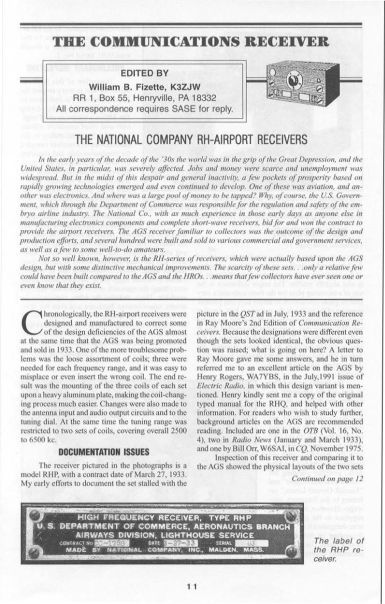
This article explores the history, documentation, and technical architecture of a surviving Type RHP high-frequency receiver, manufactured under a March 27, 1933 contract for the U.S. Department of Commerce's Airways Division (Lighthouse Service). Chronologically designed alongside the promotion of the AGS, the RH-series introduced critical mechanical improvements to address existing design deficiencies. Notably, it replaced the problematic loose-coil assembly with an integrated, three-coil heavy aluminum mounting plate to prevent coil misplacement and facilitate seamless frequency transitions. Additional modifications included a restricted tuning range (2500 to 6500 kHz) across two coil sets), an upgraded type BX black-faced tuning dial, and modified antenna input and audio output circuits.
A detailed physical and schematic inspection reveals the National Company’s signature focus on heavy-duty reliability, featuring precise heavy aluminum plate construction, hand-calibrated inductances, and a 6-volt tube lineup (78, 77, 36 37, and an 89 audio output). Despite a 1-microvolt sensitivity that is modest by modern benchmarks, the unit provided highly dependable, long-term continuous service for critical aircraft control and press wireless applications. Ultimately, the RH-series faded into historical obscurity due to its restrictive government distribution, low production run, and its rapid positioning between the release of the landmark AGS and the late-1934 introduction of the HRO receiver.