Note
Abstract
Title: The Navy HROS: Identifying World War II Variants of the National HRO Communications Receiver
Author: Chuck McGregor (with introduction by Barry Williams, KD5VC)
Source: The AWA Journal, July 2011, pp. 66–68.
Abstract:
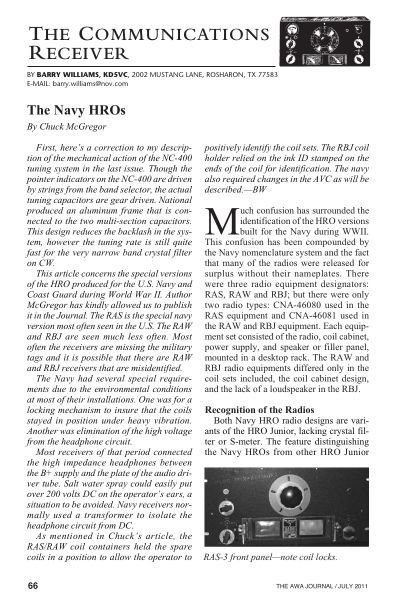
During World War II, National produced specialized variants of its HRO Junior communications receiver for the U.S. Navy and Coast Guard under three equipment designators: RAS, RAW, and RBJ. Due to the widespread post-war removal of military nameplates, identifying these surplus models has historically caused significant confusion. This paper clarifies the architectural and mechanical distinctions between the two underlying radio types utilized across these systems: the CNA-46080 (RAS) and the CNA-46081 (RAW/RBJ).
Both models are characterized by naval environmental adaptations, including physical coil-locking mechanisms, transformer-isolated headphone circuits to protect operators from high-voltage DC, and a distinct automatic gain control (AGC) circuit utilizing a 6F8G dual-triode tube rather than the standard 6B7 pentode. Crucially, the CNA-46080 (RAS) is distinguished by a 175 kHz intermediate frequency (IF) and a 10-plate CW oscillator capacitor, which accommodated the Navy's need to tune frequencies near 450 kHz. Conversely, the CNA-46081 (RAW/RBJ) features a standard 455 kHz IF and a 3-plate capacitor. The RAW and RBJ deployments differed primarily in their peripheral components, namely the number of bundled coil sets (7 versus 10) and their corresponding desktop rack storage configurations. Additionally, this article outlines the specialized power supply grounding requirements necessary to maintain delayed, amplified AGC functionality, and details the CKB-50142 plug-in noise limiter accessory uniquely designed for the RAS 175 kHz IF chassis.
Keywords: Communications Receivers, National HRO Junior, World War II Naval Radio, RAS, RAW, RBJ, AGC Circuits, Intermediate Frequency.
---