Note
QST, Nov 1967, p. 165.
QST, Jan 1968, p. 160.
Ham Radio, Mar 1968, p. 85. (complete specs)
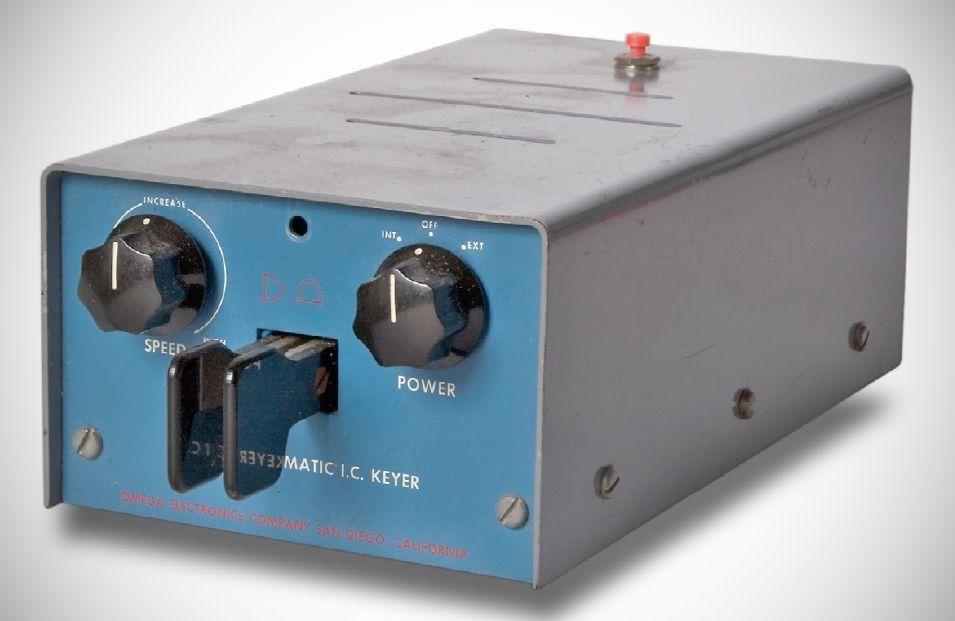
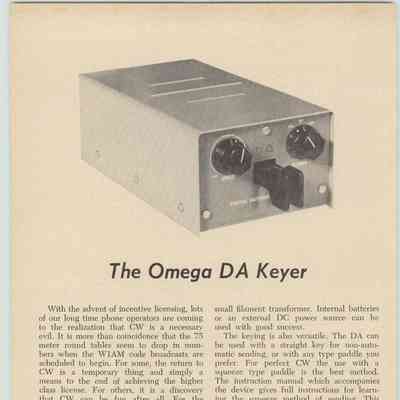
The Digital Automatic keyer from Omega Electronics used a combination of transistors and ICs. It had a built-in squeeze paddle and a speed range of 6–60 wpm. A monitor and speaker were included.
Specifications & Features
– Keying & Logic: Features "Iambimatic" action with dot and dash memories, allowing alternating dot-dash formation with both paddles closed as well as dual insertion (inserting dots or dashes while holding the opposite paddle closed).
– Speed range spans 6 to 60 WPM driven by a free-running multivibrator.
– Circuitry incorporates digital logic using 6 dual integrated circuits, 2 transistors, and 1 diode on a glass-epoxy printed circuit board.
– Self-completing dots and dashes for clean character formation.
– Paddle & Mechanism: Built-in precision double paddle with Teflon bearings.
– Includes internal adjustment options for paddle tension as well as separate dot and dash gaps.
– Provisions are included on the rear panel for connecting an external paddle or straight key.
– Output & Switching: Uses a silent 50 VA precision reed relay for keying output.
Maximum Open Circuit Voltage: 250 V.
Maximum Keyed Current: 3 A.
Maximum Keyed Power: 50 W.
– Audio Monitoring: Built-in audio monitor with tone and volume controls.
– Internal 4½-inch PM speaker.
Power Options: Batteries: Internal battery compartment (runs over 150 hours on mercury batteries or 50 hours on carbon cells; draws under 500 mW in battery mode).
– DC Input: 10–14 VDC at 100 mA (intermittent).
– AC Option: 6.3 VAC at 1.5 A via the optional DA-3 module installed in the battery compartment.
References
Review. 73, Mar 1968, p. 104.