Note
Radio News, May 1930, p. 1061. (this ad says established 1901)
The following has been extracted from "Morse Code Training Devices" by David and Julia Bart, which appeared in Volume 19 of the AWA Review (2006). The entire piece is attached.
The Omnigraph Manufacturing Company of New York was established in 1900 and made its first sales of a new training device, the Omnigraph, through a J.H. Bunnell Co. catalogue that same year.
Omnigraph promised to teach both the wireless and Morse codes "in half the usual time" and the Omnigraph came to be used extensively by the government, universities, colleges and trade schools.
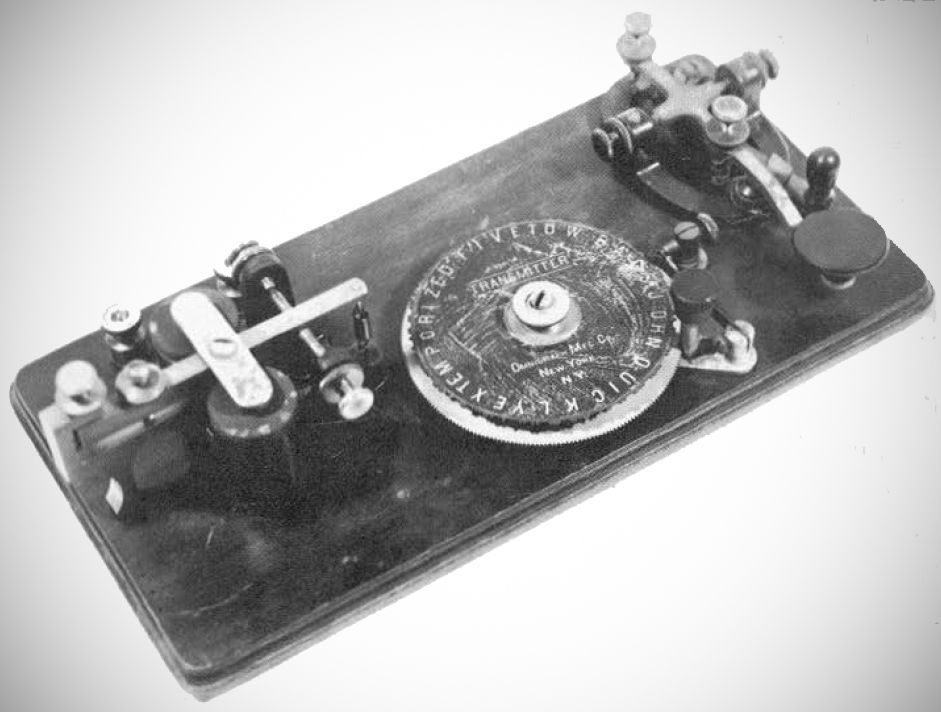
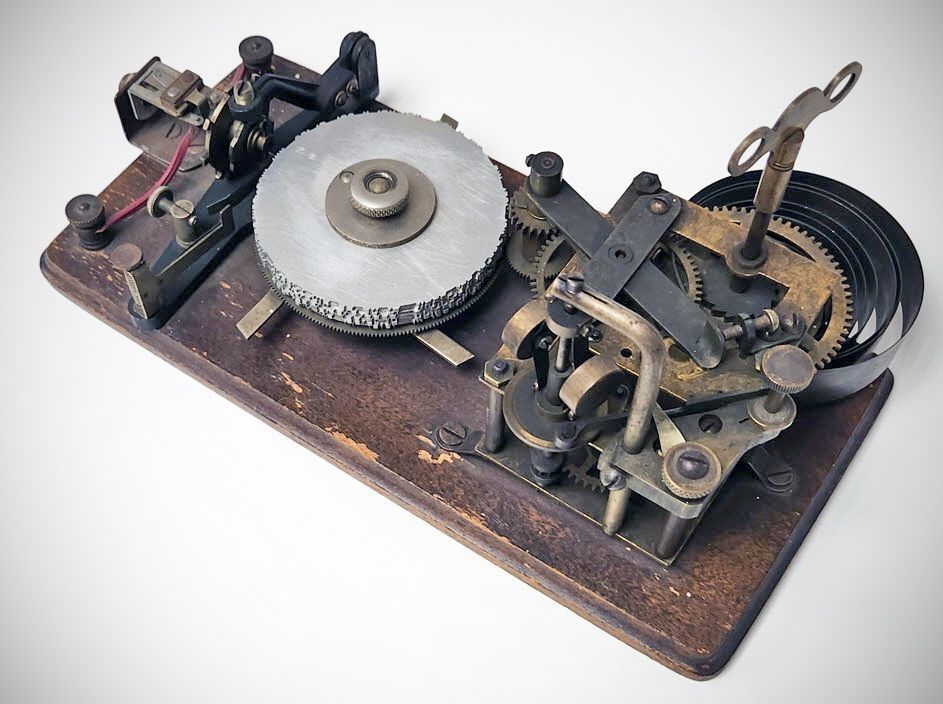
The Sears Catalogue offered the earliest versions of the Omnigraph beginning in 1902. The Sears single-disk model included a hand cranked single aluminum disk with a key and sounder mounted as a key-on-board (KOB) on a mahogany base. The disk read "JOHN QUICKLY EXTEMPORIZED FIVE TOW BAGS." An optional battery-powered motor and pulley system were also available to rotate the disk making the Omnigraph the first fully automatic training device.
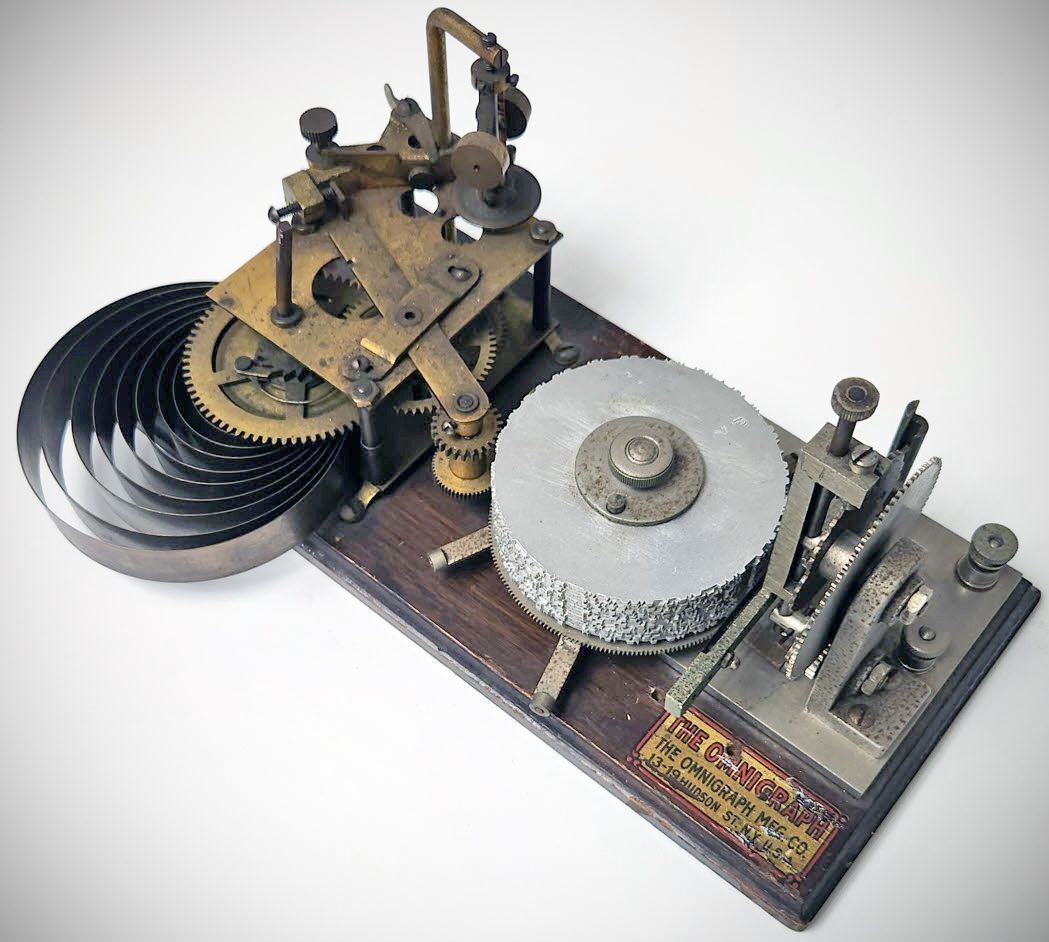
The machine generated code from the movement of an electrical contact that tracked along the raised edge of a flat aluminum disk. As the disk rotated, notches on the rim opened and closed the electrical contact enabling a sounder, buzzer, or headphones to operate. Early Omnigraphs came with the instructional booklet, How to Become an Excellent Operator. Extra disks for this first Omnigraph were available at five cents each.
The Omnigraph Company primarily focused its advertising in land line telegraph journals until about 1910 when it began selling its products as wireless training devices. By World War I, the company succeeded in its efforts to have the Omnigraph become the first device used for testing national proficiency standards in transmitting and receiving Morse code.
Both the 1914 and 1919 rule-books of the new U.S. Department of Commerce's Radio Service stated that each amateur and commercial operator license code test be "conducted by means of the Omnigraph or other automatic instrument. As the U.S. entered World War I, the U.S. military purchased large numbers of Omnigraphs to train both its telegraph and wireless operators.
As demand grew, Omnigraph produced different models that provided up to 60 practice disks. By 1917, the Electro-Importing Co. of New York advertised Omnigraphs for amateur wireless code training featuring a five disk "junior" model and the larger 15 disk model. J. H. Bunnell, Manhattan Electric Supply Company and Radio Service Company also sold Omnigraphs.
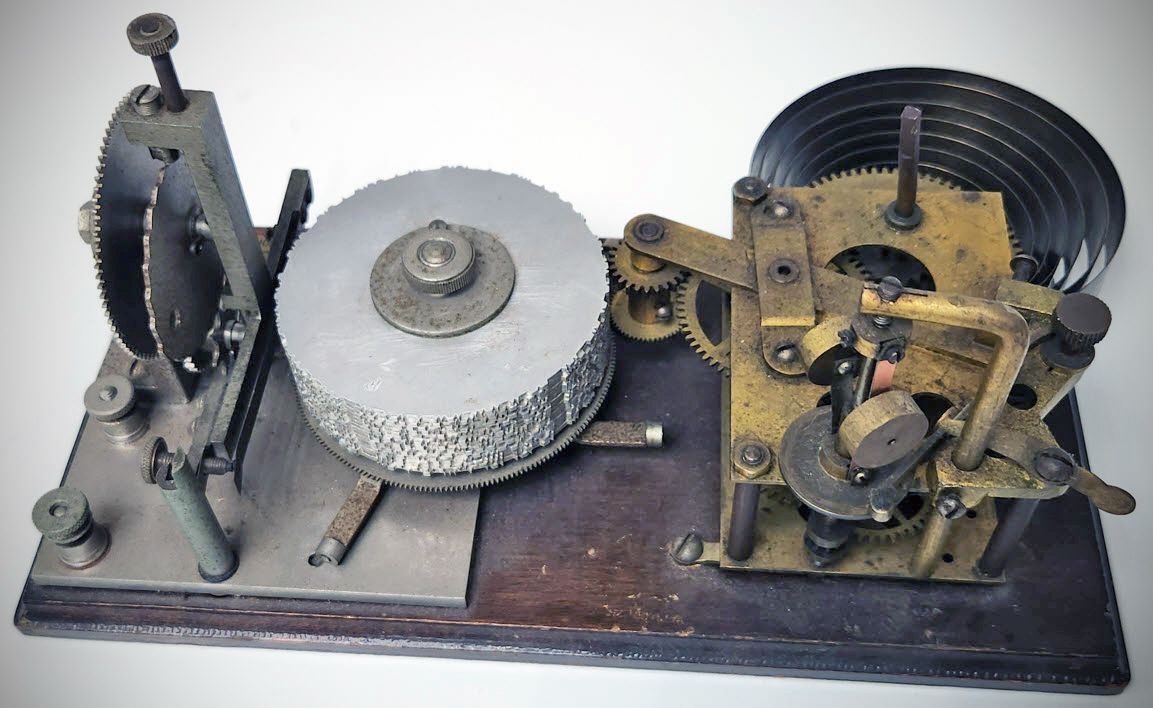
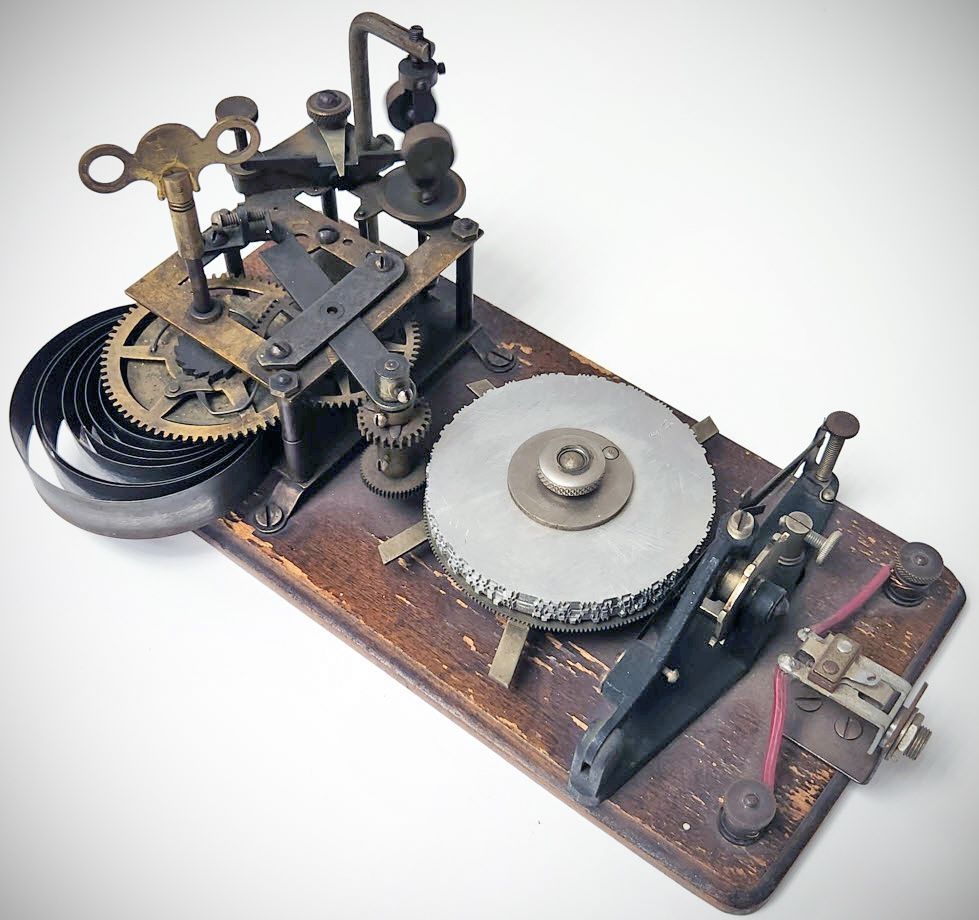
By 1922, a larger 5 disk practice set complete with a key and buzzer became available. These larger versions employed a spring driven clockwork mechanism to automatically push the contact arm up and then down the stack of disks. Speeds from 5 to 100 words per minute could be achieved by adjusting the motor's governor.
Omnigraph company advertisements stated that the Omnigraph could "send unlimited messages by the hour at any speed". The company claimed the Omnigraph could run for 45 minutes with a single winding of the clockwork motor, but practical experience showed that the sets actually began to slow down after 20 to 30 minutes of use.
Changing the order of the disks and the speeds provided variation for practice while always maintaining the uniform timing of the individual dots and dashes. Each disk contained from 12 to 36 characters and disks were available in both American Morse and Continental code. Additional disks could be purchased in groups of five for $1.00. Available disks included the alphabet, single letter disks, numerals, punctuation, railroad, commercial, press systems and interchangeable messages.
During their heyday, Omnigraphs heavily advertised in the major telegraph, wireless and radio journals of the period including QST, Radio Amateur News, Radio News, Electrical Experimenter, The Wireless Age, Western Union Tariff Circular, Journal of The Telegraph, and Radio. Many classroom correspondence schools also advertised Omnigraphs and sometimes distributed them to students under proprietary trade names. The National Wireless Institute and the New York Wireless Institute sold or used Omnigraphs in their training programs under private labels, putting their name on the instrument. International sales were made through A.W. Gamages, Ltd. in London under the Gamages label. Omnigraph advertisements appeared as late as 1927 and the company ceased operations in 1931. During its lifetime, the Omnigraph Company produced at least 15 models of the Omnigraph training device.