Note
QST, May 1975, p. 154.
QST, Oct 1976, p. 148.
QST, May 1977, p. 183.
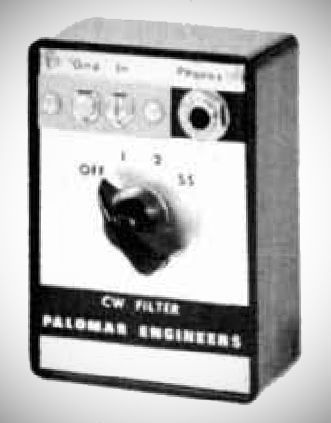
The circuit combines a wide-band and narrow-band filter to provide simulated stereo reception. Active filters prevent annoying ringing and give sharp skirt selectivity, which removes a!l signals except those within an 80-Hz bandwidth.
The simulated stereo technique allows off-frequency signals to be heard, but because of the action of mind and ears, the off-frequency signals do not interfere with the desired signal.
The filter connects between the receiver and a set of stereo headphones. In the simulated-stereo mode, the narrow-band signal is applied to one side of the stereo headset and the wide-band signal to the other.
The simulated stereo mode uses both filters with a dramatic improvement over either filter alone. The desired signal is heard in both phones; the off-frequency signals and noise are heard in only one phone. The mind concentrates on the desired signal and rejects the interference - yet off-frequency calls can still be heard, which otherwise might be missed.
The center frequency of the CW filter is 800 Hz. Bandwidths of the narrow- and wide-band filters are 80 and 300 Hz respectively.
A 9-volt battery supplies power. Input impedance is one megohm; the output will drive either low- or high-impedance headphones. The panel switch has four positions: off (receiver output direct to phones); wideband amplifier to both phones; narrowband amplifier to both phones; and simulated stereo.