Note
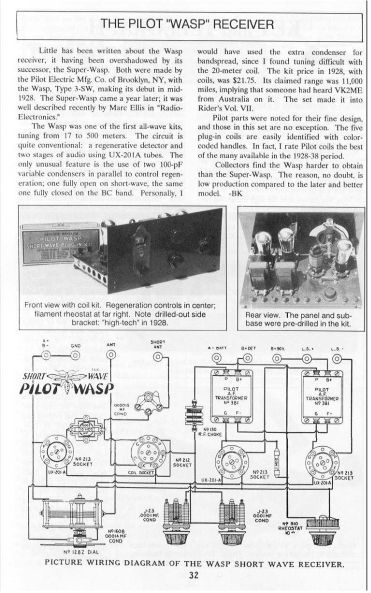
Introduced in mid-1928 by the Pilot Electric Mfg. Co. of Brooklyn, New York, the Pilot Wasp (Type 3-SW) was one of the earliest so called “all-wave” radio receiver kits. It was designed to tune a continuous range from 17 to 500 meters (600 kHz to 20 MHz) using a set of five color-coded plug-in coils.
The Wasp utilizes a conventional three-tube regenerative circuit configuration:
– Detector Stage: A regenerative detector built around a UX-201A vacuum tube.
– Audio Amplifier: Two subsequent stages of audio frequency amplification, also using UX-201A tubes, coupled by two Pilot No. 381 audio frequency transformers.
– Regeneration Control: Uniquely, the circuit employs two 100 pF variable condensers wired in parallel to manage regeneration. Operating instructions note that one condenser is left fully open for short-wave listening, while the same condenser is kept fully closed to stableize operation on the standard broadcast band.
The receiver was sold as a builder's kit for $21.75, which included the necessary plug-in coils. The kit included a pre-drilled front panel and sub-base. For a bit of late-1920s flair, it utilized stylized, drilled-out aluminum side brackets, which were considered highly modern or "high-tech" for 1928.
Though heavily marketed in its era with an ambitious claimed reception range of up to 11,000 miles, the original Wasp had a short production run. It was quickly overshadowed a year later by the release of the highly successful Pilot Super Wasp, making the original 1928 variant a relatively rare find for vintage radio collectors today.