Note
CQ, Nov 1962, p. 6.
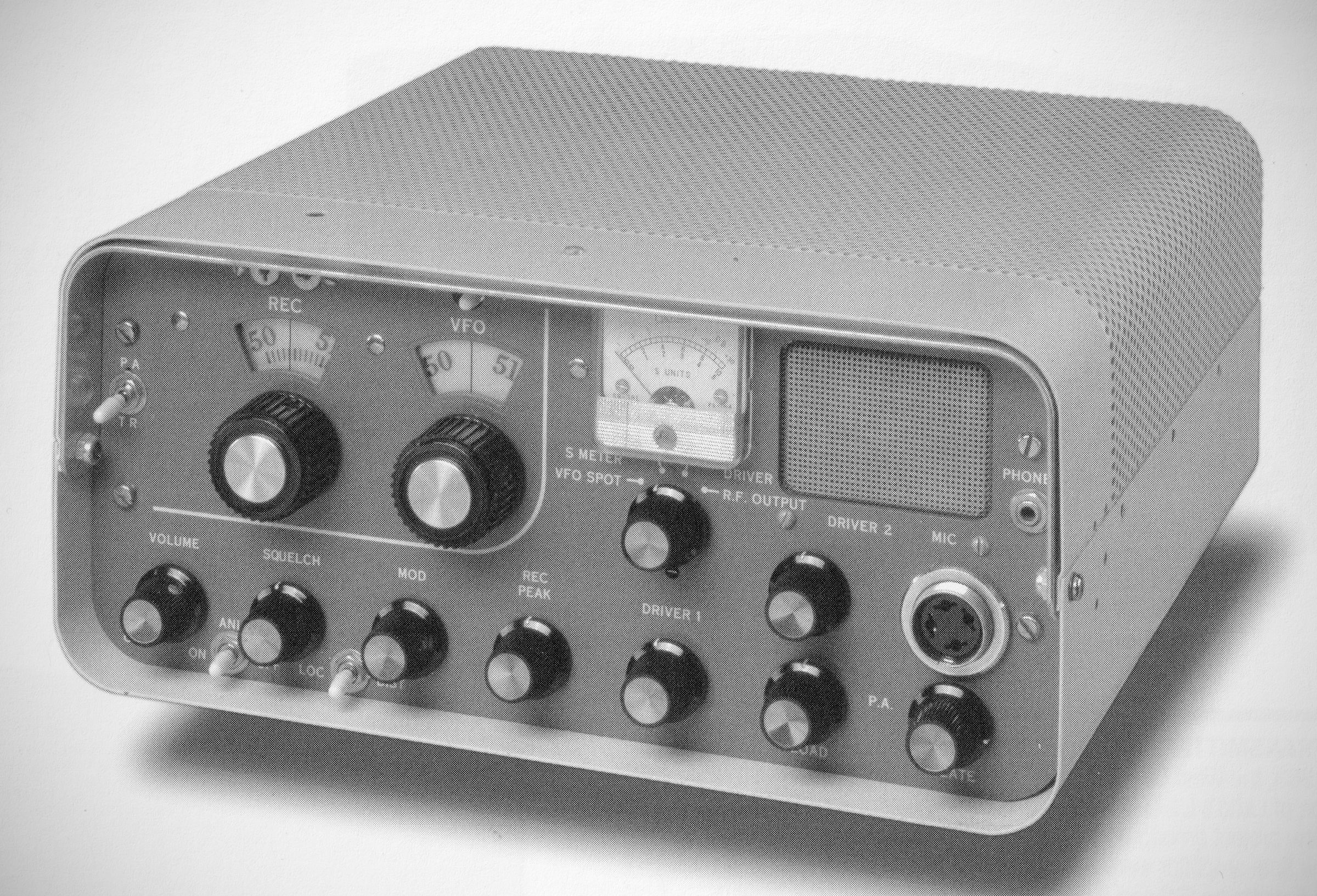
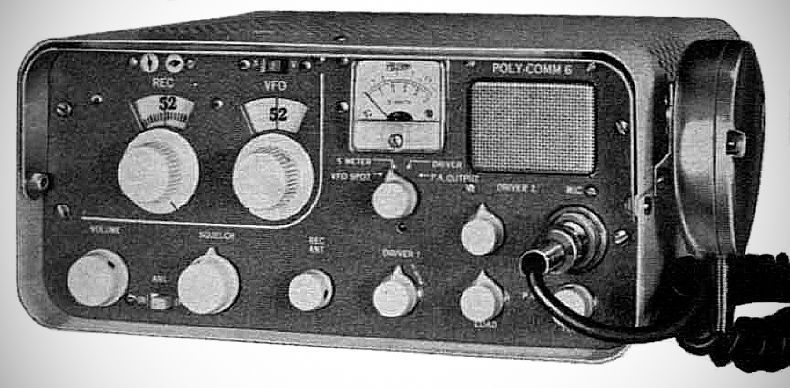
The PC6 is a single-band transceiver designed for the 50 MHz. band, serving as an improved successor to the company's two-band 62B model. It features a mobile-friendly design that includes a built-in carrying handle that swings up into the top of the case, a flexible microphone mounting clip, and a mounting bracket for installation under a car dashboard.
The unit functions via a complex tube setup and relies on silicon diode rectifiers in its power supply, alongside separate pairs of NE86 neon bulbs in series to regulate screen voltage for the oscillators.
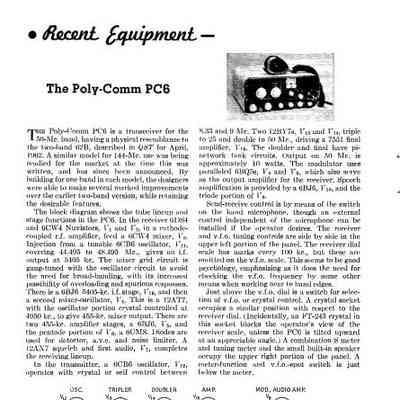
Receiver Design: Features 6DS4 and 6CW4 Nuvistors in a cathode-coupled RF amplifier feeding a 6CW4 first mixer. A tunable 6CB6 oscillator (covering 44.495 to 48.495 MHz.) delivers a 5405 kHz IF output. The unit utilizes a second mixer-oscillator (12AT7) crystal-controlled at 4950 kHz. to transition to a 455 kHz. mixer output, followed by two 455 kHz amplifier stages, a squelch system, and a noise limiter.
Transmitter Design: Utilizes a 6CB6 oscillator operating with crystal or self-control (8.33 to 9 MHz.), tripling and doubling frequencies via two 12BY7s to drive a 7551 final amplifier. The doubler and final stage employ pi-network tank circuits, generating a 50 MHz. power output of approximately 10 watts. Paralleled 6BQ5s serve as the modulator and double as the receiver's output amplifier.
Tuning Dials: The receiver and VFO tuning controls sit side-by-side on the upper left. The receiver dial marks every 100 kHz., whereas the VFO dial omits markings to encourage operators to independently check their frequency when close to band edges.
Switches & Knobs: Includes a VFO / crystal selection switch and a crystal socket (note that an FT-243 crystal plugged can block the view of the receiver dial). The bottom of the panel houses the receiver volume, squelch level controls, a noise-limiter on-off switch, an antenna trimmer, and transmitter tuning knobs.
Operation: Send-receive control is standard via a push-to-talk switch on the hand microphone.
The PC6 boasts vastly improved VFO and receiver oscillator stability compared to earlier models. Warm-up drift is slight, and short drift cycles during transmissions are practically eliminated. The receiver yields adequate sensitivity and selective filtering with no apparent spurious signals or oscillator "birdies."
The unit lacks built-in provisions for CW keying or the proper reception of CW and SSB.
Power Requirements
The unit supports both AC and DC operation and comes supplied with two distinct power cables:
115 VAC, 140 watts on transmit and 90 watts on receive.
12.6 VDC, 16 amps on transmit and 10 amps on receive.