Note
Radio Craft, Mar 1938, p. 634.
Introduced in December 1937 for the 1938 model year, the RACO Super-Clipper was a 7-band receiver designed by A. J. Haynes and manufactured by Radio Constructors Laboratories (RACO Products). Priced at $29.75 complete, it was primarily targeted at the shortwave listener (SWL) market during the late stages of the Great Depression.
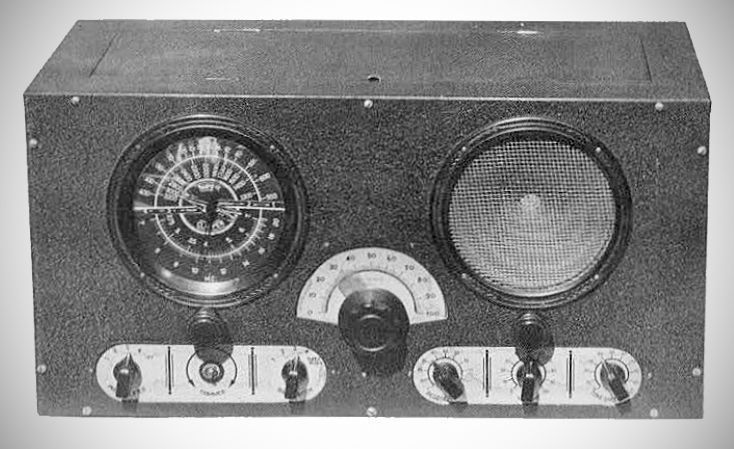
To lean into the international flavor and marketing hype of the era, the center of the main airplane dial features an illustration of a 1935 Martin M-130 "China Clipper" style flying boat inside the words SUPER CLIPPER.
Covers the four frequency bands spanning from 550 kHz to 20 MHz. These bands are tuned using a prominent 6-inch "airplane-type" main dial. Additionally, the receiver covers the 5-, 7.5-, and 10-meter VHF frequency ranges using three external plug-in coils.
A smaller, half-moon dial located in the lower center of the front panel serves a dual purpose: it acts as a bandspread control for the lower frequencies and as the primary tuning control for the VHF ranges.
On top of the chassis, a square hard-rubber mounting plate holds the VHF tuning components, a trimmer, and three tip jacks where the specialized VHF coils are plugged in.
Tube Lineup
The Super-Clipper is a 7-tube receiver that builds upon RACO's earlier "Regeneration-Super-Regeneration" (R-S-R) concept. Its tube lineup consists of:
– 6K7 RF booster
– 6K7 RF
– 6K7 UHF RF
– 6J5 common detector
– 6J5 first audio
– 6L6 audio output
– 80 rectifier