Note
QST, Aug 1971, p. 119.
QST, Feb 1972, p. 115.
Also see SX-190.
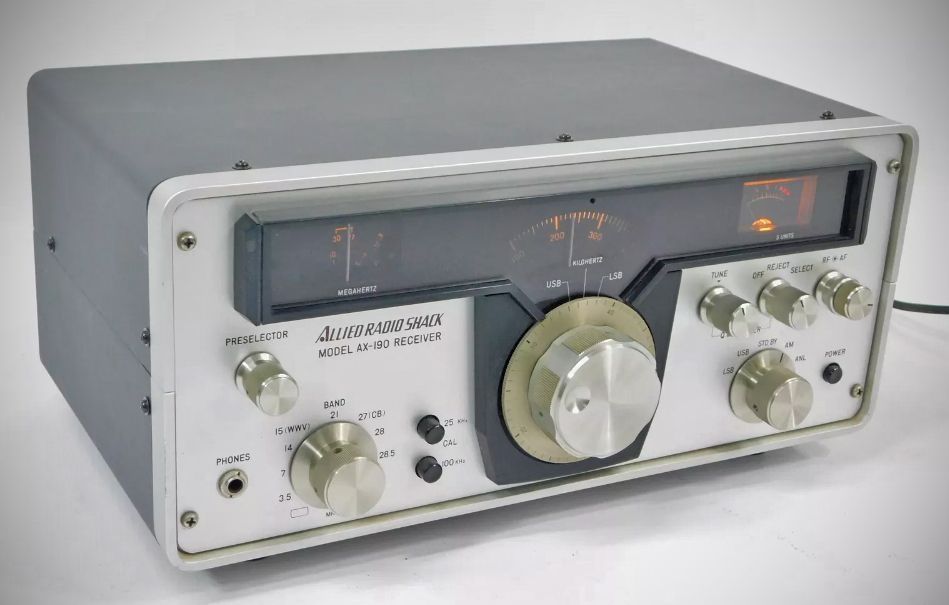
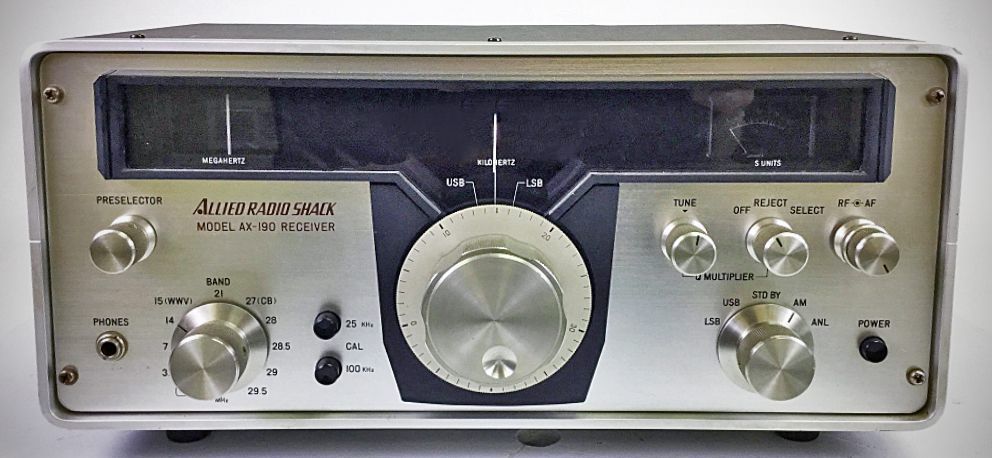
In 1971, Radio Shack introduced two all solid-state 11-band receivers, the AX-190 for amateur band coverage and the SX-190 for general communications and shortwave listening. Both receivers are dual conversion with a crystal-controlled first oscillator and tunable second oscillator.
Sensitivity: 0.5 uV on SSB and CW, and 1.0 uV on AM for 10 dB S+N/N.
A built-in Q-multiplier provides better than 60 dB image rejection and 50 dB spurious rejection. Built-in 25- and 100-kHz crystal calibrators assure visual dial accuracy of within 200 Hz. The dial reads direct to 1 kHz.
Frequency stability: better than 500 Hz per hour.
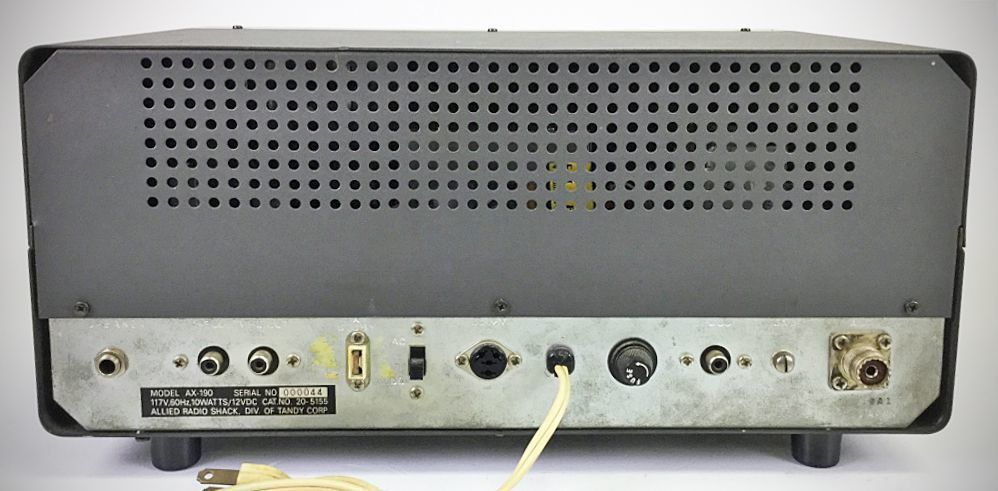
Other features include ceramic filters for sharp selectivity, dual time constant AGC, ANL, crystal-controlled BFO, illuminated S-meter, a line/tape output, and headphone jack. Each receiver has dual regulated power supplies for operation on 120 VAC and 12 VDC.
The AX-190 is crystal-controlled on 3.5–4, 7–7.5, 14–14.5, 15–15.5, 21–21.5, 27–27.5, 28–28.5, 28.5–29, 29–29.5 and 29.5–30 MHz, with a blank channel for special monitoring between 3.5 and 10 MHz. It has a VFO output and simplified interconnections for transmitter hook-up.
The SX-190 is supplied with crystals for reception on 3.5–4, 5.7–6.2, 7–7.5,
9.5–10, 11.5–12, 14–14.5, 15–15.5, 17.5–18 and 27–27.5 MHz, with blank
channels for special monitoring on 3.5–10 MHz and 10–30 MHz.
The AX-190 and SX-190 receivers are priced at $249.95. A matching
speaker i s available for $19.95.
References
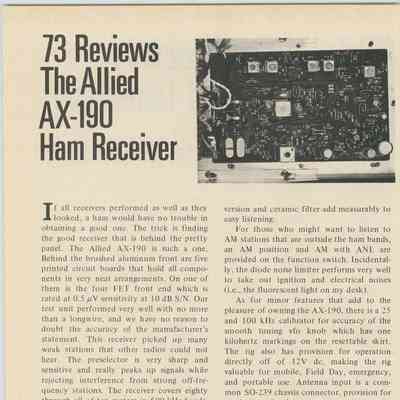
Review. 73, Jan 1972, p. 30.