Note
RCA introduced the AR-88 in 1941, on the eve of World War II. The 14-tube receiver continued to be produced throughout the war with much of the production going to England and other allies. It covered .54-32 MHz and had a crystal filter but no phasing control. A low-frequency model, the AR-88LF, was also made.
The RCA AR-88 was designed in the late 1930s by electrical engineer Lester T. Fowler and lead mechanical engineer George Blaker. Introduced into production in late 1939, it was heavily utilized during World War II and remained in service at major commercial and military radio stations for decades.
It covers a range from 535 kHz to 32 MHz spanning across six bands.
Designed for AM and CW reception.
Unlike its predecessor (the AR-77), it omits a calibrated amateur bandspread in favor of a classic 0–100 logging scale.
Maximum alignment and tuning stability are achieved because all bands are individually temperature-compensated.
The AR-88 utilizes a high-gain, sensitive 14-tube superheterodyne circuit layout. It features two completely tuned RF stages utilizing 6SG7 pentodes, which provide twice the transconductance of standard 6SK7 tubes and effectively decouple the antenna from the oscillator to prevent radiation.
Uses a high-selectivity, three-stage IF system.
Equipped with a 5-position bandwidth control switch. Three of these positions are crystal-determined, yielding sharp selectable bandwidths of 14 kHz, 8 kHz, 3 kHz, 1.5 kHz, and 400 Hz.
Incorporates an adjustable, series-type noise limiter circuit that operates based on the percentage of modulation.
A 6K6 beam power amplifier tube delivers 2.5 watts of audio power to a speaker or headphones.
Tube Lineup:
6SG7 (1st RF)
6SG7 (2nd RF)
6SA7 (1st Detector)
6J5 (Oscillator)
6SG7 (1st IF)
6SG7 (2nd IF)
6SG7 (3rd IF)
6J5 (BFO)
6H6 (2nd Detector & AVC)
6H6 (Noise Limiter)
6SJ7 (1st AF)
6K6 (Audio Output)
5Y3 (Rectifier)
VR150 (Voltage Regulator).
### Aesthetics & Variations
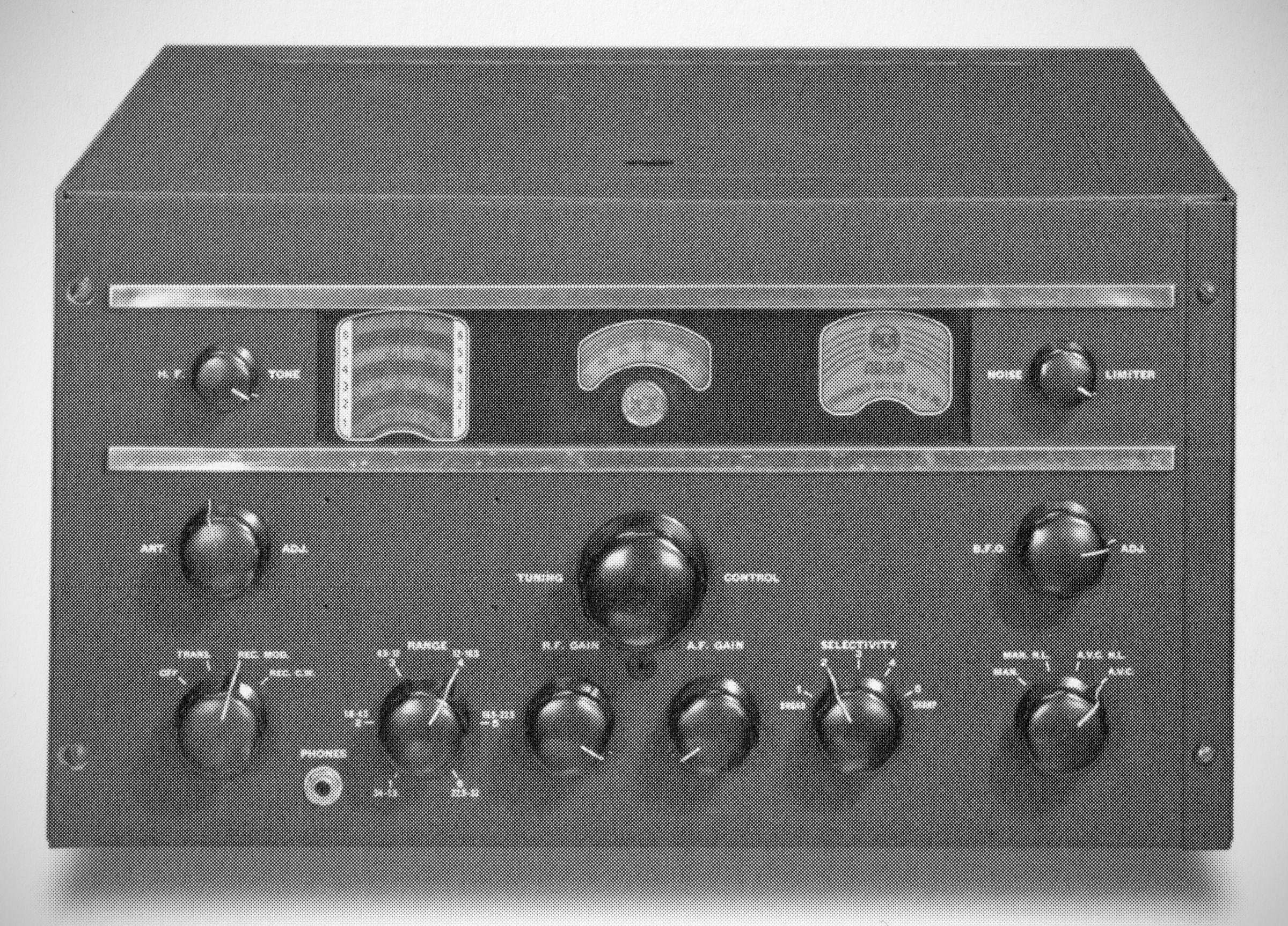
The original AR-88 units were predominantly finished in flat black or a rugged black wrinkle lacquer. On the initial AR-88 models, the crystal phasing control was fixed internally, leaving only the primary RF, audio, and tuning controls exposed on the front panel.
The success of the platform led to several famous variants, including the AR88LF (a low-frequency version covering 73 to 550 kHz used by Canadian and Soviet forces), the DR89 (a massive triple-diversity rack system), and post-war commercial iterations like the grey-paneled CR88 and CR91.The RCA AR-88 is a legendary, "world-class" communications receiver designed in the late 1930s by electrical engineer Lester T. Fowler and lead mechanical engineer George Blaker. Introduced into production in late 1939, it was heavily utilized during World War II and remained in service at major commercial and military radio stations for decades.
Here is a technical and physical breakdown of the receiver:
### Core Specifications & Performance
Frequency Coverage: It covers a range from 535 kHz to 32 MHz spanning across six bands.
Operating Modes: Designed for AM and CW reception.
Tuning Mechanism: Unlike its predecessor (the AR77), it omits a calibrated amateur bandspread in favor of a classic 0–100 logging scale.
Stability: Maximum alignment and tuning stability are achieved because all bands are individually temperature-compensated.
Weight: The receiver is incredibly robust and heavy, weighing in at a substantial 100 pounds.
### Circuitry & Tube Lineup
The AR-88 utilizes a high-gain, sensitive 14-tube superheterodyne circuit layout:
RF Stages: Features two completely tuned RF stages utilizing 6SG7 pentodes, which provide twice the transconductance ($g_m$) of standard 6SK7 tubes and effectively decouple the antenna from the oscillator to prevent radiation.
IF System: Uses a high-selectivity, three-stage IF system.
Selectivity Control: Equipped with a 5-position bandwidth control switch. Three of these positions are crystal-determined, yielding sharp selectable bandwidths of 14 kHz, 8 kHz, 3 kHz, 1.5 kHz, and 400 Hz.
Noise Limiter: Incorporates an adjustable, series-type noise limiter circuit that operates based on the percentage of modulation.
Audio Output: A 6K6 beam power amplifier tube delivers 2.5 watts of audio power to a speaker or headphones.
Complete Tube Complement: 6SG7 (1st RF), 6SG7 (2nd RF), 6SA7 (1st Detector), 6J5 (Oscillator), 6SG7 (1st IF), 6SG7 (2nd IF), 6SG7 (3rd IF), 6J5 (BFO), 6H6 (2nd Detector & AVC), 6H6 (Noise Limiter), 6SJ7 (1st AF), 6K6 (Audio Output), 5Y3 (Rectifier), and a VR150 (Voltage Regulator).
### Aesthetics & Variations
The original AR-88 units were predominantly finished in flat black or a rugged black wrinkle lacquer. On the initial AR-88 models, the crystal phasing control was fixed internally, leaving only the primary RF, audio, and tuning controls exposed on the front panel.
The success of the platform led to several famous variants, including the AR88LF (a low-frequency version covering 73 to 550 kHz used by Canadian and Soviet forces), the DR89 (a massive triple-diversity rack system), and post-war commercial iterations like the grey-paneled CR88 and CR91.
References
A brief article on the history of the AR-88. QST, Apr 1977, p. 91.