Note
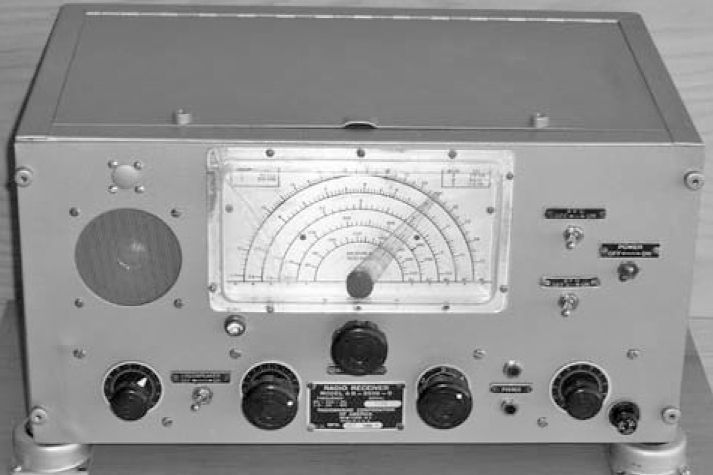
Approved in February 1943, this 10-tube superheterodyne receiver was designed for service aboard ships (specifically Liberty and Victory ships) and land stations during World War II. It was part of the RMCA 4U radio console.
It was built specifically to comply with FCC regulations limiting signal radiation to under 400 microwatts. This low-radiation design prevented German Navy direction-finding equipment from detecting local oscillator signals and locating Allied convoys.
Specifications
– Circuit & IF: It utilizes a 10-tube superheterodyne circuit featuring a triple-stage 1700 kHz intermediate frequency (IF).
– Frequency Coverage: It covers five distinct bands spanning intermediate to high frequencies: 85 kHz–25 MHz
Tube Complement:
– 6SG7 (RF Amp)
– 6SG7 (Mixer)
– 6J5 (HF Oscillator)
– (3) 6SG7s (1st, 2nd, and 3rd IF Amps)
– 6SQ7 (Detector/AVC/1st Audio)
– 25L6/GT (Audio Output)
– 25Z6 (Rectifier)
– 6J5 (BFO).
– Neon Bulb: G-10 one-watt neon regulator bulb for the oscillator, which doubles as a front-panel power indicator.
⚠️ Power: It has no power transformer and was designed primarily to run on 115-volt DC shipboard power mains (though it can run on AC or, with an accessory resistor unit, 230 volts).
Shielding: To eliminate signal leakage, the cabinet completely lacks ventilation louvers. The steel front panel is copper-plated on both sides, the steel cabinet is copper-plated on the inside, and sub-chassis sections are shielded with steel covers.
Simplified Design: Prioritizing manufacturing speed and wartime economy, the receiver lacks many common user conveniences. There is no front-panel BFO pitch control (the trimmer is on top of the internal BFO can), dial lighting, antenna trimmer, calibrator, crystal filter, dial lock, standby switch, or signal strength meter.
There is no custom engraving on the front panel. Controls are instead identified by early plastic labels attached with small screws. The original factory paint scheme is a color termed "Radiomarine Blue" (though some units used gray).