Note
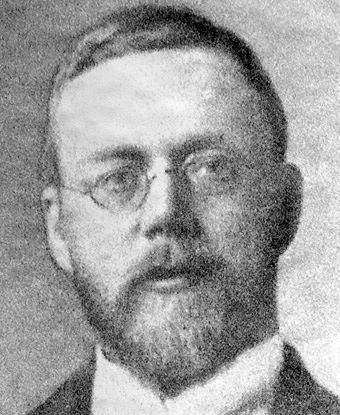
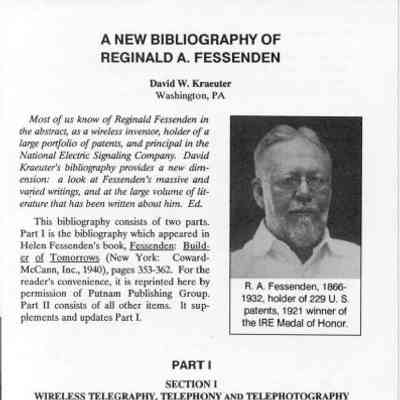
While Guglielmo Marconi is a household name for sending Morse code across the Atlantic, it was the brilliant and often volatile Canadian inventor Reginald Aubrey Fessenden (1866–1932) who actually figured out how to transmit the human voice and music. Holding over 500 patents, Fessenden transitioned wireless technology from dots and dashes to continuous waves, effectively laying the foundation for amplitude modulation (AM) radio.
Early Life and the Edison Influence
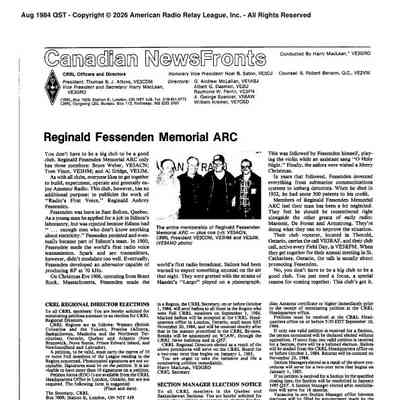
Born in East Bolton, Quebec, Fessenden was a prodigy in mathematics and classical languages. He left college before graduating to take a teaching position in Bermuda, where he became fascinated by science.
Determined to work with the best, he moved to New York in 1886 with his sights set on Thomas Edison. Despite initially being rejected—Edison famously told him he didn't know anything about electricity—Fessenden persisted, famously replying, "No, but I can learn quick." He was hired as a tester and rapidly promoted, eventually becoming a chief chemist at Edison's West Orange laboratory, where he mastered high-vacuum systems and electrical engineering principles.
The Continuous Wave Breakthrough
By the late 1890s, the wireless world was dominated by "spark-gap" transmitters. These devices generated massive, noisy bursts of electromagnetic static that were perfect for interrupting the ether with Morse code, but completely useless for audio.
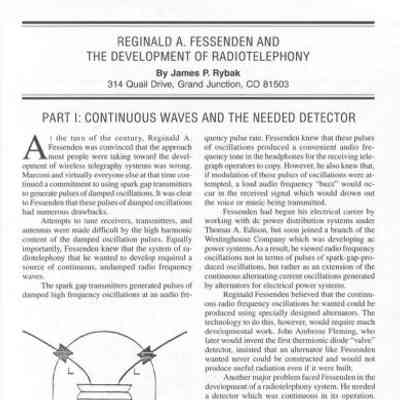
Fessenden realized that to transmit speech, radio needed a continuous wave—a smooth, uninterrupted radio frequency signal that could be molded, or modulated, by an audio signal from a microphone.
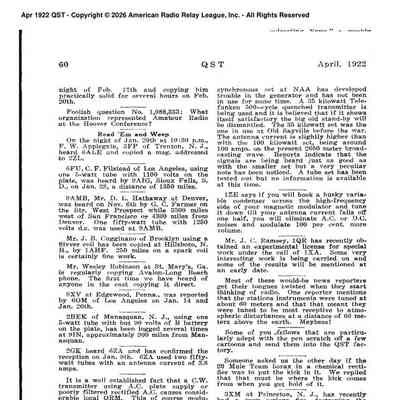
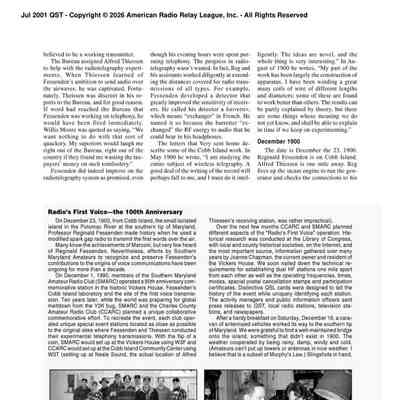
In 1900, while working for the United States Weather Bureau on Cobb Island, Maryland, Fessenden successfully transmitted the first distinct human speech over a distance of about one mile. The audio was harsh and distorted by the spark apparatus he was still adapting, but the words were unmistakable: "One, two, three, four. Is it snowing where you are, Mr. Thiessen? If it is, telegraph back and let me know."
The Historic 1906 Milestones
To achieve a truly pure continuous wave, Fessenden commissioned General Electric engineer Ernst Alexanderson to build a massive, high-speed rotary alternator capable of spinning fast enough to generate radio frequencies up to 100 kHz,
Armed with this new high-frequency alternator and funded by two Pittsburgh financiers under the banner of the National Electric Signaling Company (NESCO), Fessenden set up a broadcasting station featuring a 420-foot steel tube antenna at Brant Rock, Massachusetts.
January 1906: First Two-Way Transatlantic Voice Transmission
Fessenden established clear, two-way telegraphy communication between Brant Rock and an identical station in Machrihanish, Scotland. During testing, the Scottish operators briefly overheard the engineers in Massachusetts speaking to each other over the system, marking the first time voice spanned the Atlantic.
December 24, 1906: The First Audio Broadcast
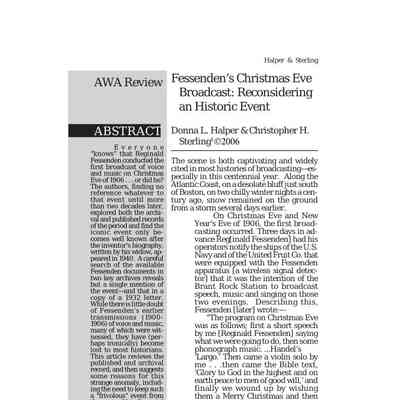
On Christmas Eve, Fessenden transmitted a short program of voice and music to shipboard wireless operators across the Atlantic. He played Handel's Largo on his violin, sang a verse of O Holy Night , and read Luke chapter 2 from the Bible before wishing his startled listeners a Merry Christmas.
Later Innovations and Legacy
Fessenden's brilliance extended far beyond radio. Following bitter legal battles with his NESCO backers that ousted him from his own company, he turned his attention to maritime engineering.
During World War I, he developed the Fessenden Fathometer (an early form of SONAR), which allowed ships to detect icebergs and submarines by bouncing sound waves off the ocean floor. He also invented the heterodyne receiver architecture—a fundamental concept where two different frequencies are mixed to create a lower, easily manipulated intermediate frequency. This principle remains a core building block of modern radio receiver design.
Despite his staggering technical contributions, Fessenden's combative nature and constant legal entanglements kept him on the fringes of the financial windfalls enjoyed by later corporate giants like RCA. He retired to Bermuda, where he passed away in 1932. His epitaph sums up his enduring contribution to a world now saturated by wireless communication: "By his genius, distant lands speak together and international spaces rejoice."
Sources
Obituary. Radio Craft, Oct 1932, p. 207.
In Memoriam. Radio News, Dec 1932, p. 334.
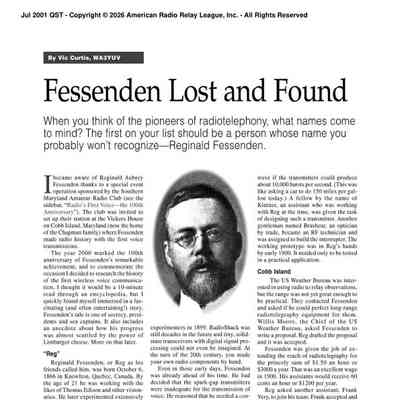
Fessenden Lost and Found, Jul 2001, QST, p. 49
https://www.nps.gov/people/reginaldfessenden.htm
https://www.britannica.com/biography/Reginald-Aubrey-Fessenden