Note
Radio, Jul 1929, p. 83.
QST, Dec 1930, p. 63.
QST, Feb 1931, p. 63.
## Overview of the REL Model No. 192
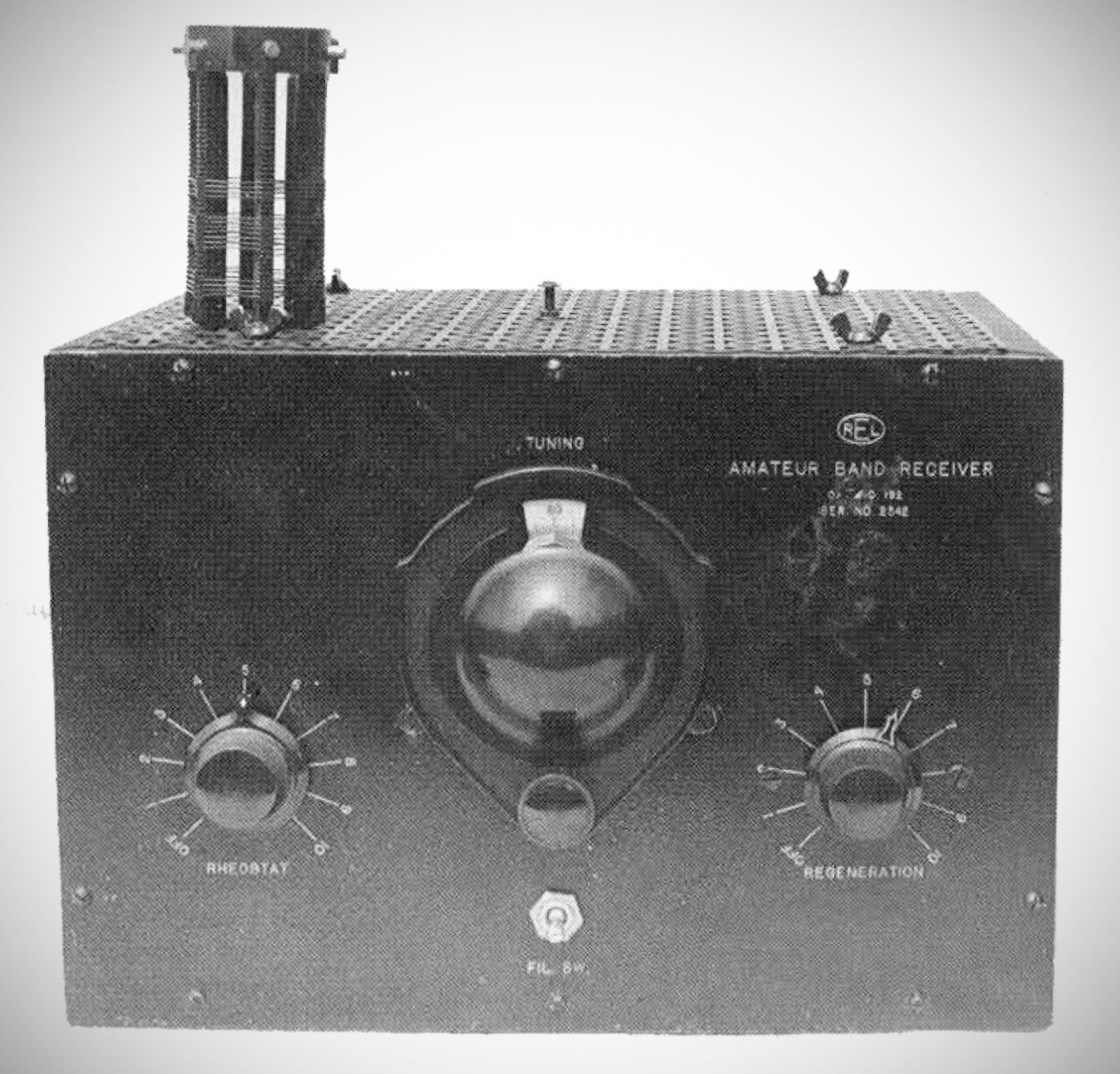
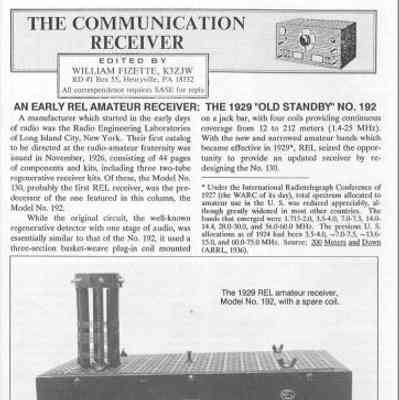
The Radio Engineering Laboratories (REL) Model No. 192, affectionately dubbed "The Old Standby," is a vintage two-tube regenerative shortwave receiver introduced in early 1929. It was specifically designed to help radio amateurs navigate the narrowed U.S. amateur radio bands mandated by the International Radiotelegraph Conference of 1927. It targets the 20-, 40-, and 80-meter amateur bands.
Originally sold principally in kit form for $40 (excluding tubes), the Model No. 192 served as an updated, redesigned version of REL's earlier Model No. 130 receiver.
Changing amateur bands requires a unique physical process. The operator plugs in the appropriate coil and manually rotates the rear "tank" section of the variable capacitor. A spring-loaded detent drops into a specific notch on a rear-mounted bakelite disk to lock the tank capacitor into the proper baseline capacity for that band, leaving the smaller 20 pF section to spread the entire ham band across the front tuning dial.
The Model No. 192 had a relatively short commercial lifespan. While its mechanical engineering was highly innovative, the core two-tube regenerative architecture was rapidly becoming obsolete by 1929. In a simple two-tube arrangement, external factors like antenna movement and regeneration adjustment heavily interact with and de-tune the main frequency, meaning the sophisticated coil-capacitor bandspread framework was somewhat wasted.
REL quickly realized this and successfully pivoted, utilizing the excellent 182/187 coil-capacitor combination to much better effect in their subsequent multi-tube shortwave receivers (such as the No. 217 introduced in February 1929) and low-power amateur transmitter kits.
The Scott Special features a classic, simple regenerative detector circuit paired with a single stage of audio amplification. The receiver utilizes two UX-201A vacuum tubes (or equivalent triodes like the CX-301A).
Unlike its predecessor, the No. 192 is entirely shielded, housed in a robust steel cabinet with an aluminum front panel. The bottom base consists of 3/4-inch plywood covered with a copper sheet that is bonded to the front panel via a ground strap to isolate the RF circuitry. The top of the cabinet features a distinctive perforated "cane-metal" sheet secured by four wing nuts, allowing quick interior access for swapping coils.
To achieve full bandspread across the 180-degree tuning dial, REL engineered oversized, proprietary plug-in coils. Molded from bakelite, the coil forms are ribbed and threaded to hold the windings perfectly stable. The coils plug into a ring-shaped molded base using six large spring contacts.
Power Requirements: Designed strictly for battery operation, requiring 6V for the tube filaments, alongside 45V and 90V "B" batteries. Battery eliminators were explicitly not recommended, and no "C" battery was required.
⚠️ Warning: The rotor shaft of the original No. 187G capacitor revolved inside a tiny pool of liquid mercury to ensure constant, noise-free electrical contact. Modern collectors restoring this rig must exercise extreme caution to avoid toxic mercury exposure or fumes. Additionally, the capacitor frames were cast using a zinc "white metal" alloy prone to severe warping and degradation over time, often requiring custom aluminum replacement frames to be fabricated today.