Note
QST, Aug 1976, p. 138.
QST, Apr 1977, p. 125.
QST, Jan 1980, p. 194.
QST, Jan 1982, p, 120.
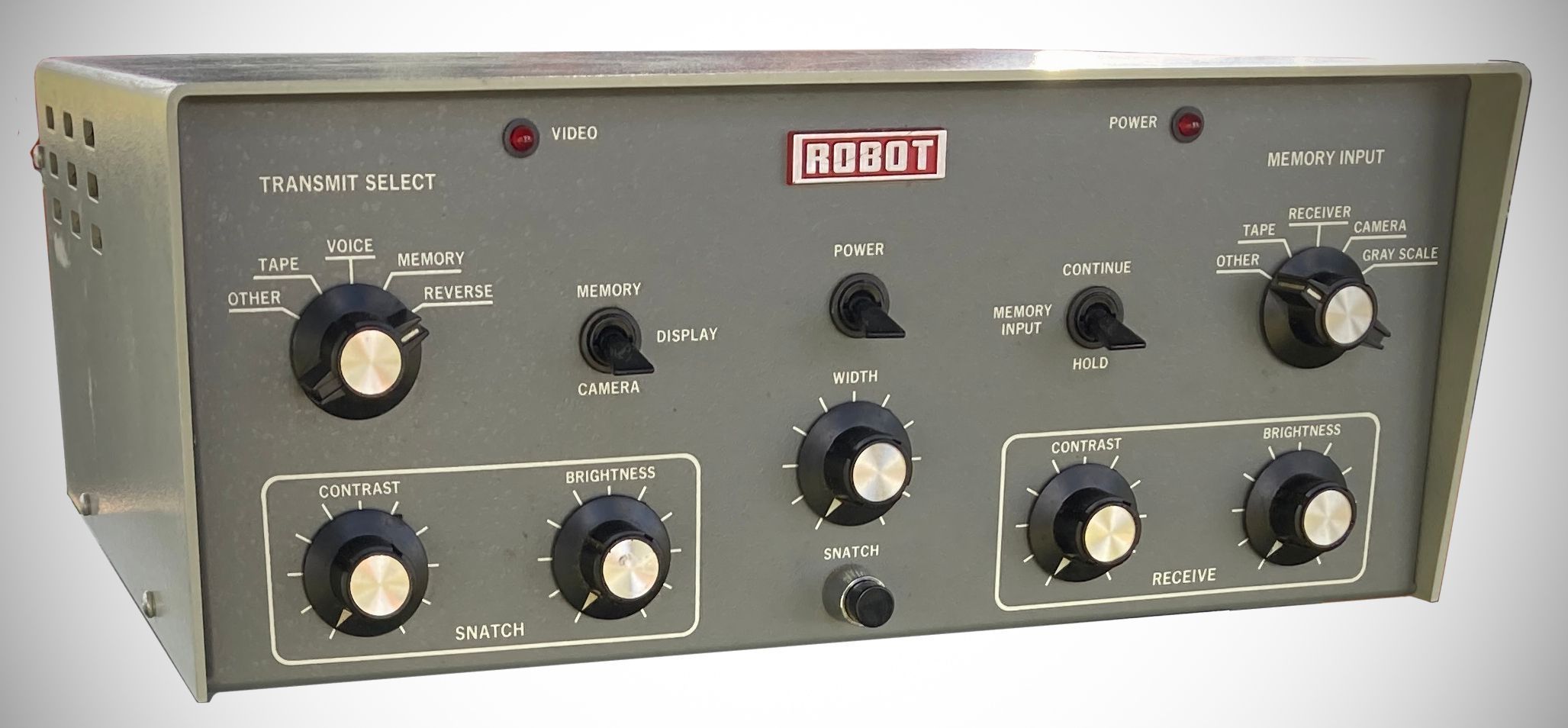
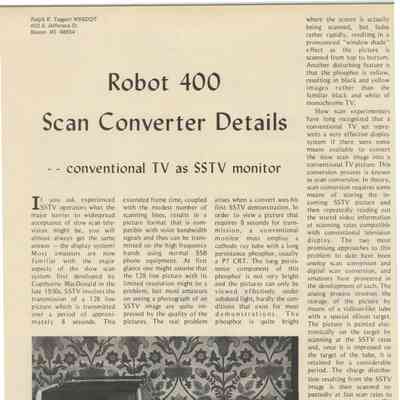
The Robot Model 400 digital scan converter was a commercial unit designed to overcome the limitations of traditional slow-scan television P7 CRT monitors (such as dim images, dark room requirements, and "window shade" fading) by converting SSTV signals into standard, non-fading television pictures using a home TV or closed-circuit TV (CCTV) monitor.
The unit relies heavily on a complex solid-state digital memory board containing 16 of the 4K RAM chips (along with 77 other ICs and 19 transistors). It utilizes a 16,384 pixel grid encoded with 4 bits per pixel, providing 16 shades of gray. While 16 shades introduce minor video contouring in smooth, low-detail areas, it has virtually no negative subjective impact when viewed on a recommended small-screen monitor (5 to 9 inches).
Robot 400 represented the top-of-the-line SSTV equipment available at the time. Given the immense circuit complexity of home-brewing a digital scan converter, the unit was an excellent value.
Key Features
– Instant Replay: Allows operators to freeze a received frame in memory and retransmit it back to the other station to critique lighting, contrast, or composition.
– Fast-Scan "Frame Snatch": Can capture a single frame of fast-scan video from a CCTV camera in 1/60 of a second, eliminating motion distortion and automatically inserting a 4-step digital gray scale for contrast reference.
– Recording & Flexibility: Simplifies making clean demonstration tapes by freezing off-the-air frames and dubbing them onto a separate cassette at a constant signal amplitude.
– Performance & Setup: The unit performed exceptionally well during testing, offering great noise immunity and reliable tape/receiver display. ⚠️ Hooking it up requires a video monitor or a properly isolated/modified solid-state TV set to prevent dangerous hot-chassis shock hazards.