Note
Ham Radio, Sep 1971, p. 65.
QST, Nov 1971, p. 123.
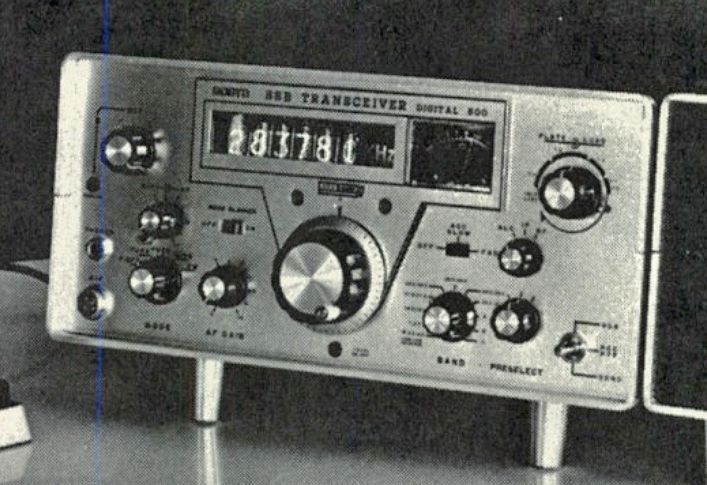
The Robyn Digital 500(A) is a interesting piece of amateur radio history. Released in 1971, it sits right at the crossroads between classic vacuum-tube architecture and emerging solid-state technology.
If you dive into the history, documentation, and user forums regarding this unique HF transceiver, several notable details emerge:
The SBE SB-36 Connection
The Robyn Digital 500 is not entirely a standalone design; it is a direct relative—often referred to as a twin or clone—of the SBE SB-36 HF transceiver. SBE (Sideband Engineers) was a brand founded by Faust Gonset, a legendary figure in vintage radio design. See entry for SB-36 for additional details.
Like many specialized US-branded radios of that specific window in the early 1970s, the Digital 500 was manufactured in Japan and imported for the American market. While some contemporary Robyn CB radios were built by companies like Trio-Kenwood, the exact manufacturer of the Digital 500's chassis remains a point of historical debate, with some collectors pointing toward GRE or similar Japanese contract builders of the era.
A True "Hybrid" Era Machine
As outlined in advertising, the radio boasts a complex hybrid component count: 49 silicon transistors, 6 FETs, 42 diodes, 30 ICs, and 6 vacuum tubes.
The Transistors & ICs handle the low-level processing, intermediate frequency stages, audio, and logic control.
The vacuum tubes are preserved where ruggedness and high power mattered most at the time—in the driver and final power amplifier stages—allowing the rig to handle 500 watts PEP input.
The Allure of the Nixie Display
One of the most striking physical characteristics of the Robyn Digital 500 is its frequency counter readout, which utilizes Nixie tubes rather than the LEDs or LCDs that became standard just a few years later. Combined with its latch circuitry and memory capabilities, a Nixie display on an early 70s transceiver made it a real showpiece.
Collector Realities: Quirks and Complexities
While beautiful on the outside, the Digital 500 has a reputation among vintage repair enthusiasts as a "work in progress" that was pushed to market right as technology was rapidly changing.
Power Supply Demands: The external matching power supply and speaker console is incredibly complex. Because it feeds a heavy hybrid architecture, the power supply has to deliver a number of voltages simultaneously, including high-voltage DC (around 800V, 400V, 180V, and -180V) alongside separate low-voltage AC rails for tube filaments and solid-state logic.
Production Drift: Hams who restore these units often note that because the factory implemented running engineering updates throughout its brief production life, finding two units that are identical internally—or that perfectly match the published schematics—can be quite rare.
Stability Challenges: Early digital logic mixed with high-voltage tube circuits meant these rigs could suffer from local oscillator instability or exciter chain quirks until they fully warmed up.
When properly restored and aligned, the Robyn Digital 500 is known for great audio quality on both transmit and receive. Because of its brief production life and limited distribution compared to dominant contemporary lines like Yaesu or Drake, it is quite rare.
Features
– 100 Hz readout.
– No calibration required.
– 500 W. PEP SSB; 400 W. CW.
– Built-in Noise Blanker.
– Selectable AGC.
– High Sensitivity Schmidt Trigger VOX.
– Nixie display with latch circuitry and memory.
– External VFO can also be displayed.
– Built-in blower.
– CW Filter available as option.
Specifications
– Better than 100 Hz stability after 30 min.
– 40 db carrier suppression.
– 50 db sideband suppression.
– 40 db harmonic suppression.
– 0.5 μν sensitivity for 10 db S+N/N.
– 2.4 kHz selectivity SSB, AM at -6 db; 4.2 kHz at -60 db.
– Image and IF rejection better than 50 db.
Tubes:
Note: other that the 6DK6 finals, no data has been found on the remaining four tubes. In the SB-36, the tubes are: (1) 6EJ7, (1) 6BQ5, (1) 6AW8, (1) 6BZ5, (2) 6KD6
References
Brief description. Ham Radio, Dec 1971, p. 90.