Note
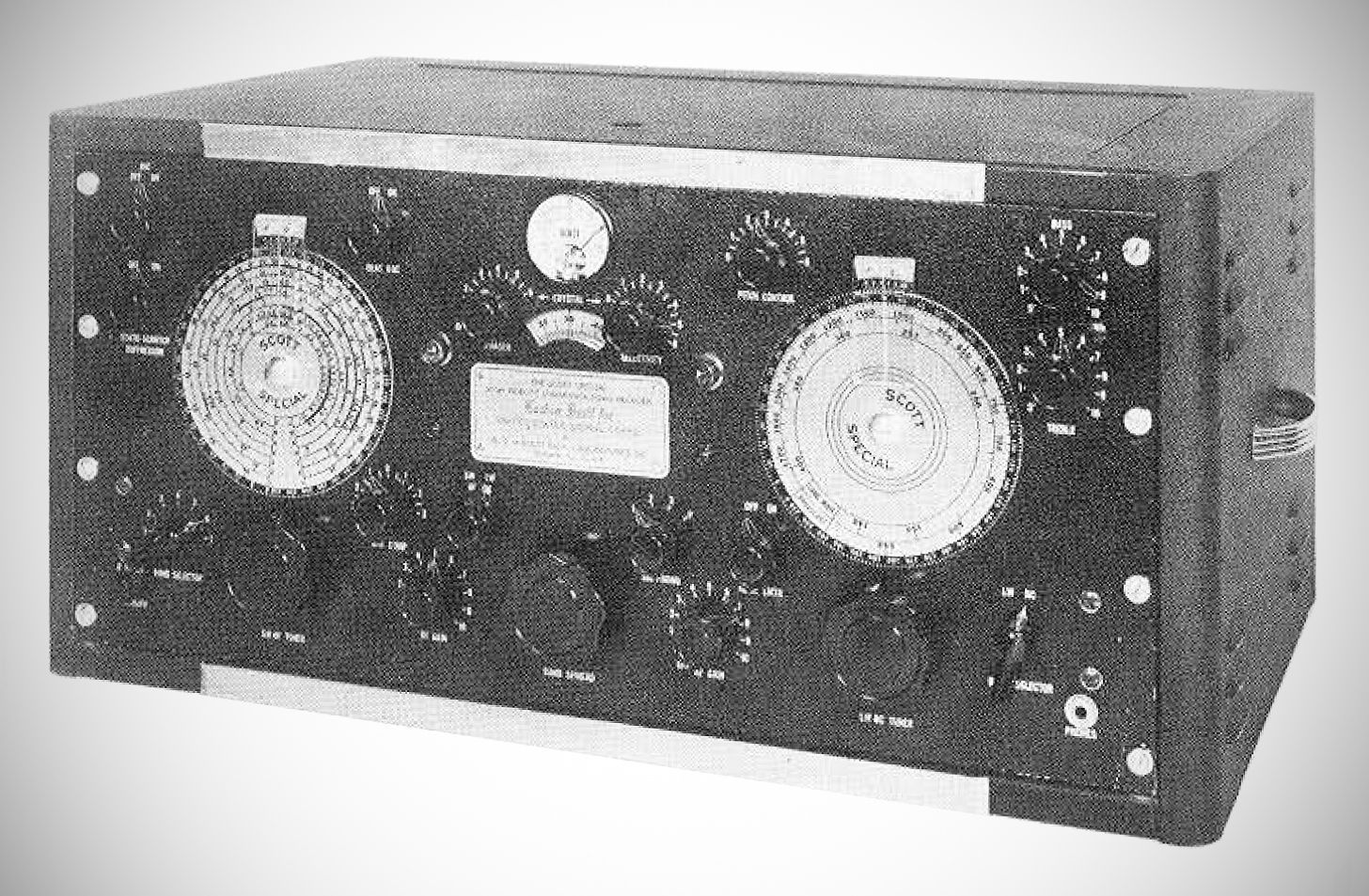
The Scott Special is a unique, high-fidelity 26-tube communications receiver produced from September 1939 into the early spring of 1940.
Unlike most receivers of its era, the Scott Special houses two complete, separate tuners. One tuner handles long-wave and broadcast bands across a spectrum of 140 kHz to 1710 kHz. The second tuner covers the shortwave spectrum across seven bands, spanning 1.7 MHz to 64 MHz. Combined, these dual front ends offer a total of nine tuning ranges—a impressive 460:1 ratio.
The front face features two large dials with flywheel-operated tuning knobs for smooth tracking. The left dial tunes shortwave, while the right dial covers the low bands. A third vernier dial for bandspread tracking sits in the center of the panel.
The receiver features a classic Scott chromed chassis housed in a 19-inch rack cabinet. It utilizes an external, separate chromed power-and-audio chassis to keep power supply noise isolated from the sensitive receiver electronics.
The 26-tube design relies heavily on 6U7G tubes for its two RF stages across all nine bands. Its audio layout includes a pair of 6J5s driving push-pull 6L6G output tubes to push out approximately 35 watts of audio power.
"Super Shield" Antenna Isolation: The receiver features electrostatic shielding between the primary and secondary windings of each antenna transformer, minimizing the transfer of unbalanced noise line voltage.
True to E. H. Scott's reputation for premium audio, it includes variable selectivity, bass/treble tone controls, and a high-frequency equalizer to recover treble response lost to tight IF selectivity.
The unit is equipped with a crystal filter featuring a phasing control, a BFO for CW (morse code) reception, a signal-level meter (calibrated in S-units and decibels), a conventional noise limiter, and a phono input fitted with a dedicated scratch suppressor.
Despite tuning the 30–42 MHz communications band and the 42–48 MHz FM broadcast band right when mobile FM systems were gaining prominence, the Scott Special lacked an FM detector. This omission occurred because the set was rushed into production during a management gap when the company lacked a chief engineer. It was built using the older 6U7G tube rather than newer low-noise technologies available at the time.