Note
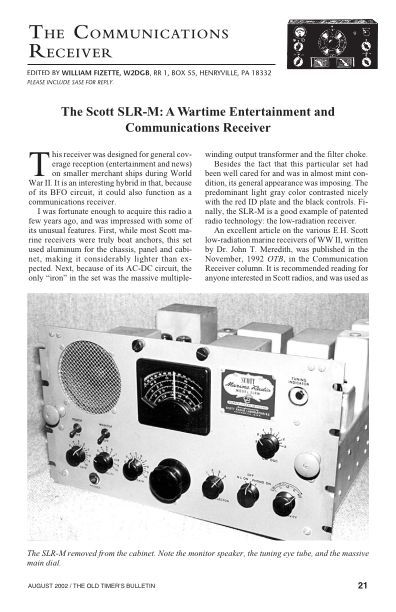
The SLR-M (Super Low Radiation - Merchant) was designed during World War II as a general coverage entertainment and news receiver for smaller merchant ships. While intended for entertainment, its inclusion of a BFO circuit allowed it to pull double duty as a communication receiver.
A primary design objective was preventing enemy vessels (such as Axis submarines) from detecting the radio's local oscillator signal. Utilizing a 1943 patent by Scott design engineer Marvin Hobbs, the receiver implemented extensive shielding—including totally shielded antenna coils, isolation of the mixer and oscillator circuits, and shielded RF filters on filament/HV lines. This limited detectable radiation to within 25 feet.
The U.S. Navy version of this identical receiver is known as the REE.
Frequency Coverage: Covers 0.54 to 18.6 MHz split across four distinct bands.
IF: 455 kHz.
Tube Lineup: It is a high-quality, state-of-the-art 12-tube receiver. The schematic reveals the following tube configuration:
– 6K7: RF Amplifier (bridges the shielded compartments)
– 12J5-GT: Oscillator
– 12SA7: Mixer
– 12SK7 (2): 1st and 2nd IF Amplifiers
– 12H6: Detector / Noise Limiter
– 1629: Tuning Eye
– 12SN7GT (2): One used for Phase Inverter; one used for BFO-Audio
– 25L6GT (2): Audio Output (configured in push-pull)
– 25Z6GT: Rectifier
Designed with an AC-DC circuit to accommodate the existing DC mains common on 1940s merchant ships. Because of this topology, the only heavy iron components are a massive multiple-winding audio output transformer and a filter choke.
The push-pull 25L6 stage delivers a respectable 1.5 Watts of audio power, capable of driving multiple external speakers.