Note
The SGC SG-2000 is a high-performance, multi-mission HF SSB transceiver designed primarily for marine, aviation, industrial, commercial, and para-military, and amateur applications. Characterized as a rugged and highly adaptive piece of equipment, it stands out as a "computer-directed civilian radio" built to meet strict environmental and operational demands.
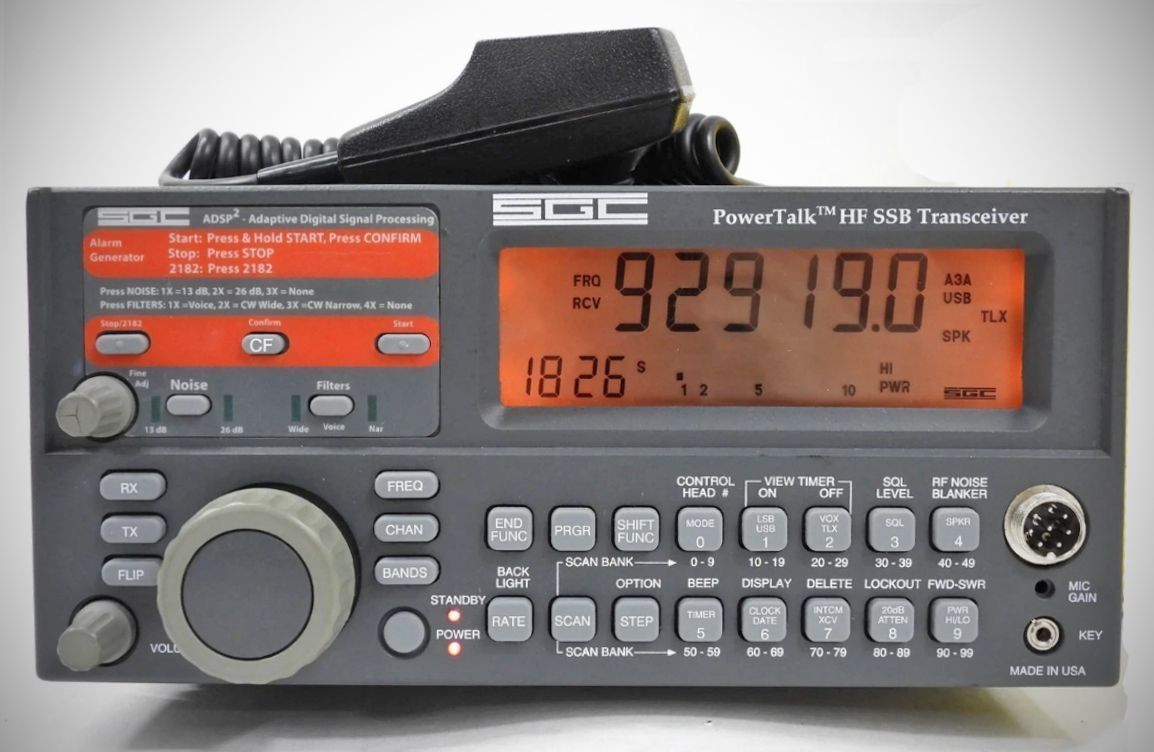
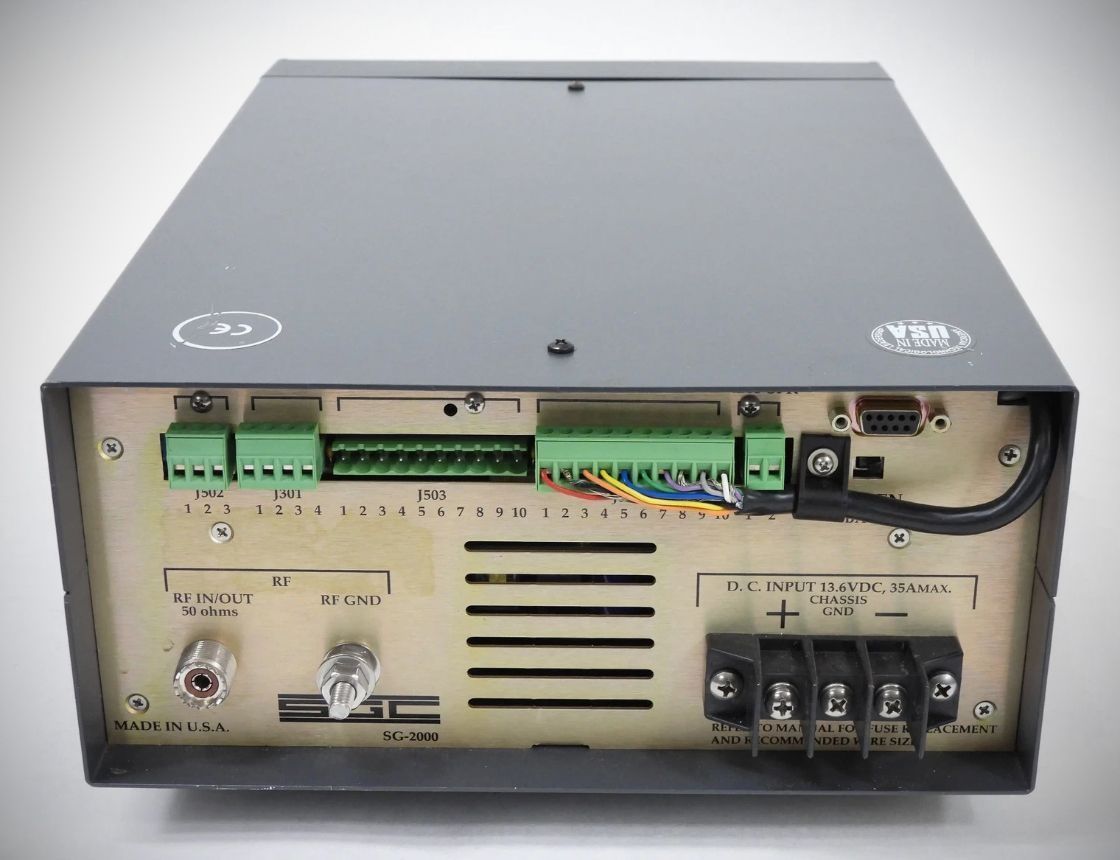
The SG-2000 is designed as two distinct units that can be separated for flexible deployment: The RF Unit: This is the main chassis containing the receiver, the transmitter's exciter, a robust 4-transistor Linear Power Amplifier (LPA), and the main microprocessor. The Control Head: This removable unit houses the primary audio amplifiers, an LCD frequency and status display, a 21-button control keypad, an internal speaker, and its own dedicated microprocessor that communicates with the RF unit via an RS-422 serial bus.
Because the architecture splits these components, the transceiver can support multiple control positions. Up to eight control devices—including up to 50-meter remote control heads (interconnected via field-reparable 10-conductor cables) and RS-232 computer terminals—can manage a single RF unit simultaneously.
Frequency Range: Transmits from 1.6 to 30 MHz. It receives from 1600 kHz to 30 MHz, with an option to extend down to 500 kHz.
Power Output: 150 Watts Peak Envelope Power (PEP) for voice modes, and up to 225 Watts for CW (Morse code). Power can be toggled to a "Low" setting (approximately 35% of full power) to prevent over-saturating nearby receivers or to conserve current.
Product Variants
Aside from the base model, SGC engineered alternative configurations based on the same platform:
– SG-2000 SlimPak: Fits tight installations by reducing the main RF unit's height by a full inch while maintaining identical operating features and utilizing the same control head.
– PRC-2250 MIL: A ruggedized, olive drab military version optimized for combat conditions, packaged with a waterproof/shockproof handset and a heavy-duty military shock mount.
– PowerTalk™ Control Head: A premium upgraded control head introduced in 1995 that features Adaptive Digital Signal Processing (ADSP™) and Syllabic Noise Suppression (SNS™) audio filtering options.
– Operating Modes: Fully supports Upper Sideband (USB) and Lower Sideband (LSB) across four modes:
A3J: Standard Single Sideband (SSB) voice.
A3H: AM-compatible mode (uses a true AM detector on receive, and re-inserts a carrier on transmit).
A3A: SSB with a pilot carrier for automated commercial tracking.
CW: Continuous Wave code transmission featuring a built-in sidetone oscillator and break-in capabilities.
– Memory and Scanning: Pre-programmed from the factory with 644 international ITU voice and data channels, plus room for 100 field-programmable, custom user channels. It includes highly flexible frequency and channel scanning features with adjustable dwell times.
– Data Capabilities: Ready out-of-the-box for a variety of external data modes including RTTY, ARQ, FEC, Packet radio, Weatherfax, and Automatic Link Establishment (ALE).
Heavy-Duty LPA Design: SGC uses a 4-transistor layout in the final amplifier stage where typical designs only use two, maximizing structural reliability and peak power performance under stress.
Built-in Protections: The radio includes comprehensive failsafes against reverse battery polarity, over-voltage spikes, thermal overload (throttling power back to <50W if it hitting 80°C), and severe antenna impedance faults or high VSWR.
Syllabic Squelch: Uses a voice-operated squelch featuring advanced syllabic detection to distinguish true voice signals from background noise.
Emergency Signaling: Features an integrated emergency alarm generator specifically tuned for standard ITU/CCIR distress signals on the 2182 KHz emergency frequency, designed with a safety mechanism that requires pressing two keys simultaneously to prevent accidental activation.
Standard Features
• Full remote control, up to 8 stations
• Upper or lower sideband select
• A3A, A3H and A3J select
• Emergency 2182 kHz direct select (Standard Head only)
• Voice or Telerex (narrow band) filter select
• CW side tone oscillator, CW with break-in
• Alarm Generator
• Speaker on/off, rear panel audio I/O port for modems, Weatherfax
• Headset/handset driver separate from speaker
• Carbon or dynamic microphone select switch
• Squelch on/off and level set
• Coupler tuned indicator
• 20 dB receive attenuator
• Transmitter power level set (50 or 150W)
• Transmitter over temperature indication and thermal protection
• Receive S-meter and transmit forward power or SWR meter display
• Time of day or date display
• Radio on/off timer
• Intercom with all stations or private channel select
Specifications
– Channels 100 channels field programmable
– 644 factory programmed ITU voice and data channels
– Scan channels: Up to 100 channels programmable in 6 groups of 10
channels each
– Scan frequency: In 0.1, 0.5, 1, 3, and 5 KHz steps
– Scan frequency range: Full HF range or a selected range of frequencies
– Scan dwell time: Adjustable from .1 to 40 seconds
– Frequency scan dwell: .1 to 1 second
– Channel dwell time: .2 to 40 seconds
– Transmitter frequency range 1.6 to 30 MHz
– Receiver frequency range: 1600 kHz to 30 MHz (500 kHz - 30 MHz Optional)
– Frequency stability ±10 Hz
– Frequency resolution 100 Hz
– Modes: A3A, A3H, A3J and CW in LSB and USB, True AM detector in
receive mode. Data modes supported by external controllers.
– Protection: Fully protected against damage due to battery reversal, over
voltage, or antenna fault (open or short).
– Display: LCD for frequency or channel with annunciators of all functions and modes, 20-segment bar meter, and time or date
– Metering: S-meter in RX mode, forward power or VSWR in TX mode
– AGC: Fast attack slow release in Voice mode. Extremely fast attack fast release in telex and ALE modes.
– Keypad: 21 push-buttons include power, up/down, all functions, and numeric entry
– Alarm generator Programmed for standard ITU and CCIR alarm on emergency frequency 2182 KHz or can be broadcast on any frequency. Having to press two push-buttons simultaneously to activate transmitter prevents accidental alarm.
– Operating temperature: -45° to 85° C
– Full specification temperature: -30° to 60° C
– Sensitivity: 0.5μV produces 0.5W of audio with 10dB SNR (Signal to
noise ratio may vary from 7 to 16 dB at nominal 0.5 μV input)
– Selectivity: 2.4 KHz at -6 dB; 4 KHz at -60 dB shape factor better than 2:1)
– Intermodulation: +86 dB (CCIR specification)
– Blocking: +100 dB (CCIR specification)
– Transmodulation: + 95 dB (CCIR specification)
– Image and IF rejection: +90 dB
– Audio output: 4W with less than 10% distortion
– Audio distortion: Less than 5% at 3W
– AGC response Less than 5dB variation at the output for 5μVolt to 1 Volt RMS at the receiver input
– Clarifier range: ±600 Hz in 100 Hz steps
– Receiver protection: Up to 50 Volt RMS at the receiver input
– Squelch Voice operated with syllabic detection — adjustable threshold
– Speaker Internal ( on removable front panel)
– Power output in 50 ohms: 150 watts* PEP ( +0dB to -.5 dB)
– Power output reduction: To less than 50 watts PEP
– Maximum stress power output: 225 watts CW
– Sideband suppression Better than -50 dB at 1400 Hz
… Harmonic suppression: Better than -63 dB
– Carrier suppression: (A3J) Better than -55 dB
– Carrier level (A3H) -3 dB, (A3A) -16 dB
– Noise suppression: Better than -60 dB
– Distortion (third order): Better than -32 dB at 135W PEP
– Audio response: Flat within 6 dB between 350 & 2400 Hz
– VSWR protection: For 4:1 VSWR, power output will reduce below 50
watts PEP
– Thermal protection: For 80°C power output will reduce below 50 watts PEP
– Ready and compatible: RTTY, ARQ, FEC, PACKET and telegraphy
– Receive/transmit switching time: 10 mS nominal
– AFSK input/output impedance 600 ohms
– AFSK input level: Minimum required 100 mV RMS, 2V RMS maximum
– AFSK output level: 240mV RMS at .5μV, maximum 1V RMS
Power Requirements
Nominal 13.6 VDC; 0.8A RX, 16A TX (voice)
Full specification compliance 11.5 VDC
Full operation 10.5 to 18.0 VDC
Current drain when radio off:
STBY mode,
Oven on; 430 mA
Oven off; 80 mA