Note
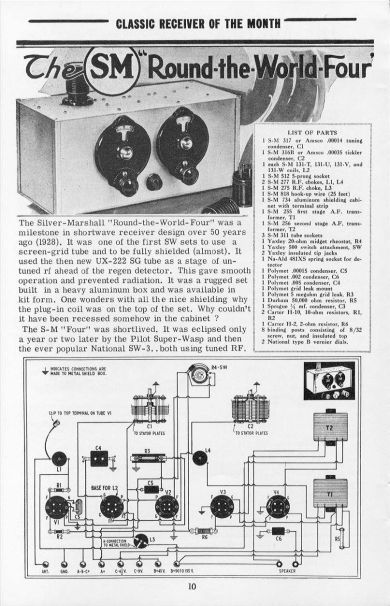
The Silver-Marshall "Round-the-World Four" is a classic vintage shortwave receiver kit that represents a significant milestone in radio design from the late 1920s. Introduced around 1928, it was celebrated as one of the first shortwave sets to incorporate a screen-grid vacuum tube and utilize extensive metal shielding to improve performance.
The "Round-the-World Four" was a popular offering for hobbyists who wanted a high-performing shortwave radio without the cost of a factory-built professional receiver. It was sold as a kit, requiring the builder to assemble the components, wire the circuit, and mount it into the aluminum housing.
While it was a big success for Silver-Marshall, its dominance was relatively short-lived. Within a year or two, the rapid evolution of radio technology brought about the Pilot Super-Wasp and the legendary National SW-3, both of which introduced the superior performance of tuned radio frequency (TRF) stages, gradually pushing the "Round-the-World Four" into the annals of radio history.
The design centers around a four-tube configuration that balances sensitivity with stability.
Circuit Type: Regenerative receiver with an untuned RF stage
Coil System: Interchangeable plug-in coils for different shortwave bands
Tube Lineup
V1: UX-222 (Screen-grid RF amplifier)
V2: UX-201A (Regenerative detector)
V3: UX-201A (First stage audio amplifier)
V4: UX-112A (Second stage audio power amplifier)
The Screen-Grid Innovation: The heart of the set's performance is the use of the then-new UX-222 screen-grid tube as an untuned radio-frequency (RF) amplifier ahead of the regenerative detector. This stage acts as a buffer, which provides incredibly smooth regenerative control and effectively prevents the detector from oscillating and radiating interference back into the antenna.
Shielding Architecture: It was among the first kits to be almost fully shielded within a heavy aluminum box. This design choice was intended to isolate stages and reduce stray capacitance, which was a major step forward from the open breadboard-style designs of the early 1920s.
Physical Layout: The kit features two prominent vernier dials on the front panel for precise tuning, along with a rheostat knob for controlling regeneration. A curious design quirk noted by collectors is that despite the heavy shielding, the plug-in coils sit exposed on top of the chassis rather than being recessed within the cabinet.
The circuit relies on a multi-voltage power supply arrangement, requiring separate A, B, and C battery connections (or an equivalent power supply unit) to provide the necessary voltages for the filaments, plates, and grid bias.