Note
Electronics World, May 1971, p. 83.
73, Dec 1972, p. 72. (close out).
Note that Simpson Electronics is not the same as Simpson Electric (maker of the model 260 VOM, et al).
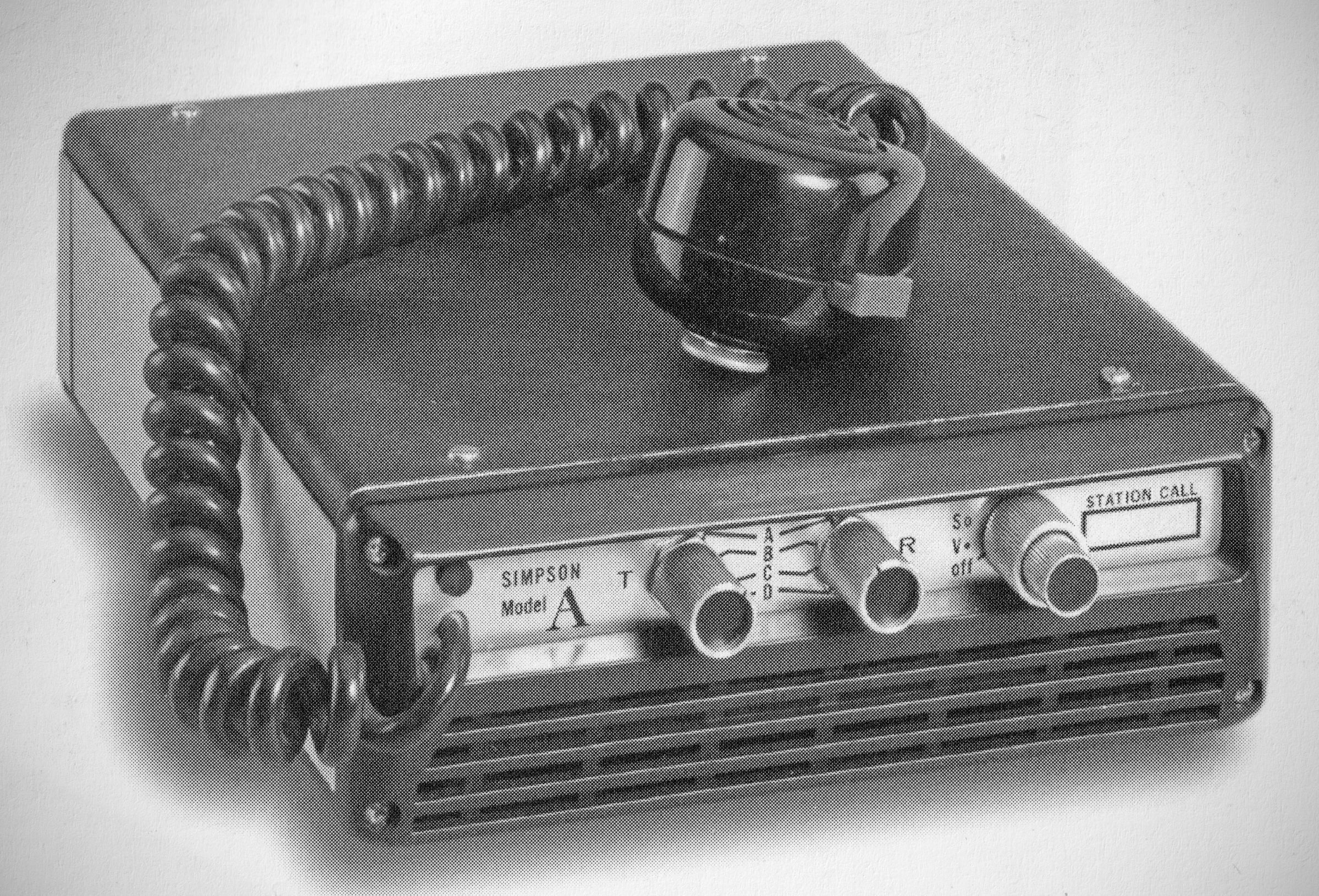
Simpson Electronics of Miami, Florida was a well-known manufacturer of marine communications gear. Their FM transceiver for the 2 meter amateur band had four crystal-controlled channels. Transmit and receive frequencies were selected independently using diodes to switch the crystals. The Model A's power output was 6 watts ($249.00, 1971 ). Simpson's push button-controlled Model B two meter transceiver was based on one of the company's VHF marine radios.
he 6-watt Simpson Model A features four channels, sensitivity of 0.6 uV for 20-dB quieting and separate plug-in transmitter and receiver boards with easy access to all tuning and metering points. The solid-state design uses integrated circuits and diode frequency switching.
The squelch is fully regulated and compensated with squelch sensitivity at 0.25 pV or less.
Intermodulation interference rejection i s 70 dB minimum.
Spurious response attenuation is greater than 60 dB.
Selectivity, furnished by ceramic filter: 13 kHz at 6 dB down and 36 kHz at 60dB down.
Audio output is 2 watts with less than 10% distortion.
Current drain on receive: squelched, 250 mA; unsquelched, 480 mA.
The transmitter has ±5 kHz deviation for 100% modulation at 1 kHz and includes instantaneous automatic deviation limiting.
Transmitter audio response is +1 dB to -3 dB from 300 to 3000 Hz.
Tuning range is 144 to 148 MHz.
References
Brief description. Electronics World, May 1971, p. 83.
Review. Popular Electronics, Aug 1971, p. 84.
Review: QST, Oct 1971, p. 58.
Review. 73, Jan 1972, p. 79.