Note
QST, Aug 1946, p. 139.
Lafayette catalog number 88 (1947), p. 103.
Some info: Allied catalog 1948 p. 162.
Lafayette catalog number 89, p 170.
On August 1, 1947, the F.C.C. authorized narrow band frequency modulation on portions of the 75, 20, 10, and 6 meter amateur bands for an experimental trial period not to exceed one year. The authorization was extended for additional one-year periods until the spring of 1951, when it was made permanent. A year later, NBFM privileges were expanded to include the voice allocations on all bands except for 160 meters.
Modulation power requirements for frequency-or phase-modulated transmitters were modest compared with amplitude modulated rigs of similar carrier power, and NBFM signals were less prone to cause interference to broadcast services than AM transmissions, with or without carrier.
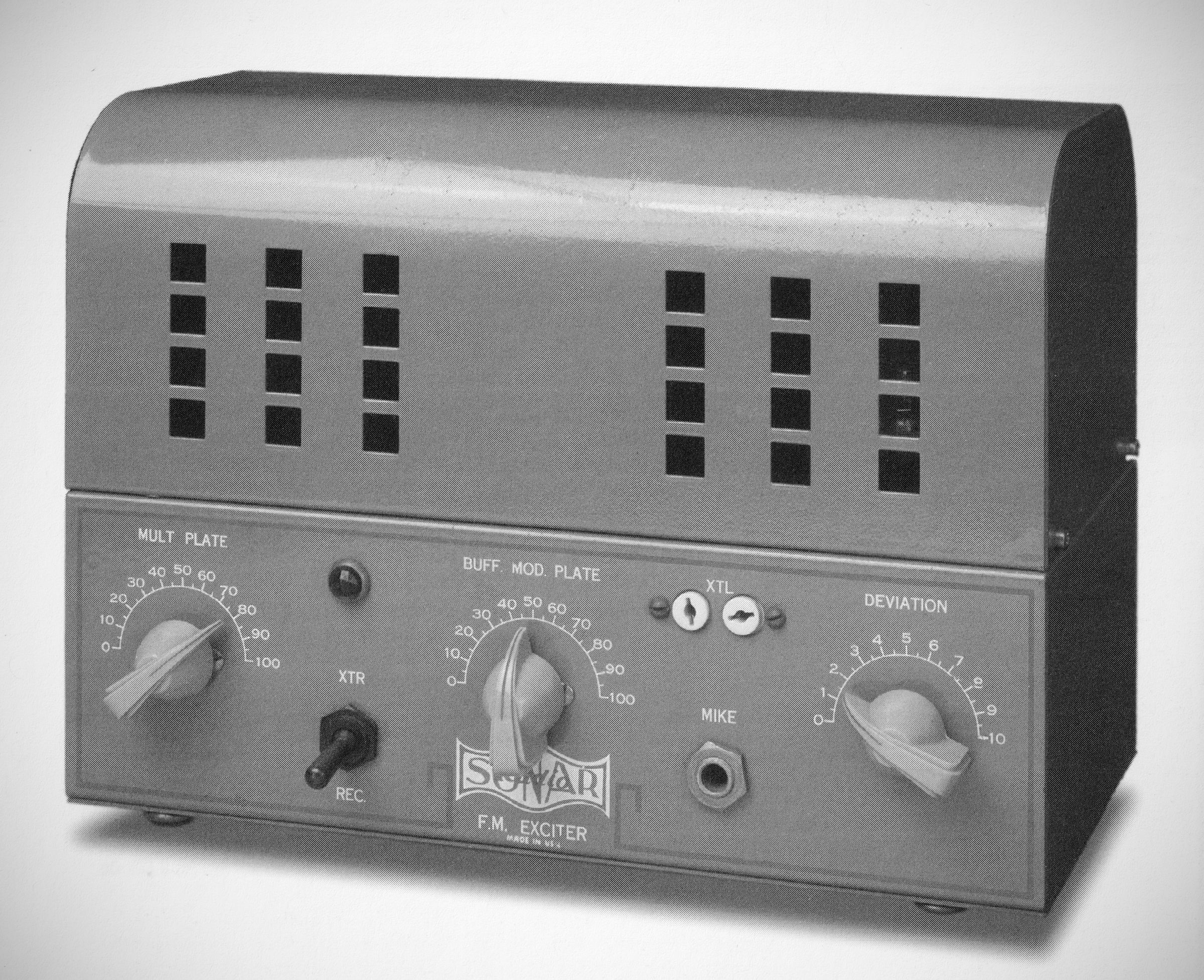
The Sonar Radio Corporation of Brooklyn, New York was one of the first on the amateur narrow band frequency modulation scene. Their XE-10 phase modulation exciter turned any CW transmitter into an NBFM rig. lt was designed primarily for crystal control but could also be used with a VFO.
The XE-10 converts any transmitter on 6, 10, or 11 meters for use on NBFM. Operation is possible on 40 meters by using at 80 meter crystal, but NBFM was not permitted on 40.
Connects to transmitter crystal socket or the grid circuit of a VFO.
Provides deviation of 2 to 3 kHz.
Circuit includes microphone amplifier, crystal oscillator, buffer modulator, and built-in power supply. Modulation and tuning controls, transmit-receive switch, crystal socket and mic jack are located on the front panel. Metering jack and antenna connector are on the rear panel.