Note
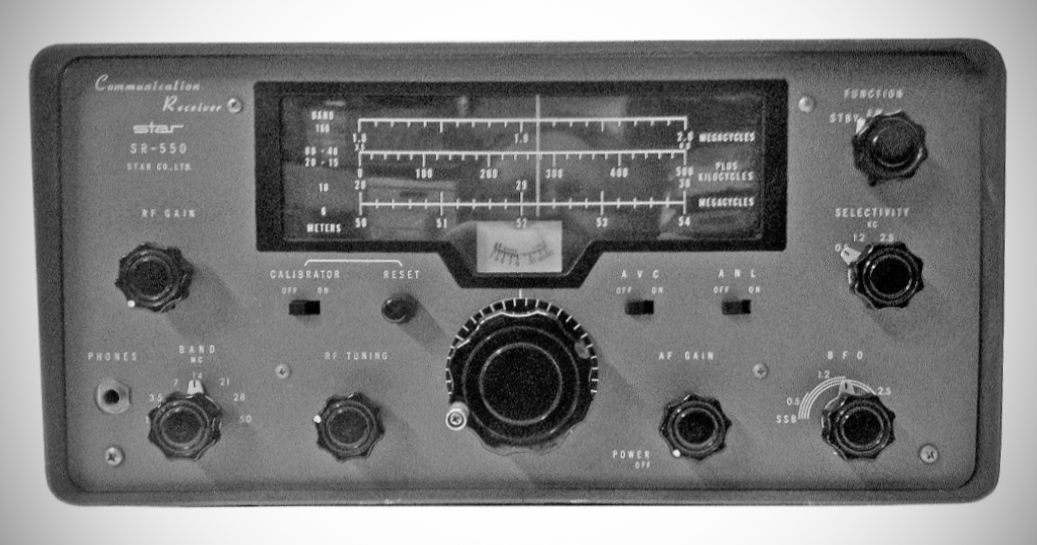
The Star SR-550 is a Japanese HF amateur radio communications receiver produced by the Star Co. Ltd. (formerly Fuji Manufacturing) beginning in 1964. It is historically notable as one of the earliest well-designed Japanese tube receivers, paving the way for engineers who later influenced iconic designs at Yaesu and Trio-Kenwood.
Sold in the US through distributors like Harrison Radio for $150, making it an affordable alternative to competitors like the Hammarlund HQ-110. Because Star was eventually outpaced and absorbed by competitors like Yaesu and Trio, the SR-550 remains quite rare today and is omitted from several major historical shortwave reference texts.
It covers the amateur bands from 160 through 6 meters (the pre-WARC era).
Including the 6-meter band was considered highly innovative for a conventional HF receiver of its era, serving as an excellent marketing feature when 6 meters was popular for local chatter.
The 550 uses superheterodyne circuit utilizing a dual-conversion design to ensure good image rejection and selectivity. The first IF is 1650 kHz, and the second is 55 kHz.
Tube Lineup: The receiver utilizes 10 tubes based around modern (for the time) 7-pin and 9-pin miniature bases. The lineup includes:
– 6BA6 (RF amplifier and two 2nd IF amplifiers).
– 12AU7 (1st local oscillator and cathode follower to drive the mixer).
– 6AU6 (1st mixer, and a separate one configured as a crystal calibrator).
– 6BE6 (2nd mixer, using a fixed 1705 kHz LC oscillator).
– 6EA8 (Pentode section acts as the BFO; triode section acts as the product detector).
– 6AL5 (Diode detectors for AM, AVC, and Automatic Noise Limiting).
– 6BM8 (A single triode/pentode tube handling the entire audio chain—a departure from typical Western reliance on 12AX7/6AQ5 combos).
– VR-105 (Gas regulator tube to stabilize B+ voltage to the oscillators).
Linear Dial Spacing: A standout mechanical feature is its slide-rule dial, which achieved completely linear spacing across all bands. It features a single set of markings spaced exactly 20 kHz apart, regardless of the band selected. Further resolution is read using a calibrated, skirted tuning knob.
Unlike many contemporary rigs, the RF amplifier stage is not ganged to the main tuning knob. It uses an independent variable capacitor controlled via a front-panel knob labeled RF TUNING to peak the stage.
Selectivity is managed at the 55 kHz 2nd IF via a 4-position front panel switch, offering bandwidths of 0.5, 1.2, 2.5, and 4 kHz. This routes through a separate shielded module called the Variable Selectivity Bandpass Filter.
Sideband Injection Scheme: The 1st mixer is cleverly designed so that high- or low-side oscillator injection automatically yields the proper sideband (LSB on 160/80/40m; USB on the higher bands), eliminating the need for a front-panel LSB/USB switch.
A RESET control which operates a small variable capacitor in parallel with the main tuning capacitor to pull the bottom of the band precisely on frequency against the built-in 3.500 MHz crystal calibrator.
Power Supply: Employs a conventional solid-state full-wave rectifier. Curiously, the primary transformer is only tapped for 100 or 115 VAC, missing a universal 220 VAC tap despite being sold in European markets.