Note
At its core, a superheterodyne receiver works on a simple concept: instead of changing your radio's filters to match every incoming station, you change every incoming station to match one filter.
Before this design came along, radios had to tune multiple filtering stages at the exact same time to pick up different frequencies. It was a mechanical nightmare, unstable, and not very selective.
The superheterodyne architecture solves this using a process called heterodyning—which is just a fancy word for mixing two frequencies together to create a new one.
The 4-Step Process
Here is how a signal travels through a classic superheterodyne circuit:
1. The Front End (RF Stage): The antenna picks up the raw radio frequency (RF) signal you want to hear (for example, a station at 1000 kHz).
2. The Mixer & Local Oscillator: This is where the magic happens. The radio generates its own internal signal using a Local Oscillator (LO). It mixes this internal signal with the incoming station's signal. The LO is designed to always track a specific distance away from the station you are tuning to. In older broadcast band receivers, this distance was often 455 kHz. So, for example, if you tuned in a station at 1000 kHz, the LO would be at 1455 kHz.
3. The Intermediate Frequency (IF) Stage: When those two signals mix, they beat against each other to create a new third frequency: the Intermediate Frequency (IF), which is the mathematical difference between the incoming frequency and the LO.
The Math: If your target station is at 1000 kHz and the radio's fixed IF is 455 kHz, the internal oscillator automatically tunes to 1455 kHz.
1455 kHz – 1000 kHz = 455 kHz
If you change the dial to a station at 600 kHz, the LO shifts to 1055 kHz. The result is exactly the same:
1055 – 600 = 455 kHz
The intermediate frequency (IF) is 455 kHz.
4. Detection & Audio: Because the signal is now always converted to that exact same IF, the radio can use incredibly sharp, permanently tuned filters and amplifiers to single out the desired signal. Finally, the detector strips away the carrier wave, leaving just the audio to be sent to the speaker.
Why It Changed Everything
By converting everything down to a single, static intermediate frequency, engineers stopped having to build complex variable filters. They could optimize one single IF stage to be exceptionally sharp, giving the radio incredible stability, high gain, and the ability to reject bleeding signals from adjacent stations.
Nearly every analog radio, television, and radar system built over the last century relies on this exact fundamental breakthrough.
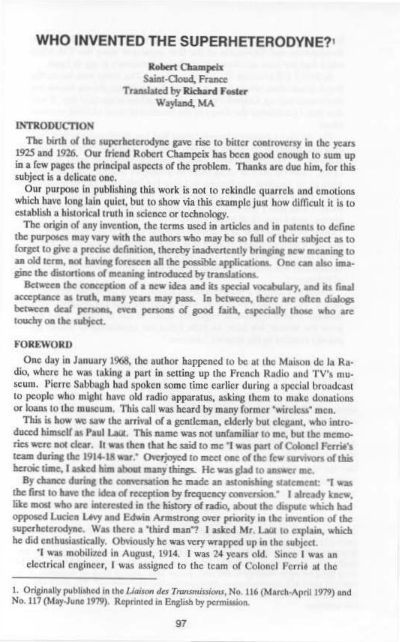
While the invention of superheterodyne is generally credited to Maj. Edwin Howard Armstrong in 1918, exactly who thought up this ingenious scheme is the subject of debate even today.