Note
QST, Feb 1969, p. 103. (260)
QST, Oct 1969, p. 149. (270)
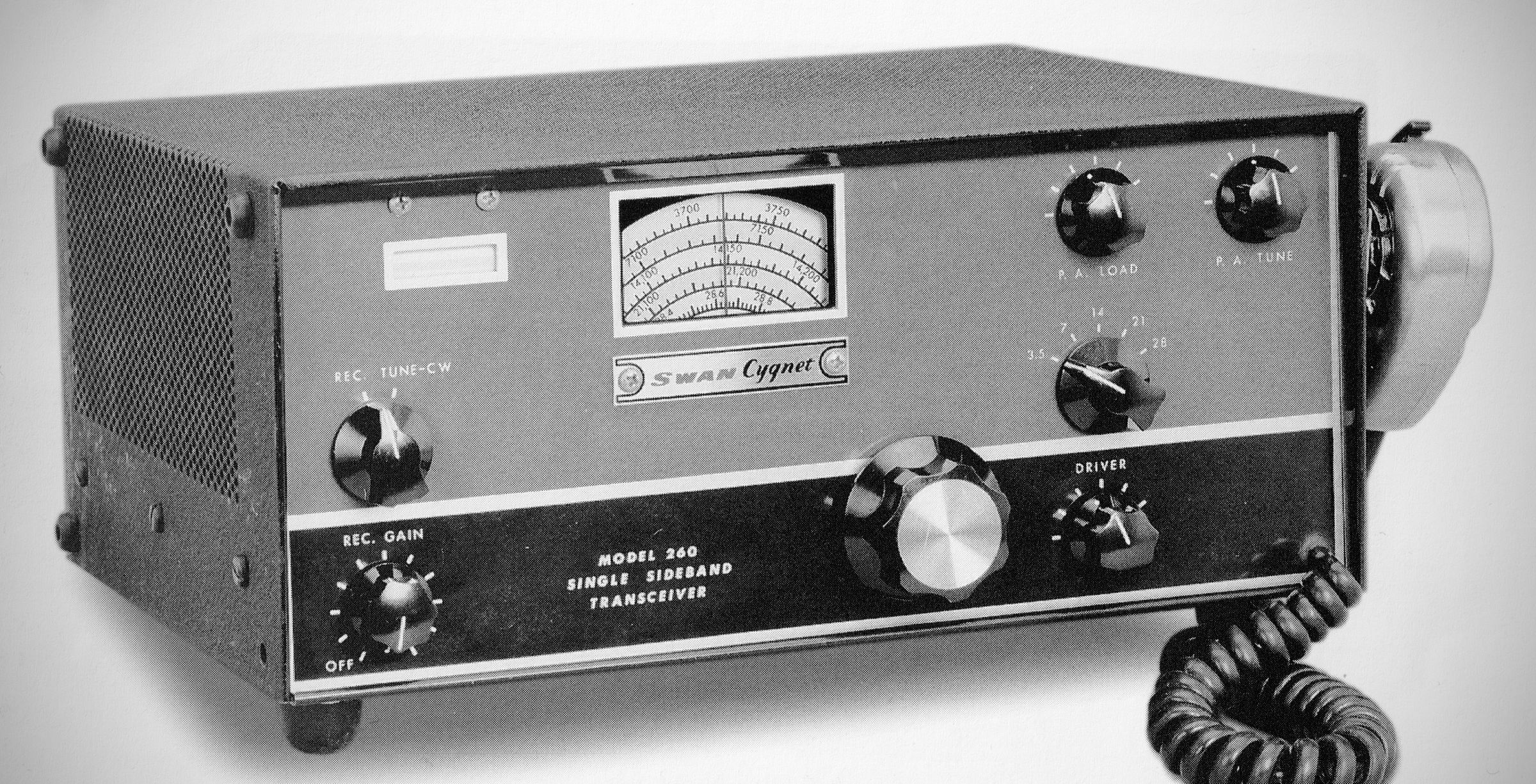
The Cygnet 260 had internal power supplies for both 120 VAC and 12 VDC. Its solid-state VFO provided full coverage of the 80-10 meter bands. Early models, such as the one pictured, used a green tuning eye to indicate PA current and mic gain. They also had the hand-held microphone hard-wired to the transceiver. Later versions of the Cygnet 260 had a jack for the microphone and a small current meter. Power input to the 6LQ6 final was 260 watts PEP on SS8 and 180 watts on CW. The transceiver had no audio gain control but used the RF gain to set the volume.
The 260 was supplanted by the 270 late in 1969, but the two were sold side by side through about 1970. After 1970 the 260 appears to have been discontinued. (QST, Feb 1971, p.107.)
Specifications
– Frequency Range
80 Meters: 3.5 to 4.0 MHz
40 Meters: 7.0 to 7.3 MHz
20 Meters: 14.0 to 14.35 MHz
15 Meters: 21.0 to 21.45 MHz
10 Meters: 28.0 to 29.7 MHz
– Power Input (Single Sideband): 260 Watts PEP Input
– Power Input (CW): 180 Watts Input
– Power Output (Tune & CW Mode):
80, 40, and 20 Meters: 130 Watts average
15 Meters: 100 Watts average
10 Meters: 75 Watts average
– Dial Calibration
80, 40, and 20 Meters: 5 KHz Increments
15 Meters: 10 KHz Increments
10 Meters: 20 KHz Increments
– Normal Sideband:
80 and 40 Meters: LSB
20, 15, and 10 Meters: USB
– Audio Passband: ±3 dB from 300 to 3000 Hz in both transmit and receive.
– Sideband Suppression: 45 dB at 1000 cycles
– Carrier Suppression: 60 dB or greater
– Distortion Products: Approximately 30 dB down
– Receiver Sensitivity: 0.5 microvolts for signal-plus-noise to noise ratio of 10 dB
– Crystal Lattice Filter:
Frequency: 5500 KHz
Bandwidth: 2700 cycles at 6 dB, 6000 cycles at 50 dB
– Pi-Network Coupler: 50 to 75 ohms for coaxial cable
– CW Keying: Grid Block Keying (with offset transmit frequency)
Tube Lineup (13 total)
V1: 12BA6 VFO Amp
V2: 12BE6 Trans. Mixer
V3: 6GK6 Driver
V4: 6LQ6 Power Amp
V5: 6BZ6 Rec. RF Amp
V6: 12BE6 Rec. Mixer
V7: 12BA6 First IF Amp
V8: 12BA6 Second IF Amp
V9: 12AX7 Product Det. and Audio Amp
V10: 6AQ5 A.F. Output
V11: 6JH8 Bal. Modulator
V12: 12BA6 Mic. Amp
V13: 6FG6 Tuning Eye