Note
QST, May 1964, p. 120.
QST, May 1965, p. 125.
QST, Jan 1966, p. 105.
QST, Oct 1966, p. 129. (406B)
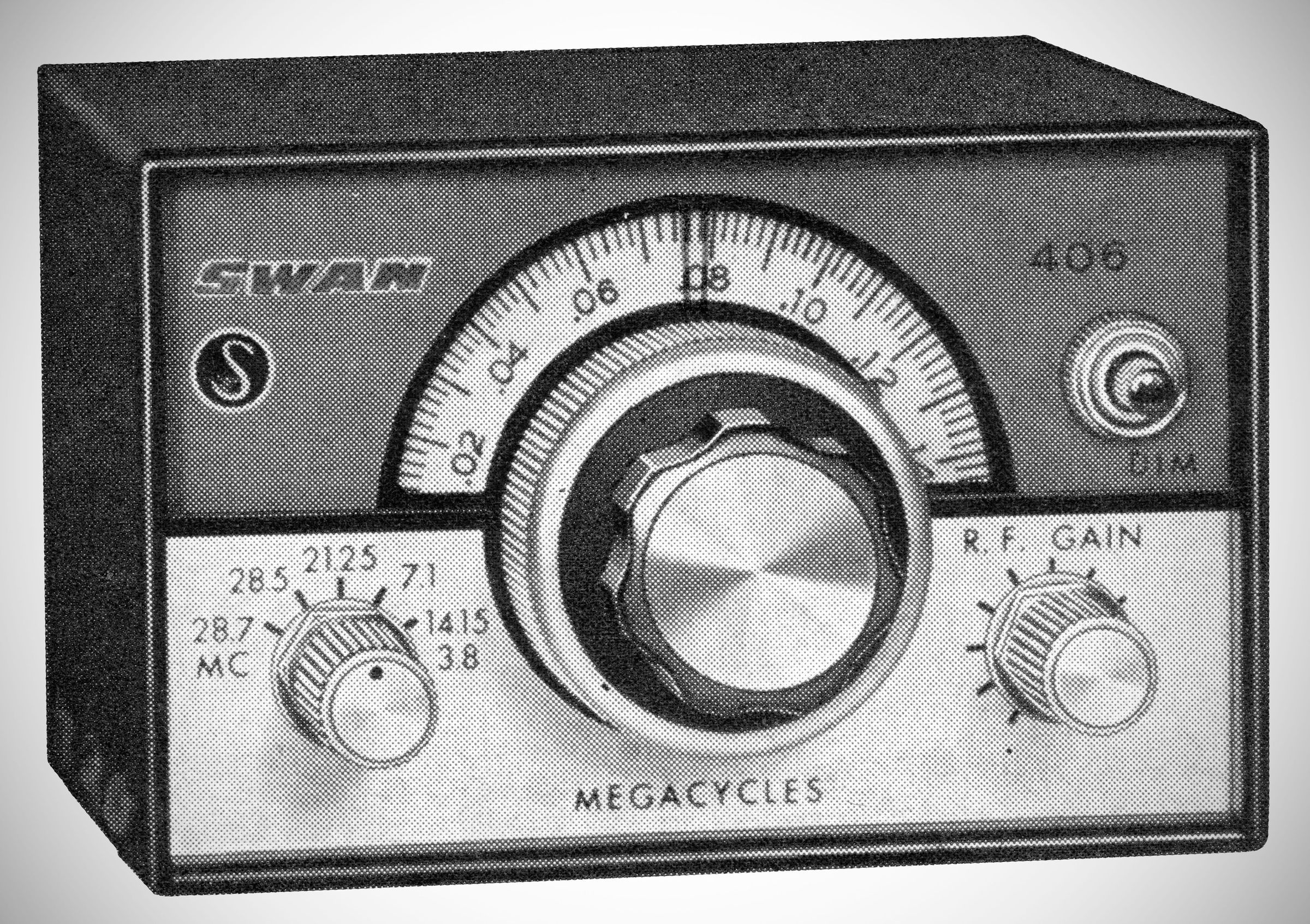
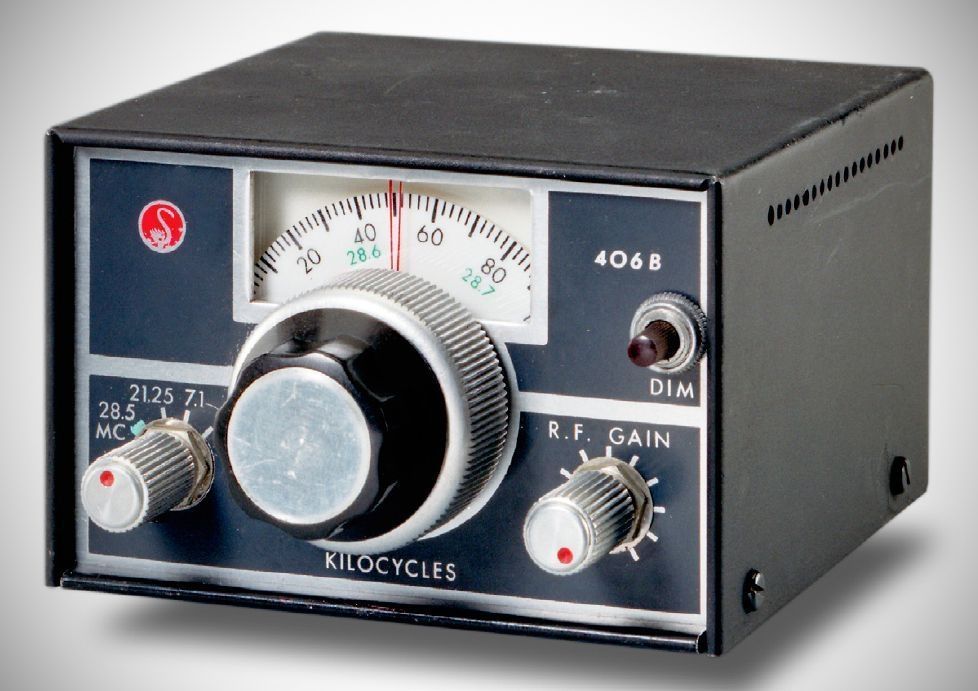
The 406(B) was the mobile VFO for the Swan 400 transceiver. It covered the American portions of the 80–15 meter phone bands and two 200 kHz segments of the 10 meter band. May also be used for fixed station operation if desired.
Phone Band Coverage as follows: 3.8-4.0, 7.1-7.3, 14.15-14.35, 21.25-21.45, 28.5-28.7, and 28.7-28.9 MHz. (These ranges can be easily adjusted to cover other segments, if desired.)
Direct reading dial scale calibrated in 2 kHz increments. Dual tuning knobs provide choice of fast 6:1 ratio or slow 36:1 vernier tuning.
Fully solid state VFO circuit with Zener regulated power supply.
Temperature Stability: Warm-up drift is virtually eliminated due to separation of the VFO from the transceiver's relatively high temperature, and by the use of transistors. Oscillator circuit is fully compensated for wide excursions in ambient operating temperature.
Voltage Stability: Zener voltage regulator completely isolates oscillator circuit from power supply variations. Input voltage can change plus or minus 50 per cent with no change in oscillator frequency.
Includes receiver RF Gain control; thus the 406 functions as a mobile control head, and makes it possible to install the Swan 400 transceiver in the trunk, if necessary.
Compact size allows installation on the automobile dashboard within easy reach and visibility of the operator. Supplied with mounting brackets and hardware.
Differences between the Swan VFOs
– Swan 420: Fixed station, slow-rate precision tuning, 200 kHz segments, plus WWV. Provides greater frequency resolution.
– Swan 410: Fixed station, full 500 kHz single-sweep coverage across all bands.
– Swan 406 / 406B: Mobile-focused, compact chassis, tuned strictly for 200 kHz phone-segments.