Note
QST, May 1964, p. 121.
QST, May 1965, p. 125.
QST, Jan 1966, p. 105.
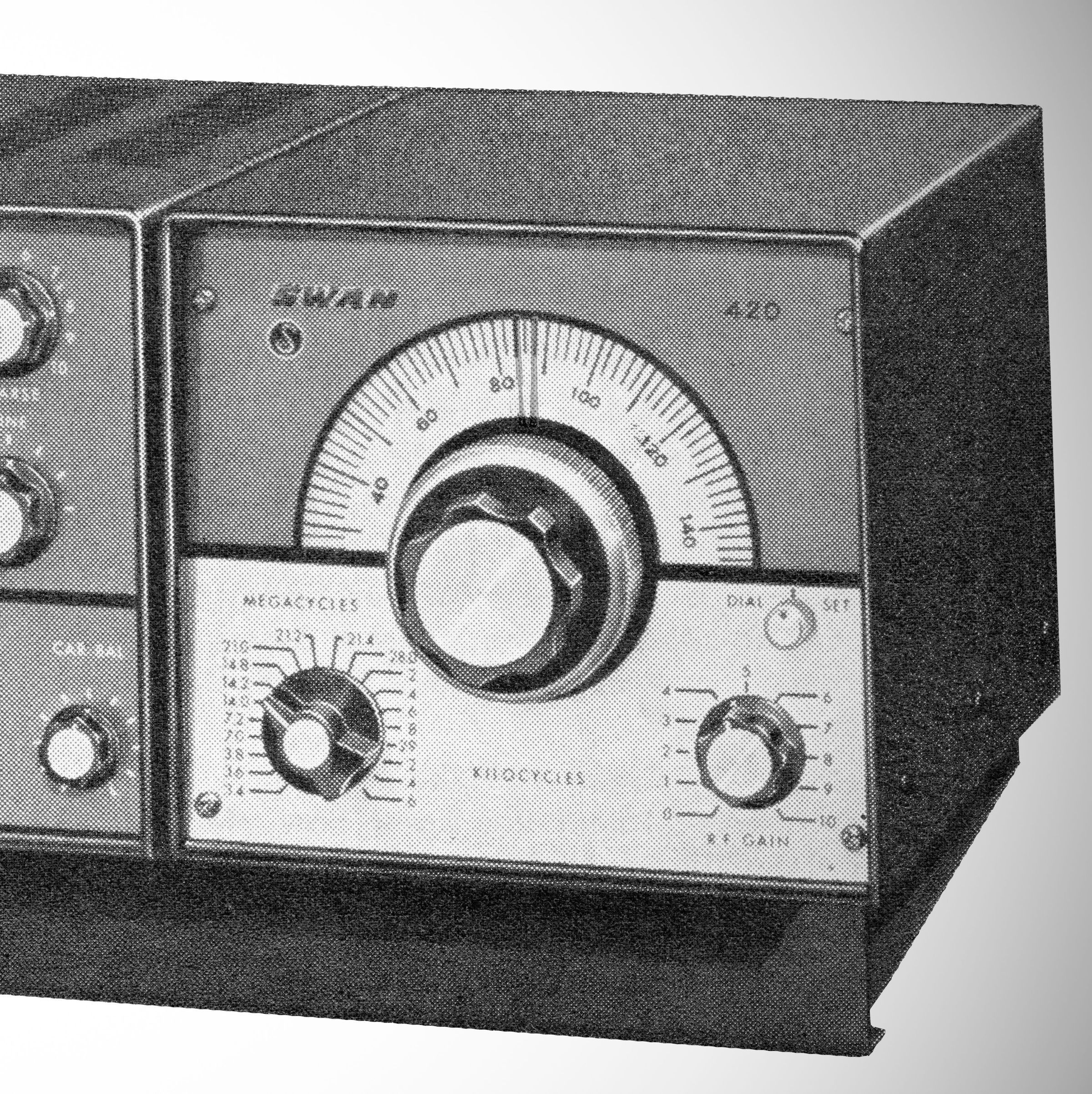
Designed for fixed station operation in conjunction with the Swan-400 SSB Transceiver. May be installed for mobile operation if full frequency coverage is desired. It uses a fully solid state VFO circuit with Zener regulated power supply. Plugs directly into the Swan 400.
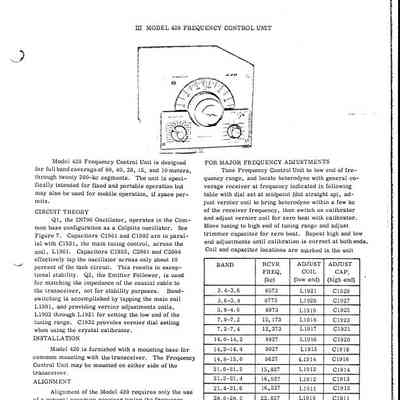
Full frequency coverage of 10, 15, 20, 40, and 80 meter amateur bands in 20 ranges of 200 kHz each, including WWV range as follows: 3.4-3.6, 3.6-3.8, 3.8-4.0, 7.0-7.2, 7.2-7.4, 14.0-14.2, 14.2-14.4, 14.8-15.0, 21.0-21.2, 21.2-21.4, 21.4-21.6, 28.0-28.2, 28.2-28.4, 28.4-28.6, 28.6-28.8, 28.8-29.0, 29.0-29.2, 29.2-29.4, 29.4-29.6, 29.6-29.8.
Direct reading dial scale calibrated in 2 kHz increments. Dual tuning knobs provide choice of fast 6:1 ratio or slow 36:1 vernier tuning.
Temperature Stability: Warm-up drift is virtually eliminated due to separation of the VFO from the transceiver's relatively high temperature, and by the use of transistors. Oscillator circuit is fully compensated for wide excursions in ambient operating temperature.
Voltage Stability: Zener voltage regulator completely isolates oscillator circuit from power supply variations. Input voltage can change plus or minus 50 per cent with no change in oscillator frequency.
Supplied with mounting base which joins the 400 and 420 in a neat tilt-up arrangement for desk top operation. (Illustrated above.)
Differences between the Swan VFOs
– Swan 420: Fixed station, slow-rate precision tuning, 200 kHz segments, plus WWV. Provides greater frequency resolution.
– Swan 410: Fixed station, full 500 kHz single-sweep coverage across all bands.
– Swan 406 / 406B: Mobile-focused, compact chassis, tuned strictly for 200 kHz phone-segments.