Note
QST, Jan 1972, pp. 112–113.
QST, Oct 1972, p. 144.
QST, Jan 1973, p. 109.
QST, Mar 1973, p. 149.
QST, Feb 1975, p. 109.
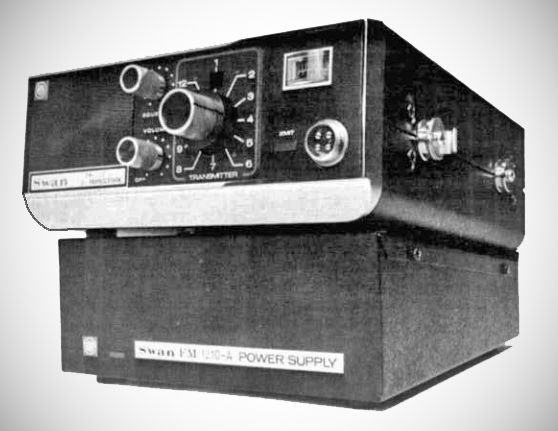
Frequency coverage 144·148 MHz. •
Number of channels: 144 (12 receive, 12 transmit, dependent switching).
Modulation: frequency modulation (phase type)
Transmitter control: PTT on microphone
Power:· 117 VAC, 50·60 Hz; 13 5 VDC nominal. • Dimensions: 8 Y•" x 7" x 3". • Weight: 8V• lbs •
Furnished with unit: dynamic microphone, an· tenna connector plug, spare fuses and lamps. AC power supply, DC power cord, and mobile mounting br
Transmitter
Fully solid state
RF output power: 10 watts nominal
Frequency deviation: phase type, factory adjusted to ±5 kHz
Frequency stability: ±0.001%, –30º to +50ºC, oven controlled
Spurious & harmonic radiation: 60 db minimum
Frequency multiplication: 12
Receiver
Type: superheterodyne, dual conversion 16.9 MHz and 455 kHz IF
Input Impedance: 50 to 75 ohms
Sensitivity: 0.5 uV for 20 db quieting; 0.25 uV for 12 db SINAD
lntermodulatlon greater than 55 db
Audio output· 2 watts at less than 10% distortion
Imago response: 55 db
Squelch threshold· less than 0.3 uV
Adjacent channel rejection: 55 db