Note
Abstract
Title: A Century of Telegraph Key Development
Author: Louise Ramsey Moreau, W3WRE
Purpose and Scope
This historical survey documents the century-long evolution of the American telegraph key, tracking its transformation from a primitive circuit-breaking strap to highly specialized semi-automatic and automatic instruments. The paper highlights how operator comfort, occupational hazards, and shifting technological eras (from landlines to wireless radio) drove mechanical innovation.
Key Themes and Findings
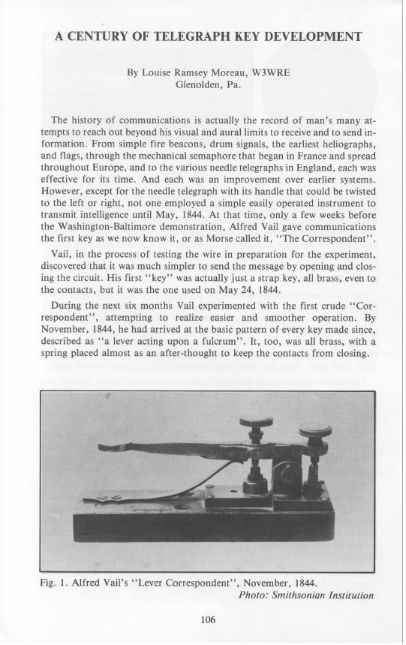
The Foundation (1844): Alfred Vail introduced the first manual key—termed the "Correspondent"—establishing the definitive "lever acting upon a fulcrum" design that underpinned all subsequent key developments.
Ergonomic & Mechanical Adjustments (1848–1880s): Early operator feedback led to the iconic "Camelback" design, variations in spring configurations (coil vs. leaf), and George M. Phelps' adjustable spring tension screw. The systemic wear of brass levers on steel trunnions was permanently solved by Jesse H. Bunnell’s 1881 one-piece "Steel Lever" design.
Combating Occupational Hazards: The rise of "telegraphers' paralysis" sparked the creation of horizontal-action keys, such as the Bunnell "Sideswiper" (Double Speed Key), to relieve repetitive vertical strain.
The Semiautomatic "Bug" Era: Horace G. Martin revolutionized high-speed transmission with the 1902 Autoplex and 1904 Vibroplex. These semiautomatic keys generated automatic dots and manual dashes, sparking fierce market competition and legal battles over counterfeit "bootleg bugs," eventually resolved via the Albright licensing system.
Transition to Wireless Radio: The advent of wireless communications initially required massive, heavily insulated spark keys to handle high voltages safely. The introduction of Continuous Wave (CW) technology in the 1920s allowed operators to return to lighter, faster semiautomatic keys, eventually laying the groundwork for post-WWII electronic keyers and modern keyboard transmitters.
The evolution of the telegraph key represents a century of global, operator-driven innovation aimed at transcending visual and aural limits to achieve faster, more reliable communication.