Note
QST, Nov 1970, p. 5.
QST, Oct 1972, p. 141. (2001)
QST, Dec 1973, p. 177.
QST, Jan 1974, p. 177.
QST, Apr 1975, p. 168.
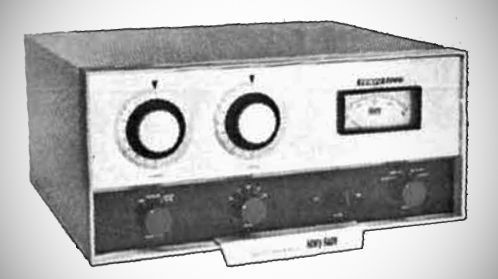
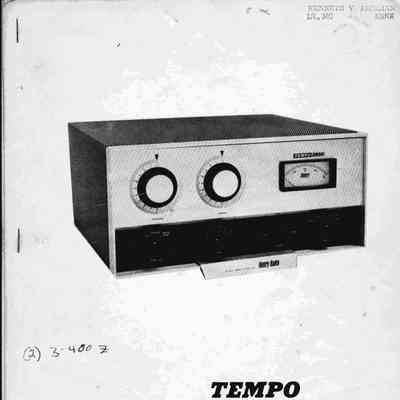
The Tempo 2000 is a full legal limit, grounded-grid linear amplifier manufactured by Henry Radio. Released in 1970, it was designed to bridge the gap for amateur radio operators looking for a powerful, conservatively designed station component capable of operating across the 80 to 10-meter amateur bands, as well as adjacent MARS frequencies.
The amplifier features an internal exciter tuning dummy load (consisting of two 100-ohm, 50-watt resistors in parallel). By switching the front panel function to DRIVER TUNE, operators can safely tune their transceiver or transmitter into a 50-ohm load before applying RF to the amplifier itself. The load with handle 100 watts continuously, and 300 watts for 30 seconds.
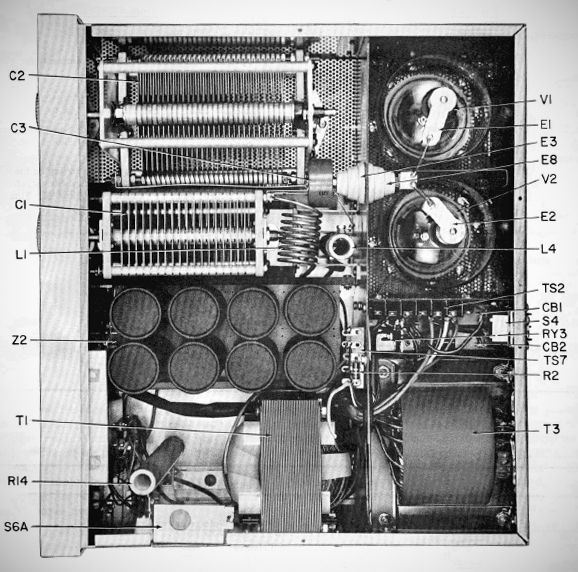
The Tempo 2000 features a self-contained solid-state high-voltage power supply utilizing a full-wave voltage doubler with a capacitive filter bank. A separate 25 VDC power supply powers the solid-state switching logic and instantaneous, silent magnetic reed T-R (transmit-receive) relays. Because this 25 VDC supply runs even when the main function switch is off, pass-through bypass switching operates seamlessly without powering up the entire amplifier.
A front-panel MODE toggle switches the taps on the primary high-voltage transformer:
CW Mode: Drops the high-voltage supply output to 1800 VDC.
SSB Mode: Increases the high-voltage supply output to 2500 VDC.
Specifications
– Tube Complement: Two 3-400Z zero-bias triodes operating in a parallel grounded-grid configuration.
– Power Input: 2000 watts PEP for SSB; 1000 watts for CW, AM, and RTTY.
– Driving Power Required: 55 watts for 1000 watts input, and 85 watts PEP for full 2,000 watts PEP input.
– Input/Output Impedances: 50 ohms nominal unbalanced input (requires no tuning); 30 to 100 ohms minimum unbalanced output handled via a Pi-network.
Power Requirements: Factory wired for 234 VAC at 10 amperes, but modifiable for 117 VAC at 20 amperes.