Note
QST, Aug 1970, p. 5.
QST, Dec 1971, p. 113. (specs)
QST, Dec 1973, p. 177.
QST, Mar 1975, 192. (specs) (A cosmetic update)
QST, Oct 1975, inside front cover (Tempo One Digital)
Essentially the same as the Tempo One, but with a digital display.
QST, Apr 1976, p. 81.
QST, Oct 1976, inside front cover.
QST, Feb 1977, inside front cover.
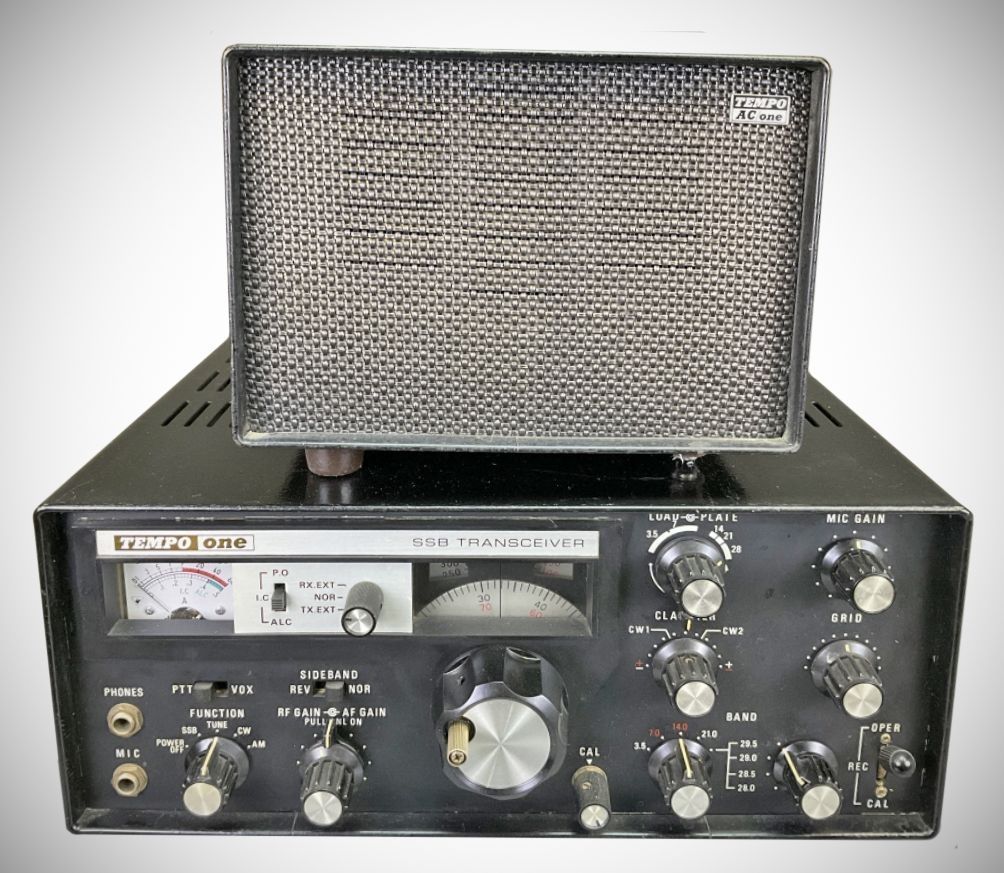
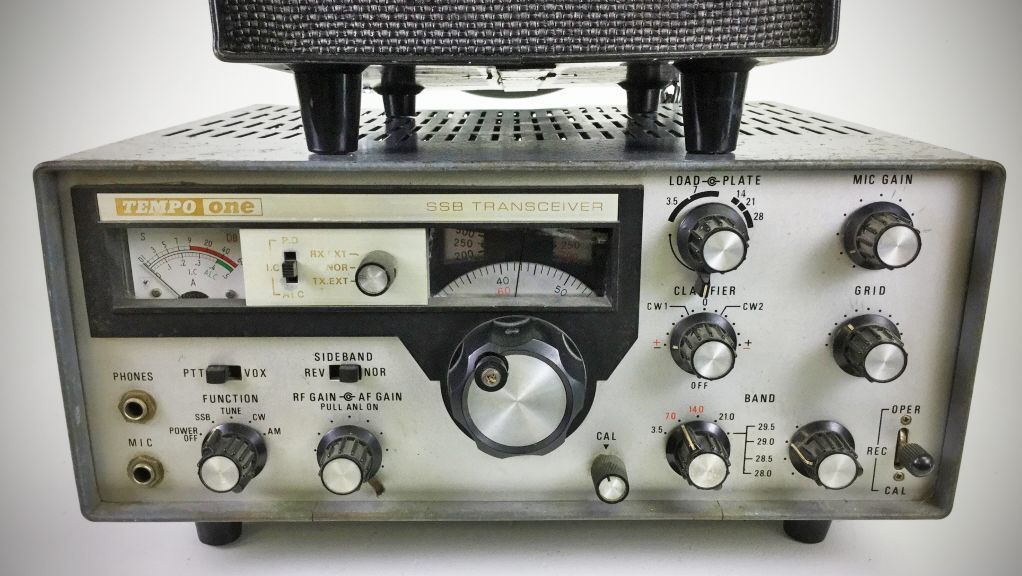
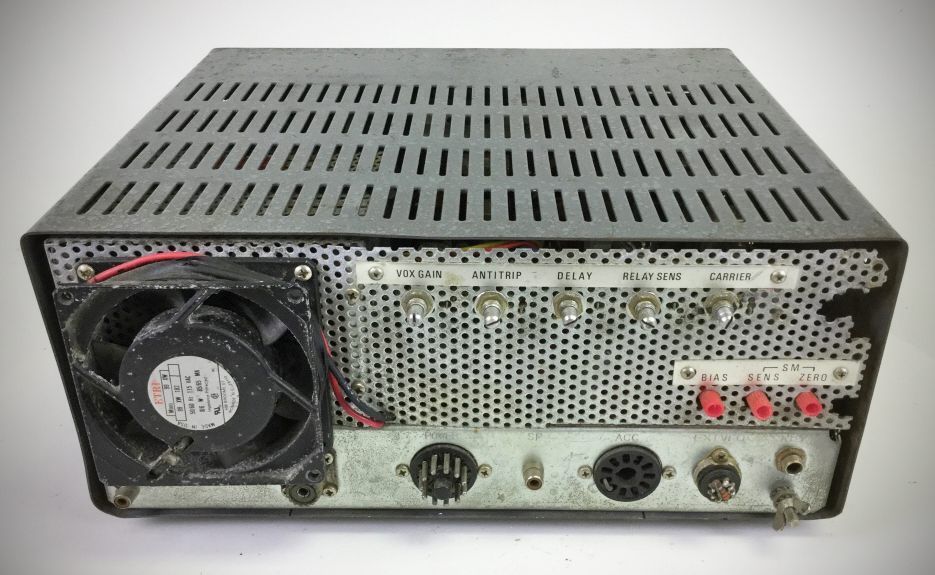
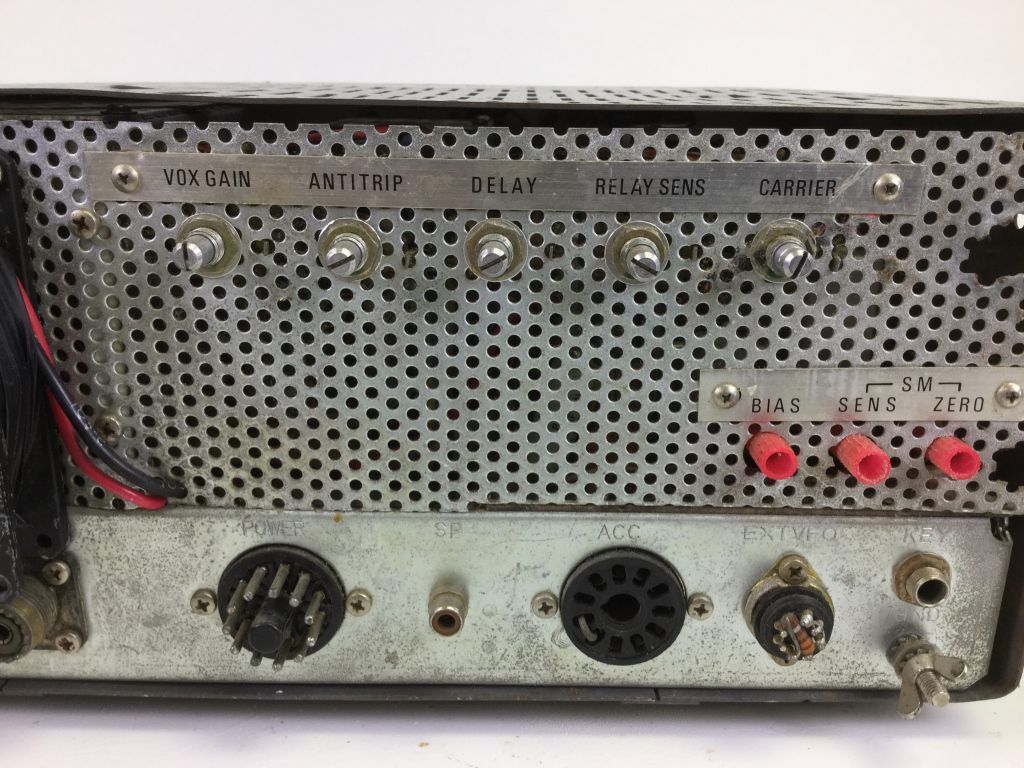
Perhaps the most well known Tempo radio, this HF transceiver was actually manufactured in Japan by Yaesu (it was heavily based on the Yaesu FT-200 / Sommerkamp FT-250 design).
The Tempo One became widely popular as a budget-friendly entry transceiver during the 1970s. It was known for good receiver sensitivity and solid transmit audio quality on SSB. Because it relied on television sweep tubes for the final amplifier stage, proper transmitter tuning—specifically brief keying during grid and plate dips—was essential to avoid overheating and extending tube longevity.
Tempo One and Tempo One Digital (with digital display) were sold concurrently.
Design & Circuit Features
– Receiver & Clarifier: Features a single-conversion superheterodyne receiver architecture with a clarifier (RIT) control that allows offset tuning during receive mode without altering the transmit frequency.
– Tuning Mechanism: Uses a smooth, gear-driven VFO with a dual-rate analog tuning dial calibrated in 1 kHz increments.
– VFO & Accessories: Compatible with the external VF/ONE VFO, enabling split-frequency operating capability for DXing and contesting.
– Cabinet Styling: Offered in both a textured black cabinet and silver/grey front panel variations.
Specifications
– Modes: SSB (USB–LSB), CW, AM
– Input power: 240W
– Frequency range: 3.5–4; 7–7.5; 14–14.5; 21–21.5; 28.5–29
(crystals optionally available for ranges 28–28.5; 29–29.5; 29.5–30 MC)
– Antenna impedance: 50–100 ohms
– Frequency stability: After warm-up, within 100 cps/ every 30 minutes
– Carrier suppression: -40 dB
– Sideband suppression: -50 dB at 1000 cps
– Third order intermodulation products: -30 dB (P.E.P.)
– A.F. bandwidth: 300–2700 cps
– Receiver sensitivity: 0.5 uV input S/N 10 dB
– Selectivity: 2.4 kc (-6 dB), 4 kc (-60 dB)
– I.F. interference ratio: 50 dB
– Image ratio: 50 dB
– Audio output: 1W at 10% distortion
– Audio output impedance: 8 ohms
– Power supply: AC or DC with separate power supplies
– Tubes & semiconductors: 16 tubes, 15 diodes, 7 transistors
– Dimensions: 13frac14'' wide, 5frac12'' high, 11'' deep
– Weight: 17.5 lbs. (8kg)
Tubes Lineup (16 total)
V1: 6U8 Receiver Mixer (Note: 6EA8 or 6GH8 are listed as alternative types)
V2: 6BZ6 RF Amplifier
V3: 6CB6 Local Oscillator Mixer / Pre-mixer
V4: 6EJ7 Transmitter Mixer
V5: 12BY7 Driver
V6: 6JS6A Power Amplifier / Final (PA)
V7: 6JS6A Power Amplifier / Final (PA)
V8: 6AV6 VOX Amplifier
V9: 12AU7 VOX Amplifier & Relay Control
V101: 6BM8 Audio Output Amplifier
V102: 12AX7 Product Detector & AGC Amplifier
V103: 6BZ6 First IF Amplifier
V104: 6BA6 Second IF Amplifier
V105: 12AX7 Microphone Amplifier
V106: 12AU7 Carrier Oscillator
V107: 7360 Balanced Modulator
Power Supplies
AC
– Speaker (built-in): 5'' x 3'' 8 ohms
– Supply voltage: 100V/110V/117V/200V/220V/234V 50 60 Hz
DC
– Power source:-12 VDC, 12.5A (receive), 15A (transmit), 27A (transmit 100W peak)