Note
QST, May 1981, p. 134.
QST, Feb 1982, p. 183.
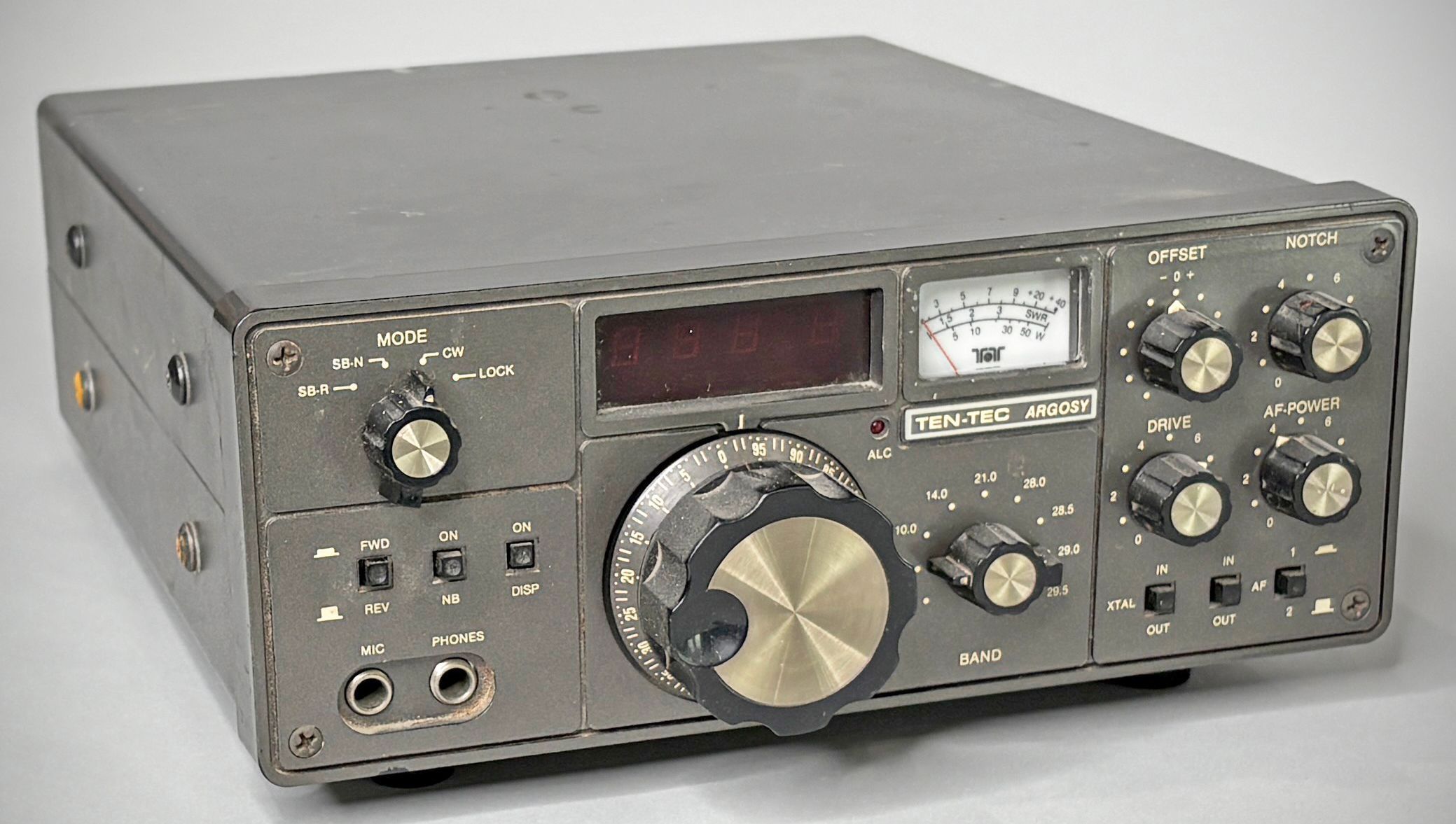
he Ten-Tec 525D Argosy II is the upgraded successor to the original analog 525. While they share the same core DNA—a compact HF rig with legendary full break-in (QSK) and a dual-power 5W/50W switch—the "D" model brought several refinements beyond just the digital display.
Here are the primary differences between the original 525 and the 525D:
1. Digital vs. Analog Display
525 (Argosy I): Uses a traditional circular analog dial. To know your frequency, you have to read the marks on the dial, which can be less precise.
525D (Argosy II): Features a 4-digit red LED digital display. It provides a direct frequency readout with an accuracy of approximately ±100 Hz.
2. The Power Switching Logic
There is a subtle but important technical difference in how the Hi-Lo (50W/5W) switch works:
525: In the "Lo" position, the final power amplifier is mechanically bypassed, leaving just the driver stages to provide the 5W output.
525D: The switching is handled differently; the Hi-Lo switch adjusts the TX ALC (Automatic Level Control) circuitry to limit the output of the finals, rather than bypassing them.
3. Receiver and Circuit Improvements
Strong Signal Handling: The 525D (particularly later serial numbers) features an improved receiver mixer. The original 525 used a lower-current mixer that was more prone to "overload" or distortion when strong signals were nearby.
Internal Layout: The 525D has revised circuit board numbering and some component value changes (especially on the AF/IF board) to reduce the "IF hiss" that some users complained about in the early 525 models.
Noise Blanker Compatibility: Because the front-end mixer was redesigned in the 525D, the optional plug-in Noise Blanker boards are specific to each version. If you are buying a 525D, you must ensure any added Noise Blanker is the correct model for that specific version
References
Use with the Heath HD-1410. QST, Jul 1982, p. 38.