Note
QST, Jun 1981, p. 118.
QST, Jan 1982 p. 177.
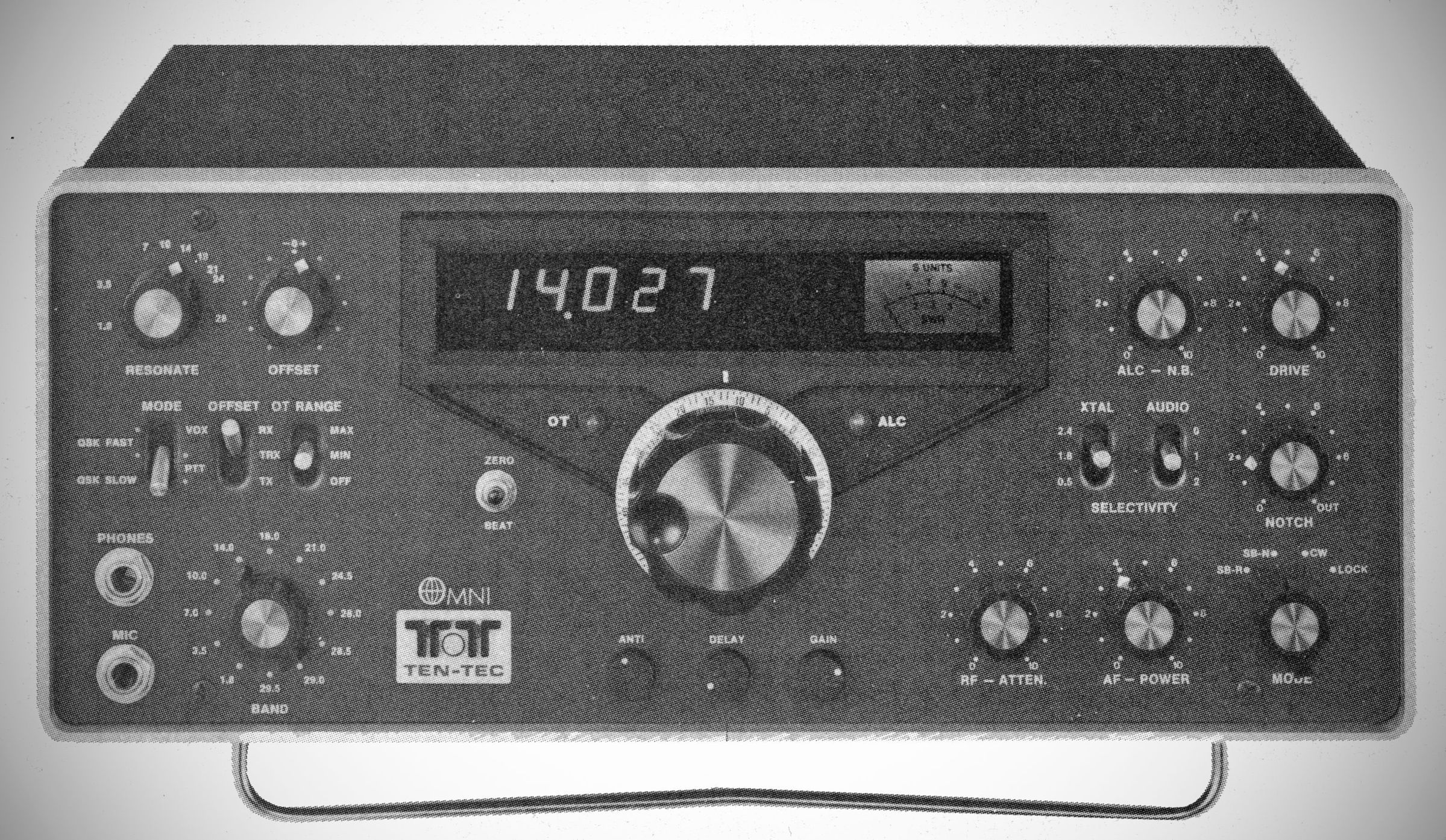
The Ten-Tec Omni C (Model 546C) is a solid-state HF transceiver designed for fixed, portable, or mobile amateur radio operation. It features a medium-power transmitter paired with a highly selective receiver.
Frequency Coverage & Tuning
– Amateur Bands: Factory-equipped with crystals providing transceive operation across the 160, 80, 40, 30, 20, 15, and 10-meter bands. (Provisions were originally included for 18 and 24.5 MHz bands upon future availability) .
– VFO Range: Each band segment covers a 500 kHz range with approximately 40 kHz of overrun on each band edge.
– Frequency Readout: A 6-digit, 0.43-inch LED display provides frequency accuracy down to 100 Hz. The least significant digit (100 Hz) is green, while the others are red.
– Tuning Rate: Driven by a Permeability Tuned Oscillator (PTO) vernier mechanism offering a typical rate of 18 kHz per revolution.
Transmitter Performance
– Power Input/Output: Supports up to 200 watts DC power input on CW and SSB modes (at 14 VDC), capable of a 100% duty cycle for up to 20 minutes. Typical RF power output ranges between 85 to 100 watts.
– "Tune-O-Matic" Band Changing: Eliminates traditional manual transmitter tune-up.
– Carrier and Sideband Suppression: Minimum of 60 dB carrier suppression and 60 dB sideband suppression (at a 1 kHz tone) using a 9 MHz, 8-pole crystal ladder filter and balanced modulator.
– Transmit T/R Switching: Offers standard PTT or VOX functionality on SSB, and instant break-in (QSK) on CW.
– CW Features: Built-in automatic 750 Hz CW offset and an internally generated CW sidetone with tone and volume adjustments independent of the main AF volume control.
Receiver Architecture
– Sensitivity: Tailored by band, scaling from 2.0 µV on the 1.8 MHz band to 3 µV on the 28 MHz band for a 10 dB S+N/N ratio.
– IF and Selectivity: Operates on a 9 MHz Intermediate Frequency. The standard setup includes a 2.4 kHz bandwidth 8-pole crystal ladder filter (1.7 to 1 shape factor). It can accept optional drop-in filters for 1800 Hz, 500 Hz, or 250 Hz bandwidths.
– Audio Filter Selectivity: Employs an audio filter centered at 750 Hz. It features selectable response curves, allowing a single-section 450 Hz bandwidth or a sharper four-section 150 Hz bandwidth.
– Interference Rejection: Features a built-in tunable audio notch filter capable of providing 50 dB of rejection from 250 Hz to greater than 6 kHz, alongside a high-dynamic-range IF-type noise blanker with a balanced noise gate.
– Front End Protection: Includes an 18 dB PIN diode RF attenuator to extend the unit's typical 90 dB dynamic range.
– Offset Tuning (RIT): Dual-range receiver offset tuning providing a "MAX" range of 4 kHz or a "MIN" range of ±500 Hz. A dedicated front-panel "Zero Beat" push button temporarily disables the offset for precise frequency alignment.
Power requirements: 12–14 VDC, 850 mA on receive and a maximum of 18.5 A on transmit. It is fully compatible with external matching AC power supplies (like the Ten-Tec Model 255 or 280).