Note
Abstract
Title: The Acorn Tube: A Milestone in Pre-WWII Very High Frequency (VHF) and Ultra High Frequency (UHF) Vacuum Tube Design
Background: In the late 1930s and early 1940s, traditional vacuum tubes faced severe performance limitations at high frequencies due to their underlying "lightbulb" architectural origins. To overcome these constraints, RCA introduced the "acorn" tube design, which served as a critical technological bridge for emerging Very High Frequency (VHF) and Ultra High Frequency (UHF) applications.
Methods & Structural Innovations: The acorn tube design fundamentally re-engineered vacuum tube physical dimensions. High-frequency limitations were mitigated by:
– Shrinking the physical dimensions of internal elements.
– Adopting a highly compact, specialized all-glass bulb geometry.
– Utilizing thick, radially arranged Dumet element leads to minimize inductance and capacitance.
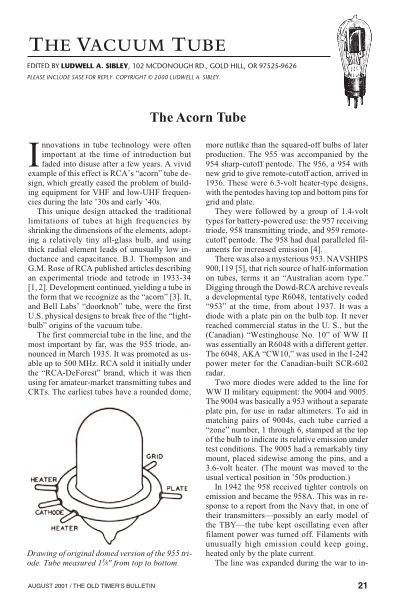
Evolution & Commercial Deployment: Following experimental triode and tetrode designs in 1933–1934 by B.J. Thompson and G.M. Rose, RCA commercialized the line in March 1935 with the 955 triode (rated up to 500 MHz). The product line expanded to include 6.3-volt pentodes (954, 956), low-voltage battery-operated variants (957, 958, 959), high-frequency WWII radar altimeter diodes (9004, 9005), and advanced seven-pin oscillator triodes (6F4, 6L4) capable of reaching 1200 MHz.
Applications & Legacy: Manufactured by several prominent U.S. and international firms during WWII, acorn tubes became indispensable components in pre-war and wartime military gear, including IFF transponders, radar receivers, and navigation aids. Despite their vital contribution to early radar and civilian test equipment, the commercial life cycle of the acorn tube was brief. By roughly 1941, newer, more advanced high-frequency technologies emerged, abruptly displacing the acorn line in favor of next-generation miniature and lighthouse tubes after a brief but impactful six-year operational zenith.
Keywords: Acorn tube, RCA, vacuum tube history, VHF/UHF, 955 triode, radar technology, World War II military electronics.