Note
Abstract
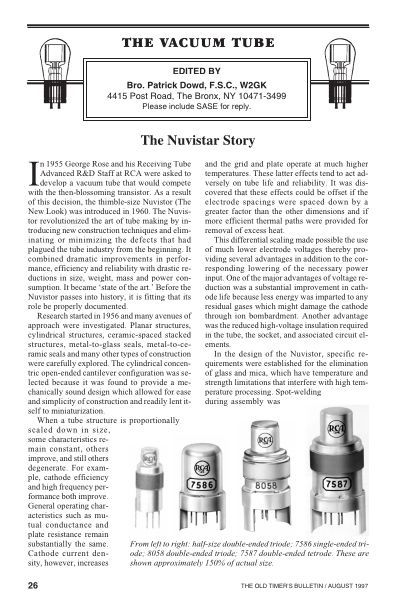
In response to the rapid rise of the transistor, George Rose and the Receiving Tube Advanced R&D Staff at RCA initiated research in 1956 to develop a highly competitive, modernized vacuum tube. Introduced in 1960, the thimble-sized Nuvistor ("The New Look") revolutionized traditional tube manufacturing by eliminating glass, mica, and spot-welding. Instead, it utilized a cylindrical concentric open-ended cantilever structure mounted onto a strong ceramic (forsterite) base-wafer, with components solidly held together via high-temperature brazing. This design allowed for differential scaling, which drastically reduced the tube's size, weight, and operating voltage while simultaneously boosting cathode efficiency and high-frequency performance.
The resulting all-ceramic-metal construction yielded unprecedented reliability and ruggedness, enabling Nuvistors to operate flawlessly under extreme conditions—including severe mechanical shock, continuous vibrations, high doses of radiation, temperatures of $350^\circ\text{C}$, and immersion in liquid nitrogen. The structural symmetry allowed for highly mechanized mass production and automated exhaust processing.
A full family of commercial entertainment and industrial Nuvistors—including triodes, tetrodes, and diodes—was deployed globally. Notably, the Nuvistor served as a cornerstone for the success of early 1960s color television sets for RCA and Zenith, and saw widespread implementation in military, scientific, and communications hardware. Over its 20-plus-year manufacturing lifespan (produced by RCA, Sylvania, and Japanese manufacturers), the Nuvistor established itself as the pinnacle of vacuum tube technology before eventually being superseded by the transistor.