Note
For nearly a century, The Radio Amateur’s Handbook (now officially titled The ARRL Handbook for Radio Communications) has served as the definitive bible of the amateur radio community. First published by the American Radio Relay League in 1926 under the guidance of F. E. Handy, it has evolved from a modest, paper-bound guide into a massive, multi-pound compendium of applied electronics, RF engineering, and practical station construction.
What makes the Handbook unique is its remarkable mirroring of technology's march over the last hundred years.
The Evolution of a Classic
– The Early Decades: The pages were filled with the mechanics of the "Golden Age" of radio—winding coils on oatmeal boxes, configuring regenerative receivers, and safely wiring lethal, high-voltage power supplies for glowing vacuum tubes.
– The Transistor Revolution: In the 1960s and 70s, solid-state circuitry began taking over, introducing operators to the nuances of bipolars, FETs, and eventually integrated circuits.
– The Modern Era: Today's editions seamlessly bridge the gap between traditional analog design and modern digital frontiers, covering software-defined radio (SDR), digital signal processing (DSP), and advanced data modes.
More than just a reference, the Handbook is an active workshop companion.
For generations of hams, engineers, and tinkerers, the Handbook hasn't just been something to read—it is something to use. Its enduring appeal lies in its balance of theory and practice. You can open it to find a rigorous mathematical explanation of transmission line theory, and on the very next page, find a practical blueprint for building a scratch-built antenna coupler or troubleshooting an audio hum.
Whether an operator is looking to restore a vintage rig or master the latest digital protocols, the ARRL Handbook remains an indispensable, living archive of the art and science of radio.
––––––––––––––
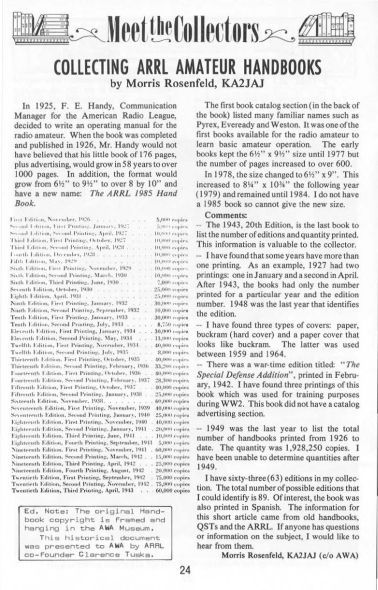
Tracking Data: The 1943 (20th) edition was the last to detail both the specific number of editions and the quantities printed. By 1948, the publisher stopped identifying the edition number entirely.
Total Print Run: The last year to record the grand total of handbooks printed since 1926 was 1949, reaching a total of 1,928,250 copies.
Cover Variations: The handbooks feature three cover types: paper, buckram (hardcover), and a faux-buckram paper cover utilized between 1959 and 1964.
Special Editions: A "Special Defense Edition" was printed in February 1942 for WWII training purposes; it spanned three printings and omitted the traditional advertising section. The handbook was also published in Spanish.