Note
QST, May 1964, p. 7.
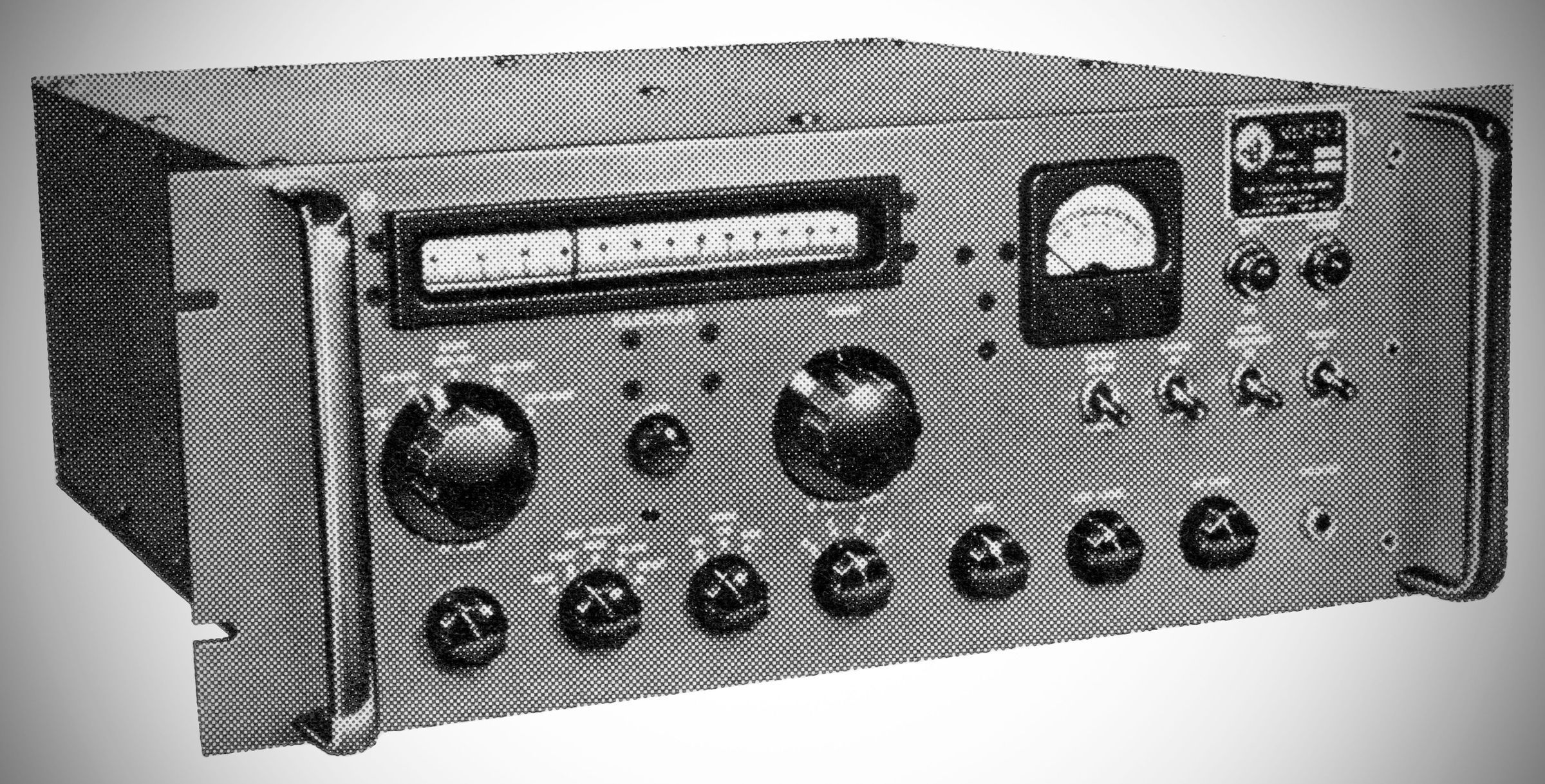
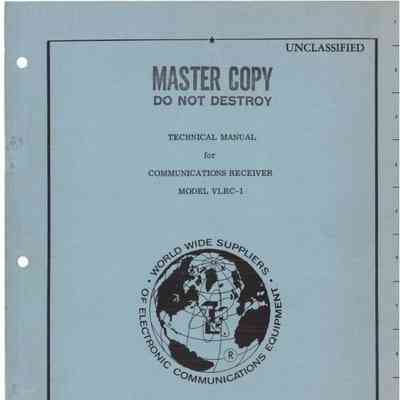
The TMC Model VLRC-1 is a commercial/military, fully solid state double-conversion superheterodyne communications receiver manufactured by The Technical Materiel Corporation (Mamaroneck, N.Y.). Introduced in 1964. It is designed for continuous duty reception of low-frequency (LF) and very-low-frequency (VLF) signals.
The VLRC-1 is built into a standard 19-inch rack-mount enclosure. It utilizes a motherboard chassis that houses seven plug-in module assemblies:
1. Three RF Band Modules (A4604-1, -2, -3)
2. Local Oscillator Module (A4605)
3. 6.5 MC Oscillator Module (A3655)
4. 6.4 MC IF, AGC, and Noise Silencer Module (A3661)
5. 100 KC IF Module (A4603)
6. BFO, Product Detector, and 600 Ohm Audio Amplifier Module (A3638)
7. Power Supply and Audio Amplifier Module (A3634)
Frequency Range: 10 kHz to 40 kHz, divided across three selectable tuning bands:
Band 1: 10 to 16 kHz
Band 2: 16 to 25 kHz
Band 3: 25 to 40 kHz
Modes of Reception: AM, AME, CW, MCW, FAX, and FSK out of the box. Independent Sideband (ISB) and Single Sideband (SSB) reception are supported when connected to an external sideband converter (such as the TMC Model LFCA-1).
Tuning System: Continuous tuning using magnetic core inductors. It can also be controlled by an external synthesizer (such as the TMC Model LFSB-1) in 10 Hz increments.
Frequency Stability: Unsynthesized stability is 0.01% of operating frequency after warm-up. Synthesized stability depends on the external frequency standard.
Specifications
– First Intermediate Frequency (IF): 6.4 MHz with an 8 kHz bandpass.
– Second Intermediate Frequency (IF): 100 kHz with a selectable bandpass of 0.1 kHz or 0.5 kHz via a front-panel switch.
– RF Bandpass: Minimum of 0.5 kHz across all bands.
– Local Oscillator: Operates from 110 kHz to 140 kHz (always 100 kHz above the incoming RF frequency). The LO signal is mixed with a crystal-controlled 6.5 MHz oscillator to produce a 6.36 to 6.39 MHz spectrum signal, which is then mixed with the amplified RF to yield the 6.4 MHz first IF.
– Sensitivity: A 0.3 microvolt signal at the 50-ohm antenna input produces a 15 dB signal-plus-noise-to-noise ratio ($S+N/N$) at a 0.5 kHz bandwidth.
– Image Rejection: At least 80 dB down referenced to a 0.3 microvolt input.
AGC System: Maintains audio output within $\pm3$ dB for a 100 dB change in input signal from 0.3 microvolts. AGC decay times are front-panel selectable for FAST (3.3 seconds), MED (9.9 seconds), or SLOW (16.5 seconds). Manual and remote AGC control are also provided.
Noise Silencer: Features an IF type impulse noise silencer using a Schmitt trigger and noise gate to mute the receiver during high-amplitude noise spikes.
Audio Outputs:
A 600-ohm balanced center-tapped line output delivering 0 dBm.
A 4-ohm output delivering 0.5 watts average power for a speaker, along with a front-panel 1/4-inch monitor jack for headphones.
Power Requirements
It runs on standard 115/230 VAC, 50/60 Hz primary power consuming around 15 watts. It also supports automatic emergency switchover to an external 24 volt battery supply, which is maintained via an internal trickle charger.
See also closely related VLRB-1.