Note
"Message Memory Keyer"
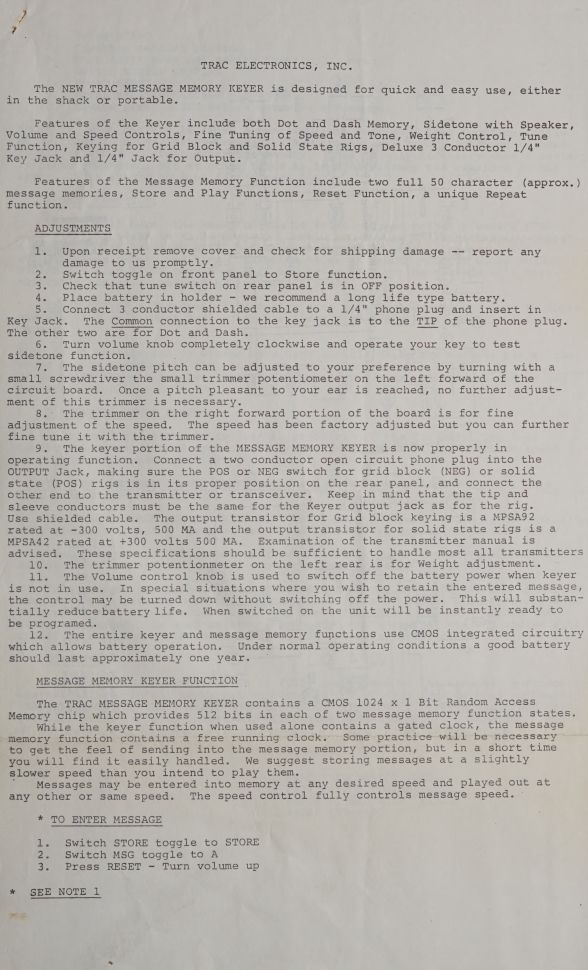
The attached PDF *probably* refers to the TE-201.
The TRAC TE-201 Message Memory Keyer utilizes CMOS integrated circuitry to ensure low power consumption for battery-powered operation.
Keyer & Memory Features
– Dual Memory Slots: Provides two full 50-character message memories (A and B).
– Clock Systems: Features a gated clock for standard keyer functions and a free-running clock for the message memory portion.
– Operating Modes: Supports Iambic operation when used with a dual-paddle squeeze key.
– Standardized Jacks: Equipped with a deluxe 3-conductor 1/4" Key Jack and a 1/4" Output Jack.
– Memory Controls: Includes dedicated functions for Store, Play, Reset, and a unique Repeat function.
Controls and Adjustments
– External Controls
Volume & Power: The volume knob includes an integrated power switch; turning the volume down without clicking it off retains stored messages but significantly reduces battery life.
Speed: Controls the overall sending and playback speed.
Message Toggles: Front panel switches to select between Store/Play and Message A/B.
Functional Buttons: Dedicated Reset (which also acts as a Stop function) and Start buttons.
Rear Panel: Features a Tune switch (must be OFF for standard use) and a POS/NEG switch to select between solid state and grid block rigs.
Internal Trimmer Adjustments
– For fine-tuning, the device includes three internal potentiometers located on the circuit board:
Sidetone Pitch: Adjusted via the trimmer on the left forward portion of the board.
Fine Speed: Adjusted via the trimmer on the right forward portion of the board.
Weight: Adjusted via the trimmer on the left rear of the board.
Operational Logic
– Repeat Function: A message will automatically repeat once if the user omits pressing Reset before pressing Start for playback.
– Gap Filling: Messages can be stored with deliberate gaps, allowing the operator to manually key in specific details (like a log number or signal report) during playback.
– Programming Hint: It is recommended to store messages at a slightly slower speed than the intended playback speed.
– Memory Maintenance: When first connecting a battery, it is suggested to "clear" memories A and B by cycling through a Store/Reset/Start sequence
Technical Specifications
– Circuitry: CMOS Integrated Circuitry
– Memory Capacity: 1024 x 1 Bit Random Access Memory (RAM)
– Message Storage: Two message memories, approximately 50 characters (512 bits) each
– Solid State Output: MPSA42 transistor; rated at +300V, 500mA (POS switch position)
– Grid Block Output: MPSA92 transistor; rated at −300V, 500mA (NEG switch position)
Power Source: 9V Battery (Long-life type recommended)
Battery Life: Approximately one year under normal operating conditions