Note
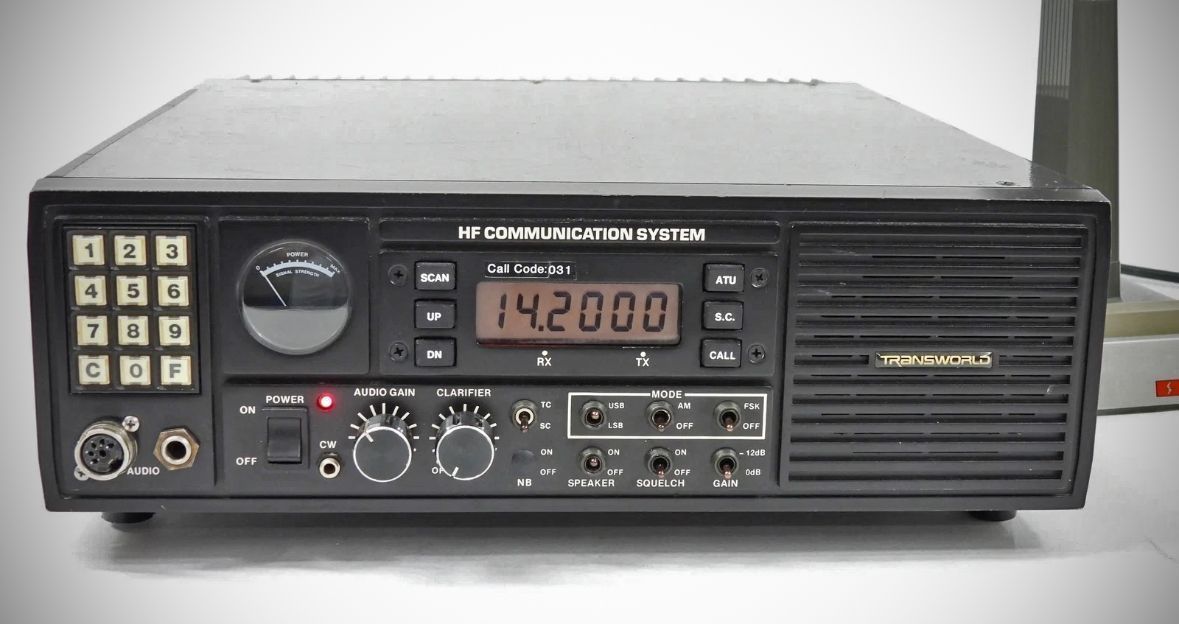
The Transworld TW100 is an advanced, microprocessor-controlled solid-state HF transceiver designed and manufactured in the United States. It provides versatile communication capabilities across the entire HF spectrum for voice, telegraphy, and radioteletype applications. Designed primarily for governmental and industrial users.
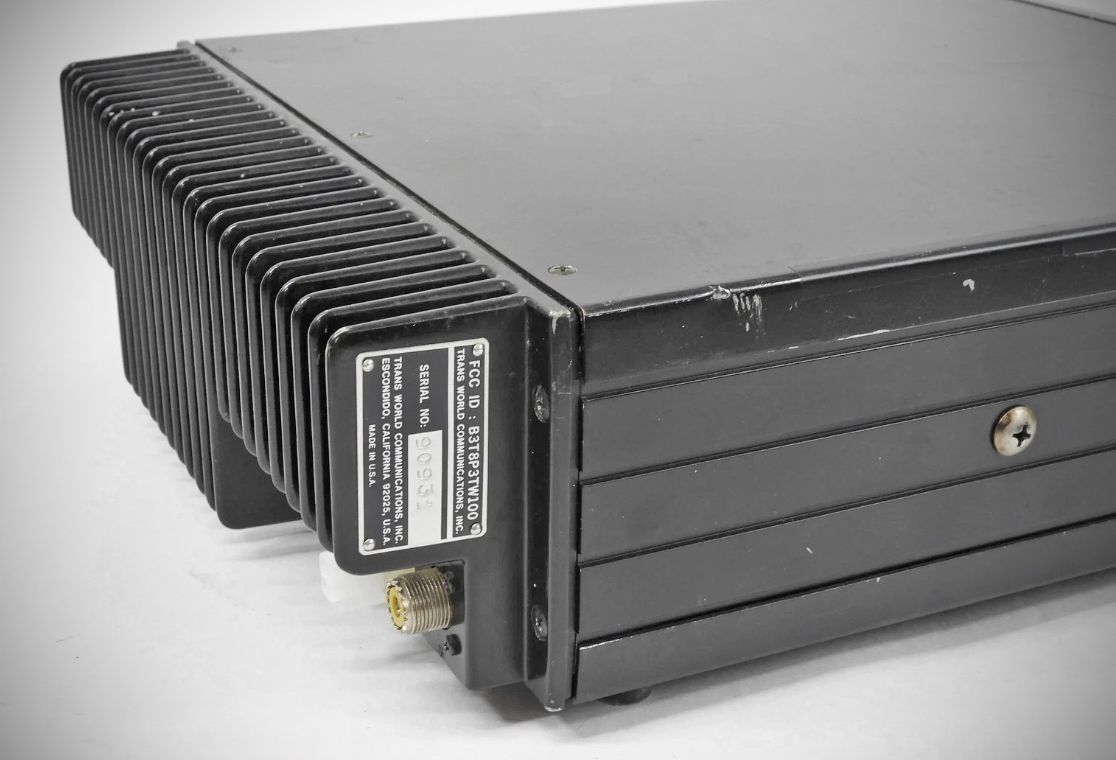
The TW100 features a rugged, modular design built specifically to endure severe environmental conditions. Its chassis consists of a diecast front panel and a massive rear heatsink joined by aluminum side extrusions, utilizing stainless steel external hardware. The main circuitry is housed inside six separate diecast boxes that offer complete RF shielding and environmental protection, allowing modules to be easily swapped for simple field service.
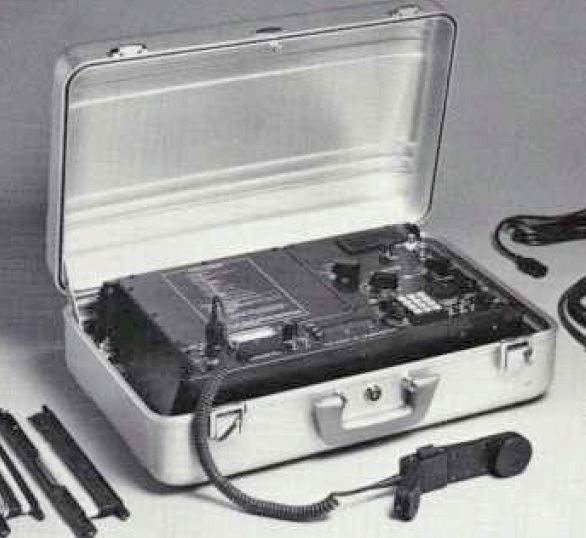
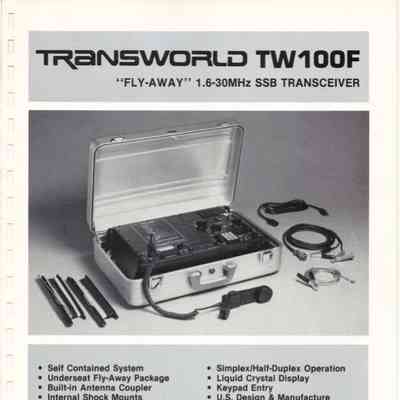
A special version (TW-100F) is designed for quick "Fly Away" operation. Completely self contained in an aluminum skinned attache-type case, and small enough to meet IATA underseat requirements, the TW100F includes all the accessories necessary to quickly establish long distance HF communications from temporary field locations. Included are: AC and DC Power Cables, Ground Strap, Handset, and two section longwire antenna. The TW100F operates directly from 115/230V 50-400Hz AC or 12VDC power sources.
Features
– Frequency Range & Tuning: Covers 1.6 to 30 MHz in synthesized 100 Hz steps (or optional 10 Hz steps). It supports continuous keypad entry via a free-tuning channel (Channel 00) and features up/down pushbutton tuning.
– Memory & Scanning: Equipped with 100 memory channels to store simplex or half-duplex frequencies. It features an automatic scanning mode that can scan up to 98 channels.
– Power Output: Delivers 125 Watts PEP and 100 Watts Average power output. The transmitter includes automatic overload protection against thermal issues and antenna mismatches (such as open or shorted antennas).
– Display & Interface: Features a large, easily read Liquid Crystal Display (LCD) to show the channel number and frequency, paired with a front-panel keypad for direct entry.
– Audio Systems: Integrates a noise-immune, voice-derived syllabic squelch system to reduce background noise. The transmitter utilizes a VOGAD (Voice Operated Gain Adjusting Device) to ensure constant audio level and maximum output regardless of the operator's voice level.
Operating Modes
The transceiver features three internal switch-selectable operational modes to secure programming and prevent unauthorized adjustments:
– Mode 1: Full flexibility; memory channels and the continuous tune channel can be programmed directly from the keyboard.
– Mode 2: Memory channels are locked and cannot be changed, while the continuous tune channel operates in receive-only mode.
– Mode 3: Only pre-programmed memory channels function; frequency changing and the frequency display are entirely disabled.
Note: A distinct model variant, the TW100SX, is permanently stripped of frequency display capabilities and requires an external programming unit to alter channel memories.
Specifications
– Frequency Range: 1.6 to 30 MHz in 100 Hz synthesized steps (10 Hz optional with HS10 upgrade).
– Frequency Entry: Keypad-controlled microprocessor.
– Channels: 100 Simplex and Half-Duplex channels.
– Channel Programming: Mode 1 allows front panel entry; Modes 2 and 3 are internal (SX models require an external programmer).
– Continuous Entry: Channel 00 via keypad; Mode 1 allows Transmit & Receive entry, Mode 2 is Receive Only, and Mode 3/SX models disable it entirely.
– Frequency Display: 6-digit LCD via keystroke (locked out in Mode 3 and SX models).
– Incremental Tuning: Up & Down pushbutton switches for receive only in 100 Hz steps.
– Scanning: Automatic scanning across 2 to 98 channels.
– Antenna Impedance: 50 Ohms via an SO-239 connector.
– Frequency Control/Stability: ±0.0001, ±20 Hz} maximum (improves to 1 part in 10^7 with the HS10 option).
– Operating Modes: A3J (USB standard, LSB optional), A3A (SSB reduced carrier), A3H (compatible AM), A1 (CW), and F1 (teletype/FSK optional).
– TX/RX Switching Time: 20 ms maximum.
– Environmental/Ruggedness: Operating temperature range of -30º to +60º; shock and vibration testing methods in accordance with MIL-STD-810D.
– Power Output: 125 Watts PEP, 100 Watts Average (F.C.C. Type Accepted for Parts 81, 83, 90, and 97 at 120 Watts).
– Overload Protection: Protected against thermal overload and impedance mismatches, including open or shorted antennas.
– Carrier Suppression: Greater than –50 dB.
– Harmonic Suppression: –63 dB (except below 2 MHz).
– Unwanted Sideband Rejection: 60 dB at 1 kHz typical.
– Spurious Suppression: Greater than –63 dB.
– Audio Input: 150 Ohms with VOGAD for a constant audio level; 600 Ohms 0 dBm available on the rear connector.
– Audio Bandwidth: 300 Hz to 2700 Hz (optional wideband 300 Hz to 3100 Hz available).
– Intermodulation Distortion: –32 dB typical.
– ALC: Less than 1 dB increase in output for a 20 dB increase in audio input.
– Metering: Front-panel relative RF output meter (calibrated to 100 Watts full scale).
– Sensitivity: 0.35 uV for 10 dB SINAD (includes a front-panel selectable 12 dB attenuator).
Selectivity: 300 to 2700 Hz at –6 dB; 60 dB at 5 kHz (Optional: 300 to 3100 Hz at –4 dB.
– Image & IF Rejection: Greater than 80 dB.
– Intercept Point: +11 dBm standard (+23 dBm with the front panel attenuator activated).
– Intermodulation: 85 dB.
– Clarifier Range: ±125 Hz minimum, ± 70 Hz in calibrated digital 10 Hz steps when equipped with the HS10 option).
– Squelch: Audio-derived, noise-immune syllabic type.
– Audio Output: 4 Watts into 3 Ohms delivered to the internal loudspeaker; separate 600 Ohm 0 dBm squelched and unsquelched line outputs on the rear panel.
– Metering: Front-panel relative signal strength (S-meter)
Power Requirements
DC Input: 13.6 VDC ±20%: 620 mA on receive, 12 A average on tansmit (SSB).
Optional DC Input: 28 VDC nominal (20–32 V): 350 mA on Receive, 7 A Average on Transmit (SSB).
AC Input: Internal AC power supply support for 110/230 V ±10%, 50/60 Hz for SSB operation.
Options & Accessories
The capabilities of the TW100 can be expanded via several internal options and system accessories:
– TRANSCALL Adaptive System: An internal microprocessor-controlled option that automates path evaluation on up to ten channels, dynamically selecting the best available channel based on signal strength and the lowest error rate.
– SELCALL Selective Calling: Enables digital selective calling for up to 256 stations per system, complete with an automatic transpond acknowledge feature.
– Antenna Tuners: Connects to the companion AT100 (or the AT100/M memory version for scanning systems) to automatically match the radio to wire or whip antennas in approximately 1 second.
– Linear Amplifiers: Compatible with all-solid-state companion amplifiers, boosting output to either 500 Watts PEP (TW500A) or 1000 Watts PEP/Average (TW1000A).
Power & Control Upgrades: Includes options for internal AC or 28V DC power supplies, a high-stability oscillator (HS10) providing 1 part in $10^7 stability, a pulse-type noise blanker, lower sideband operation, and RS232 computer or remote control capabilities.