Note
CQ, Feb 1965, p. 100.
QST, May 1965, p. 168.
QST, Jul 1966, p. 161. List of all models.
QST, Dec 1967, p. 158. List of models.
QST, Apr 1969, p. 141. List of new models.
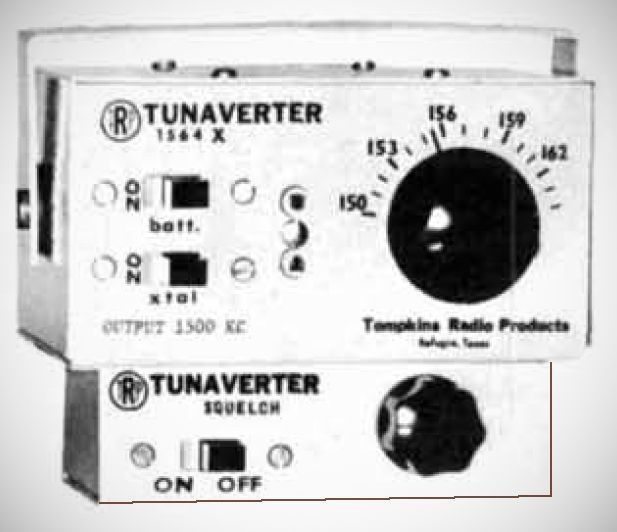
Popular Electronics, Jan 1969, p. 24. (Model SU add-on squelch)
Ham Radio, Dec 1969, p. 90. (pro-line, s-line, sc-line)
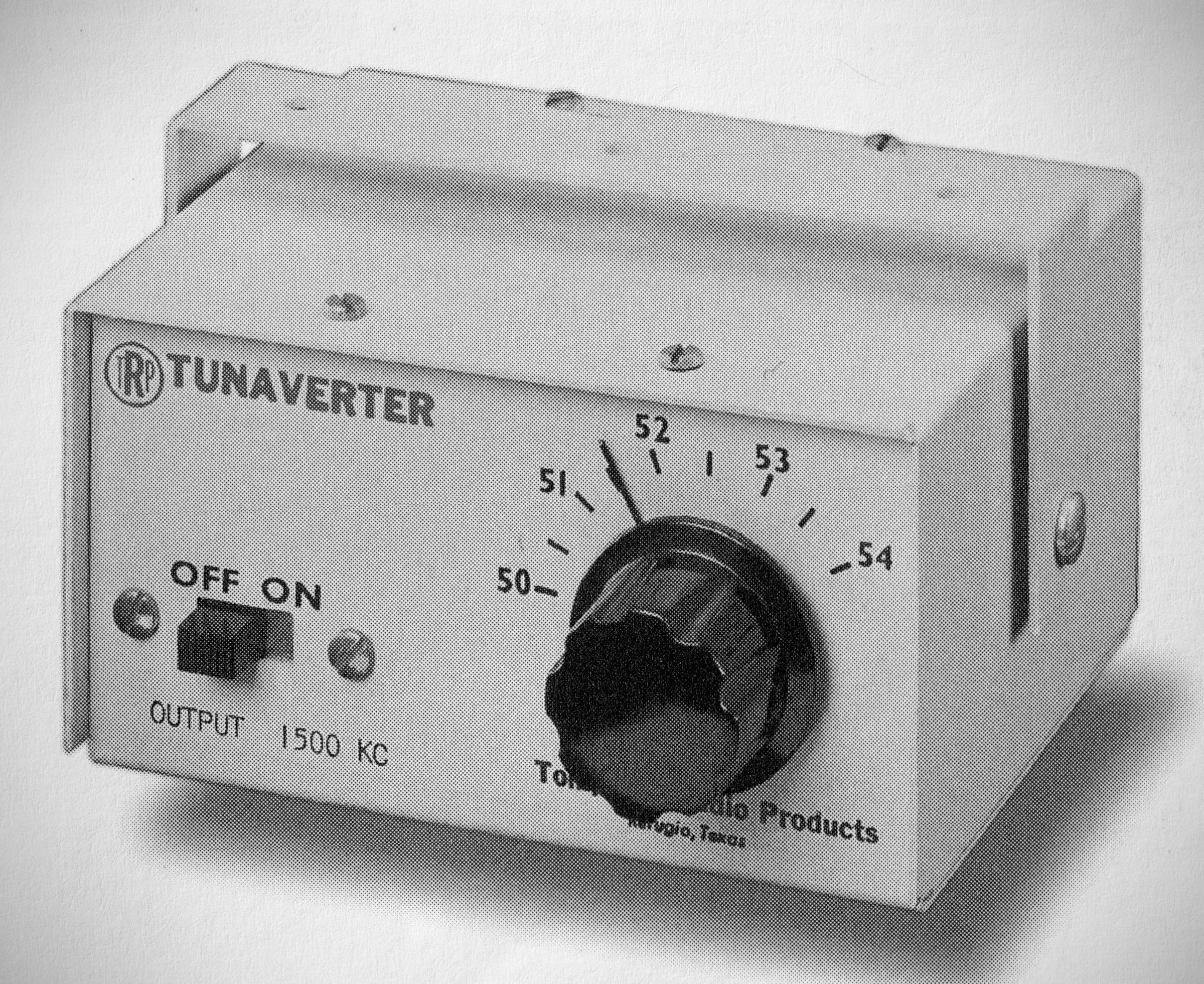
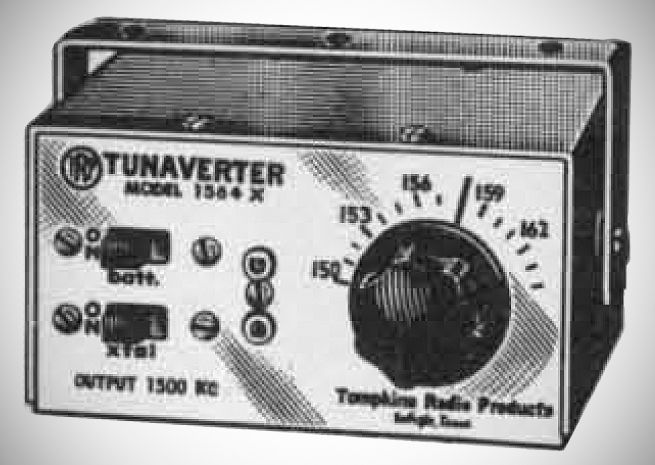
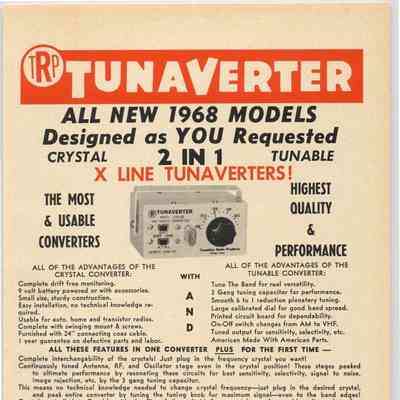
The Tunaverter from Tompkins Radio Products was a tunable converter, just as its name implies, but it could also be crystal-controlled on a fixed frequency. The output frequency of the Tunaverter was 1500 kHz. Tompkins made them for the 160-10 meter amateur bands as well as for other services. The Tunaverter was power by an internal 9 volt battery. Introduced in the mid-1960s, these devices were designed to expand the frequency coverage of standard AM broadcast receivers—particularly car radios and small portable transistor radios—allowing them to receive amateur radio bands, marine frequencies, shortwave broadcasts, or public safety and utility bands.
Car Radio Integration: Intended primarily for vehicle use, the unit includes a mounting gimbal, 50-ohm input impedance, muting terminals for operation alongside a transmitter, and switching to route signals directly between a regular car antenna, a ham antenna, and the car receiver.
The Tunaverter converts incoming high-frequency or VHF signals down to an intermediate output frequency that matches standard broadcast receivers (typically tuned near 550 kHz or around 1500 kHz). When paired with a car radio, the car unit serves as the receiver's IF amplifier, detector, and audio stage.
For portable use, coupling to a simple transistor radio could be achieved inductively by wrapping a few turns of wire around the portable radio's internal ferrite loopstick antenna. Specific models were also tailored for specialized station setups; for instance, the BFO-less Model 80 (80-meter band) provided a 550 kHz IF output specifically suited for driving surplus Command Set receivers like the BC-453 "Q-5'er" for Novice-class CW operation.
At its core, the base receiving circuit uses a single-transistor autodyne converter layout featuring ganged tuning for the oscillator and antenna stages.
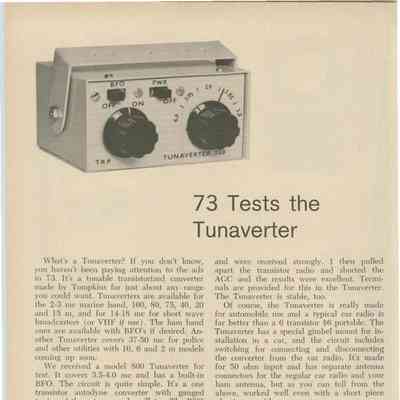
Models targeted at amateur radio operators (such as the Model 800 covering 3.5–4.0 MHz) incorporate a separate single-transistor, tunable Beat Frequency Oscillator (BFO) to beat against incoming signals for CW and Single Sideband (SSB) reception.
Frequency Coverage Options: TRP produced various dedicated fixed-band models, including coverage for the 2–3 MHz marine band, amateur bands (160, 80/75, 40, 20, and 15 meters), shortwave broadcast allocations (14–18 MHz), and VHF high/low utility bands (such as 37–50 MHz for police/public service).
References
Brief description. Popular Electronics, Apr 1968, p. 22.
Tunaverter squelch module. Ham Radio, Jan 1969, p. 72.