Note
Service magazine, Jan 1935, p. 9.
Radio Craft, Mar 1935, p. 552.
QST, Apr 1935, p. 91.
Allied catalog 1936, p. 87.
Introduced in early 1935 as a follow-up to the All-Star Senior, the All-Star Junior was an affordable, five-tube shortwave superheterodyne receiver kit tailored for budget-conscious amateurs and shortwave listeners during the Great Depression. Promoted heavily by Lawrence Cockaday in Radio News and distributed by jobbers like Allied Radio, it offered a gateway to advanced radio circuitry at a fraction of the cost of commercial units.
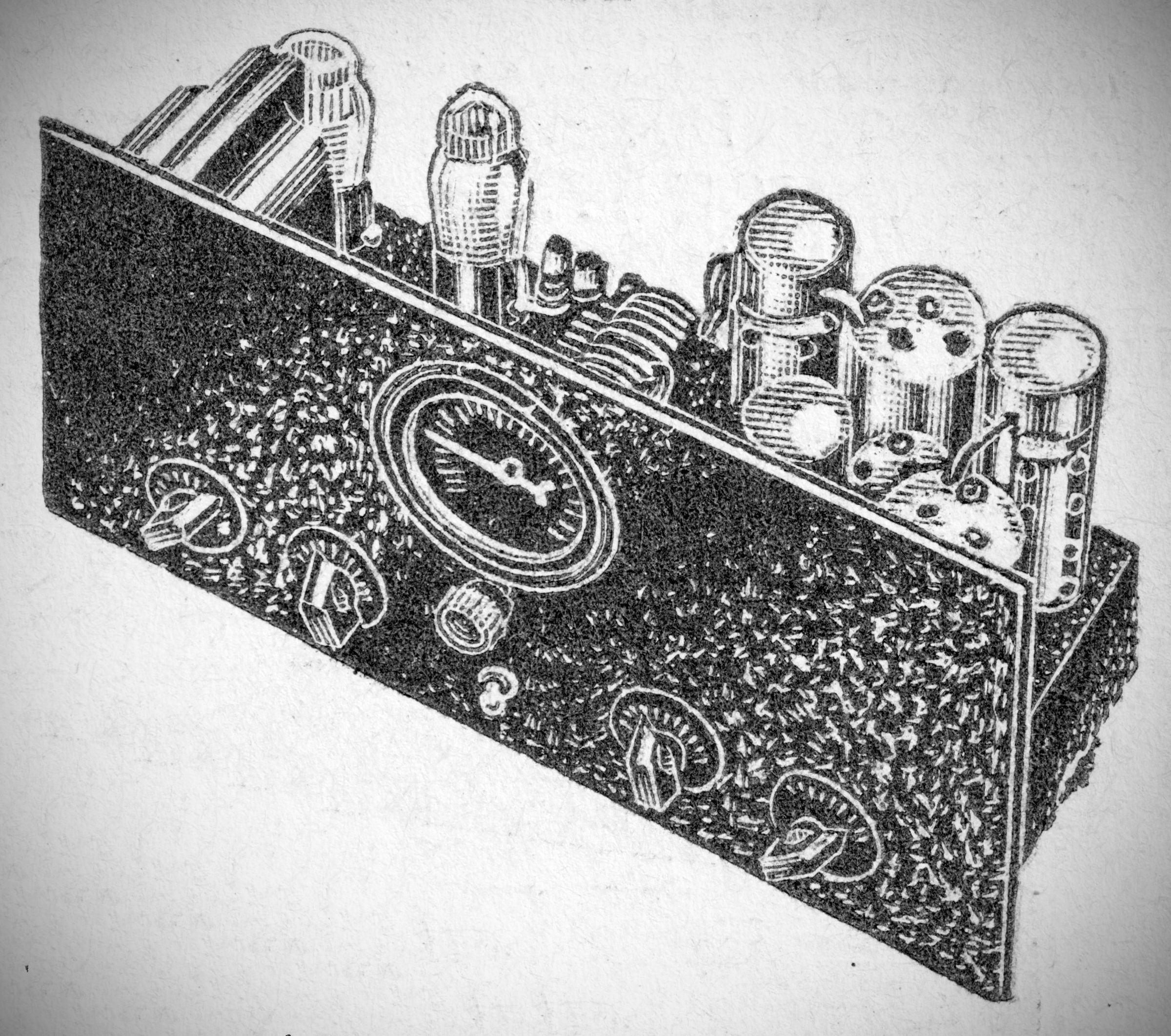
The receiver was built on a formed and punched metal chassis paired with an 8 x 16 front panel, matching the layout of the original Senior model but finished in a distinct black crystalline coat with updated knobs.
The front layout featured a prominent central Crowe airplane-type logging dial controlling a Hammarlund dual 35-pF band-spread capacitor. It was flanked by separate 140-pF variable tuning capacitors used to manually band-set the local oscillator and antenna circuits. Additional controls included a BFO switch, a gain control coupled with the AC power switch, and a "local-distance" switch.
The All-Star Junior streamlined its predecessor's design to save on components, omitting features like a headphone jack and an interstage audio transformer to lower the cost.
Superheterodyne (lacked an RF preselector stage)
Frequency Coverage: 540 kHz to 30 MHz (550 to 10 meters) across 6 bands
IF: 370 kHz
Tuning Mechanism: Meissner plug-in coils (two per band segment)
Tube Lineup
A major upgrade over the Senior version was the transition to more advanced 6-volt tubes rather than older 2.5-volt types. The 5-tube lineup consisted of:
– 6A7: First detector / Pentagrid converter
– 6F7: A dual-purpose tube serving simultaneously as the 370-kHz IF amplifier and the Beat Frequency Oscillator (BFO)
– 77: Second detector
– 42: Audio power output
– 80: Full-wave rectifier
Because it lacked an RF preselector or AVC, the receiver had broad selectivity and was prone to image responses, particularly on the higher shortwave frequencies. The "local-distance" switch helped compensate for overloading by adjusting the cathode bias on the 6A7 converter when handling strong local signals. While basic by modern standards, a well-restored unit remains a highly energetic little receiver capable of pulling in plenty of signals across the bands.
References
Radio Craft, Mar 1935, p. 535.
Lafayette catalog number 59, p. 109.
Build the All Star Junior. Radio News, Mar 1935, p. 542.
Building the 5 Tube All Star. part 1. Radio Craft, Mar 1935, p. 534.
Built this 5 Tube All Star Junior, part 2. Radio Craft, Apr 1935, p. 598.
Money Making with the All Star Jr. Radio Craft, May 1935, p. 666.
Informal Tests. Radio News, Apr 1935, p. 615.