Note
See:
http://www.antiqueradio.com/Aug03_Boyd_AllStar.html
Radio News, Sep 1934, p. 188, 189.
Lafayette catalog number 59, p. 109.
Radio Craft, Mar 1935, p. 552.
Allied 1935 catalog, p. 83.
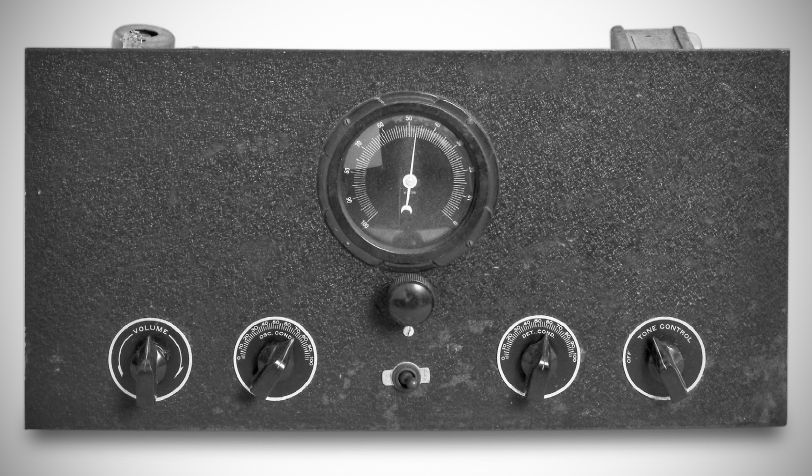
Introduced in late 1934, the All-Star (and its later evolution, the All-Star Senior) was a superheterodyne shortwave receiver designed during the Great Depression. Conceived as a low-cost kit radio, it was popularized by Laurence M. Cockaday in Radio News.
Rather than being produced by a single company, it was a collaborative design co-sponsored by a group of prominent component manufacturers who self-proclaimed themselves the "Stars".
The receiver was marketed primarily through an affordable "foundation unit" that cost $2.50 from mail-order houses like Allied Radio and Lafayette.
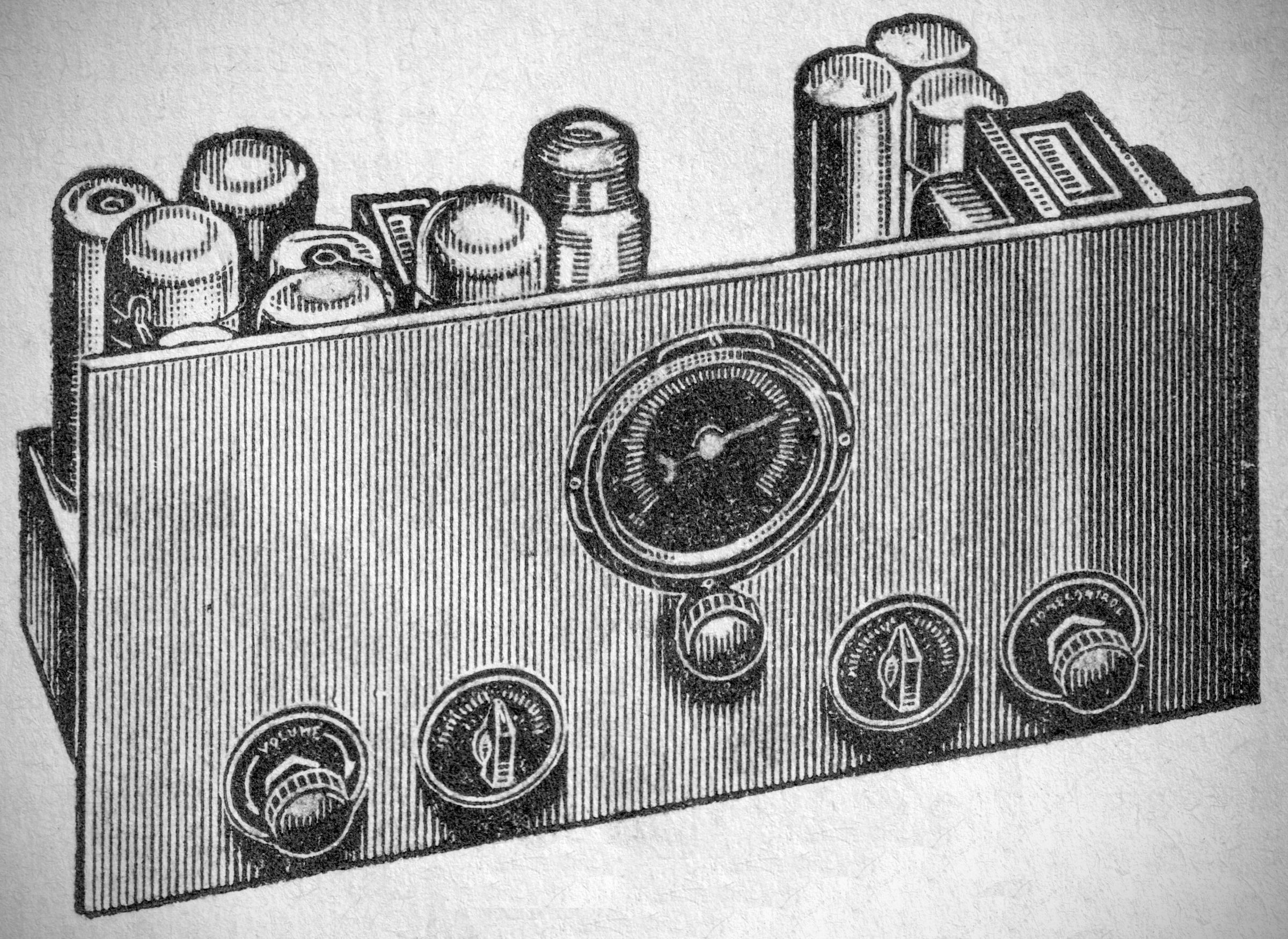
The basic package contained a pre-punched metal chassis, a front panel, a small coil shield, a schematic, and step-by-step assembly instructions.
The center of the front panel featured a distinctive Crowe "airplane-type" dial controlling a Hammarlund dual 35-pF band-spread condenser. Two additional 140-pF units were used to manually band-set the local oscillator and antenna circuits.
Band changing was handled manually via Meissner plug-in coils. Sets were standard for the 80-, 40-, and 20-meter amateur bands, with subsequent coils manufactured for 10 meters, 160 meters, and the standard AM broadcast band.
The chassis was specifically pre-drilled to fit specific components from its co-sponsors:
– Thordarson (transformers and chokes)
– Hammarlund (condensers)
– Meissner (coils and IF transformers)
– Ohmite (resistors)
– Cornell-Dubilier (capacitors)
– Belden, Electrad, and Crowe (wire, misc)
To minimize the total ~$34 cost of parts, builders often salvaged general hardware like tube sockets, shields, and volume controls from old broadcast radios.
The receiver was notable for its distinct superheterodyne architecture:
Tube Lineup (Original 2.5-Volt Version):
(1) 2A7: Pentagrid converter / mixer
(2) 58: Pentodes used as Intermediate Frequency (IF) amplifiers
(1) 56: Triode power detector
(1) 2A5: Pentode audio output amplifier
(1) 80: Full-wave rectifier
The receiver utilized an unusual 370 kHz IF system provided by Meissner transformers, offering high gain and reasonably sharp selectivity.
To allow for CW (Morse code) reception, an optional BFO circuit was added via an extra 58 tube and a specialized BFO coil.
No Automatic Volume Control (AVC): The gain of the IF stages was manually adjusted via a potentiometer in the cathode circuit.
It typically paired with an external electro-dynamic speaker (such as an 8-inch Jensen) utilizing a 2500-ohm field coil. The audio transformer was mounted directly on the speaker frame, plugging into the receiver chassis via a four-wire cable.
⚠️Safety Note: The original schematic features a "hot" phone jack layout. When operating or restoring an original unit, it is crucial to ensure the headphone jack is properly insulated from the chassis and to never use a headphone plug with an exposed metal shell.
References
Construction article. Radio News, Sep 1934, p. 146.
More on the All Star. Radio News, Oct 1934, p. 235.