Note
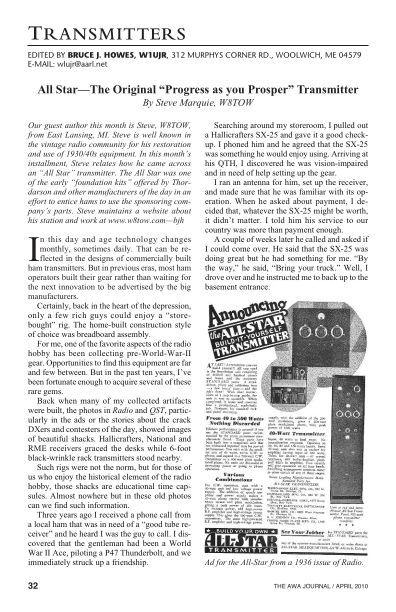
Introduced in 1936, the All Star Transmitter was an early "build-it-yourself" foundation kit marketed as the original "progress as you prosper" rig. Instead of forcing amateur radio operators to purchase an expensive, fully assembled "store-bought" system all at once, it allowed hams to build a basic transmitter and expand its power and capabilities in stages over time.
The Consortium: The kit was a joint venture between prominent manufacturers of the era to promote their standard parts. It featured Thordarson transformers, Hammarlund condensers, Crowe knobs and nameplates, and components from Cornell-Dubilier, Triplett, Ohmite, and Johnson.
Designed for standard rack-and-panel mounting, the complete high-power setup spans seven individual decks connected via wiring harnesses. It was highly regarded for its perfect front-panel symmetry, clean layout, and professional "factory-built" look, contrasting with the messy "breadboard" style common during the Great Depression.
Scalable Configurations
The transmitter was highly modular, allowing hams to expand the system without discarding any previously purchased components:
– 40-Watt Base Unit: The system starts as a 40-watt crystal-controlled CW transmitter and low-voltage power supply.
– 40-Watt Phone Rig: Adding a speech amplifier and modulator deck upgrades the base unit to an AM phone transmitter with a peak power of 100 watts.
– 400 to 500-Watt High-Power Rig: By adding a high-power R.F. amplifier, a high-voltage power supply, and a 200-watt modulator deck, the system scales up to a 500-watt CW transmitter or a 400-watt plate-modulated AM phone system (achieving 1,600 watts of peak power).
Bands: Operates across the 20, 40, 80, and 160-meter bands.
Tube Lineup: Features a 47 crystal oscillator, an 802 buffer/doubler, and a pair of 802s configured in push-pull for the final amplifier stage.
Designed so that no neutralization is required. The deck utilizes a single milliampere meter with individual toggle switches for each stage, allowing operators to tune each stage sequentially during setup.
References
Review. Radio News, May 1936, p. 665.