Note
QST, Feb 1979, p. 1.
QST, Dec 1980, p. 1. (last ad)
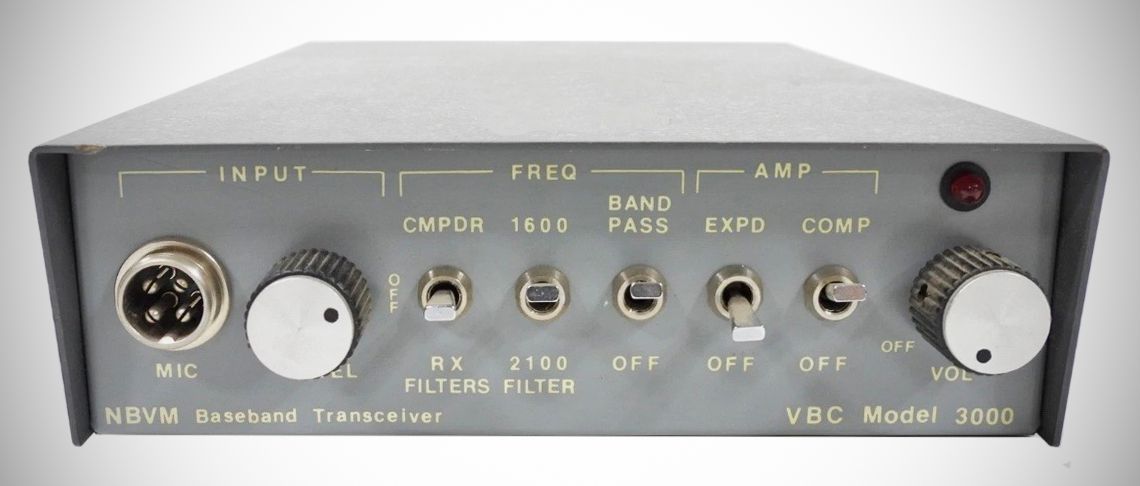
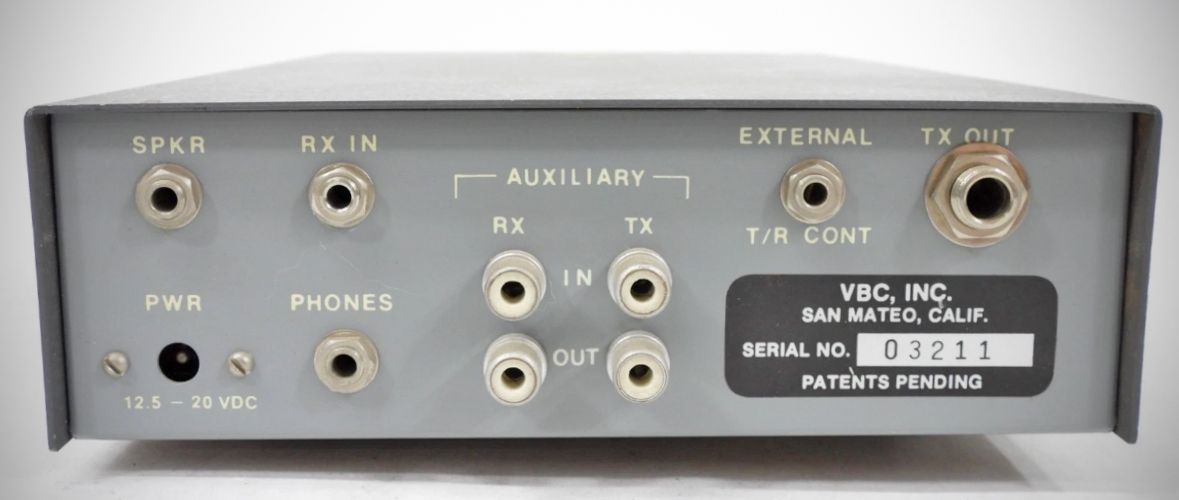
The VBC Model 3000 is a NBVM Baseband Transceiver. NBVM stands for Narrow Band Voice Modulation. Despite having "transceiver" in its name, it is not a standalone radio. It is an outboard audio processing unit designed to interface with existing transmitter or transceiver.
Its primary purpose was to heavily process microphone audio to significantly reduce the transmitted bandwidth of voice signals. This was achieved through amplitude companding—compressing the dynamic range of the audio before transmission and expanding it upon reception. The objective was to nearly double of the number of signals that could occupy a given segment of radio spectrum.
Produced by the Variable Speech Control (VSC) Corporation in the late 1970s and early 1980s, this device was intended to solve the problem of crowded radio spectrums.
The technology was first described in the December 1977 issue of QST. A year later, in the November 1978 issue, a practical system was announced, and in the February 1979 issue, Henry radio advertised a commercial product--the VBC-3000.
ARRL was very optimistic, calling NBVM "...one of the biggest breakthroughs in amateur radio in three decades." Henry Radio's ad described it as "the most important innovation in amateur radio since SSB." ARRL was sufficiently enthralled with NBVM so as to include the VSB-3000 in the 1979 issue of the Radio Amateur's Handbook.
While the technology was innovative, it never achieved widespread adoption in the amateur or commercial markets, and ultimately sputtered into obscurity. The processed audio often had a distinct "watery" or robotic quality, and because both the sender and receiver required the same proprietary hardware, the barrier to entry was high.
The last QST ad for the VBC-3000 was in the December 1980 issue. It was effectively superseded in the "narrow bandwidth" conversation by the burgeoning interest in packet radio and early digital modes, as well as the distraction of the WARC-79 band changes.
The unit was relatively expensive (retailing for $349 in 1979, which is roughly $1,500 today). Combined with the "robotic" audio quality and the requirement that the person on the other end also own a $350 box, the momentum stalled. By the time the 1981 ARRL Handbook was being prepped, NBVM was already being relegated to a technical footnote rather than the "future of SSB."
References
QST, Dec 1977, p. 24. "A new era in voice communications"
QST, Nov 1978, p. 11. "A baseband communications system"