Note
QST, Jul 1976, p. 141.
QST, Nov 1976, p. 153.
73, Jun 1977, pp. 162, 171. (TRX-50)
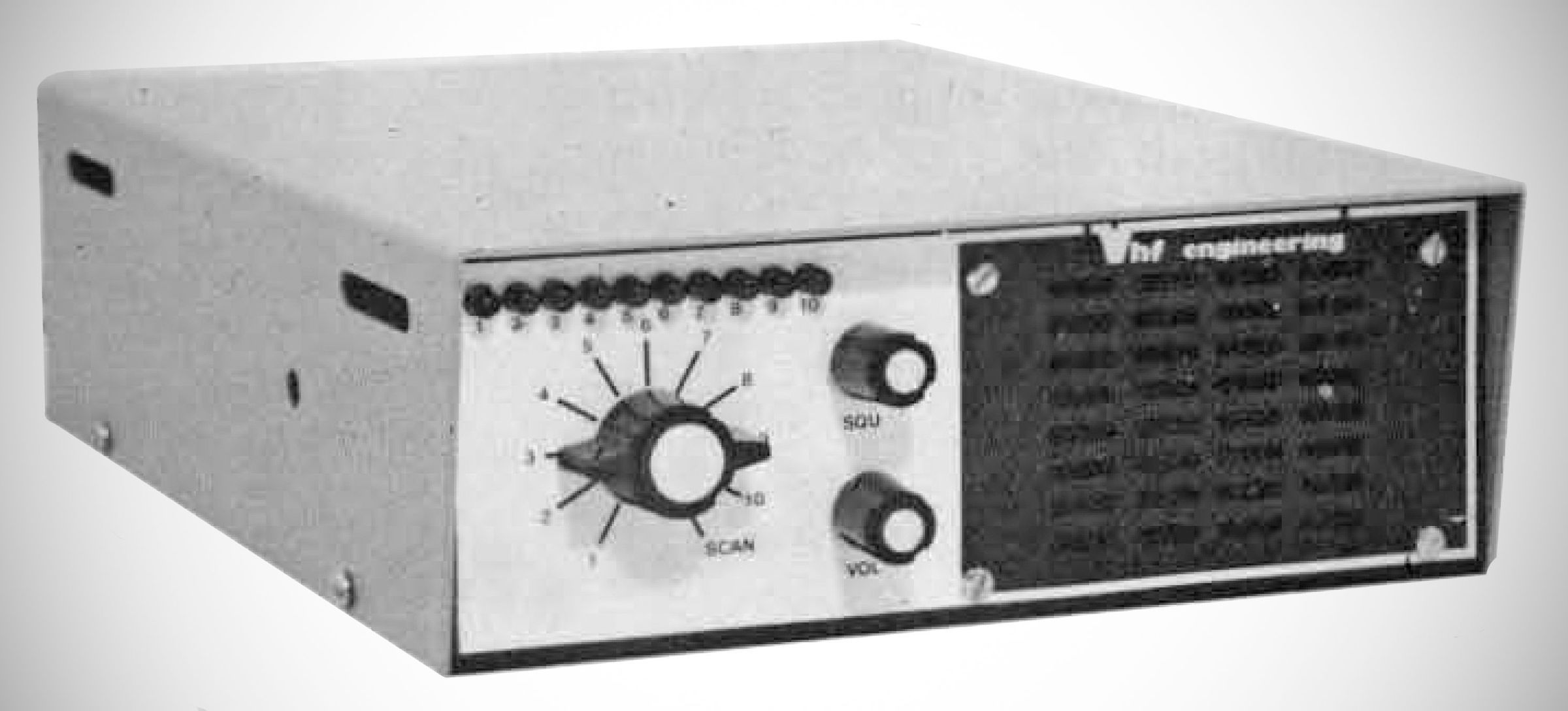
The TRX series of transceivers are constructed from a line of individual modules produced by VHF Engineering. Each of these modules were also sold separately. These are very basic transceivers. Each transceiver model in the series is designed to operate on a specific amateur radio frequency band:
TRX-50: 6 meters. 20 watts. $249.95
TRX-144: 2 meters 15 watts. $219.95
TRX-220: 220 MHz. 15 watts. $219.95
TRX-432: 432 MHz. 10 watts. $254.95
Modules include the following (to be combined with the company's receiver, exciter, and power amplifier modules):
SC3 Scanner module: A complete 10-channel scanning module featuring a priority channel. It is designed to work with the CD1 or CD3 crystal decks (or any receiver with one side of the crystal at RF ground) and requires a logic 0 signal to stop scanning.
CD1 Crystal Deck module: A 10-channel diode-switched receive crystal deck. It interfaces directly with the CD2 deck or operates in conjunction with the SC3 scanner.
CD2 Crystal Dec module: An 11-position crystal switch for the TX series transmitters. It features an extra set of contacts that can be wired to the CD1 or CD3 for 10-channel transceive operation, or used to switch LED indicators. The 11th position is dedicated to activating the SC3 auto-scan module. Every crystal position includes a trimmer for netting.
CD3 Crystal Deck module: Similar to the CD1, but uses low-loss PIN diodes required for 432 MHz (UHF) operation.
TRC1: A pre-drilled and punched case only.
TRC2: A pre-drilled and punched case package designed to integrate the TX, RX, CD1, CD2, SC3, and PA modules. It includes all necessary interfacing hardware, such as volume and squelch controls, knobs, speaker, grill cloth, antenna connectors, T/R relay, 10 LEDs, pull-up resistors, mounting hardware, and basic plans.
#### Microphone
A 2,000-ohm dynamic microphone equipped with a push-to-talk (P.T.T.) switch and a coiled cord.