Note
73, Oct 1979, p. 13.
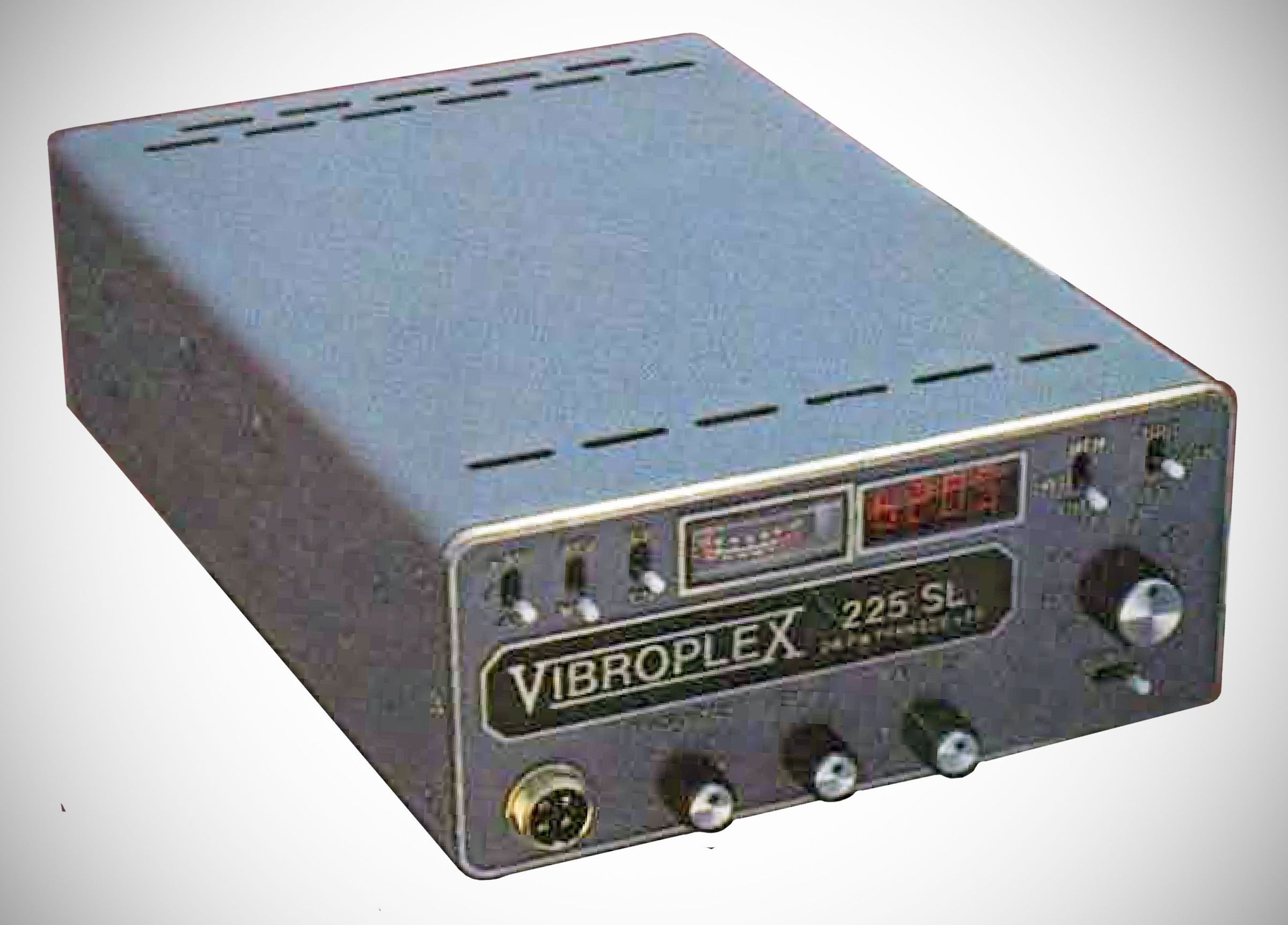
The Vibroplex 225SL (or 225 SL) is an obscure piece of amateur radio hardware introduced around 1979 by the Vibroplex Company during their ownership period based in Portland, Maine.
Vibroplex is globally famous for its CW equipment—specifically semi-automatic telegraph keys (or "bugs," as they were frequently referred to) iambic paddles, and straight keys. The 225SL represented a very unusual foray into manufacturing a 2-meter VHF FM voice transceiver for the ham radio market.
he product was commercially unsuccessful and produced in extremely small quantities. Telegraph key historians note that only one surviving example is known to exist.
Because of its extreme rarity, detailed technical schematics and user manual documentation for the 225SL remain largely unpublished in standard ham radio reference catalogs.
Here is what is known about the unit, based on advertising.
Premium Prestige: The ad positions the radio as the "definitive statement of quality" in amateur radio, explicitly drawing a luxury comparison to Rolls-Royce (even featuring the radio sitting on the hood of a Rolls-Royce next to the Spirit of Ecstasy hood ornament).
Target Audience: Marketed toward operators seeking high quality rather than mass-market equipment, appealing to those "who wish to defy mediocrity" and own the best.
Features
– Built with an advanced dual-gate MOSFET paired with a five-pole, high-Q toroidal filter in the front end to eliminate intermodulation products.
– IF Selectivity: Features 10-pole filters providing high adjacent-channel selectivity.
– Microcomputer Control: Designed for either mobile or base/fixed station use, controlled by an internal microcomputer.
– 16 Programmable Memory Channels: Offers 16 fully flexible memory channels without needing diode matrices.
– Memory Channel Monitoring: Allows the user to operate on one channel while simultaneously monitoring a second memory channel.
– Programmable Repeater Offsets: Transmit offsets can be programmed directly from the front panel.
– Dual Scanning Modes: Includes two separate scanners—one for scanning band frequencies and another for scanning stored memory channels.
– Selectable Pause/Latch Control: Features a pause-defeat control with a user-programmable pause duration ranging from 0.5 seconds to 10 seconds.