Note
QST, Feb 1966, p. 121.
QST, May 1967, p. 123.
QST, Jan 1968, p. 139.
QST, Apr 1969, p. 119.
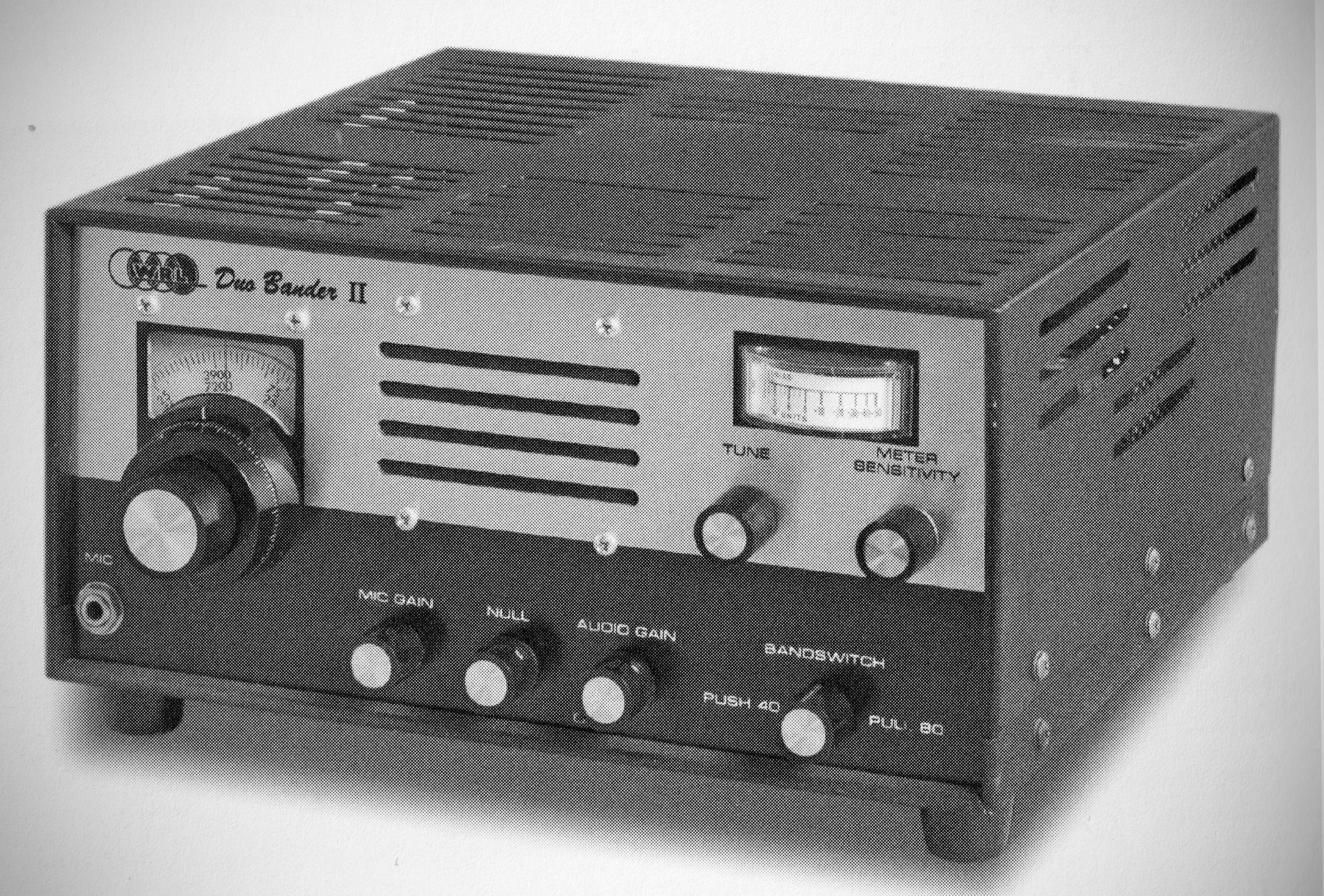
QST, Jul 1969, p. 125. (Duo Bander II)
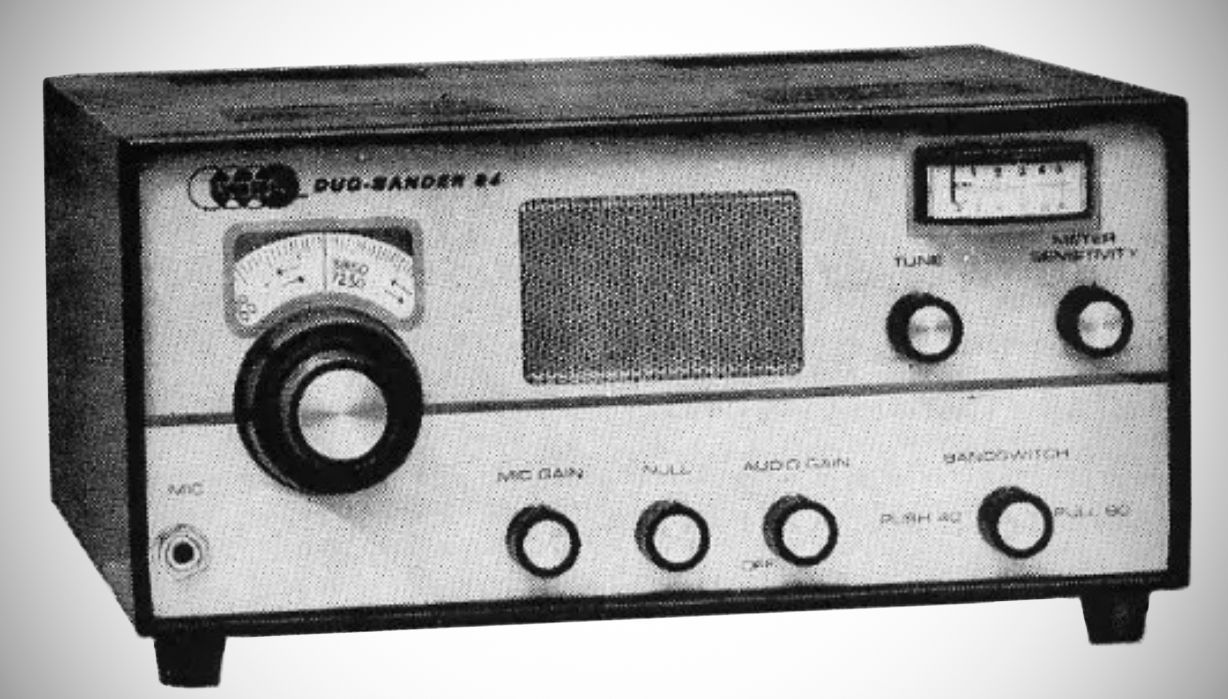
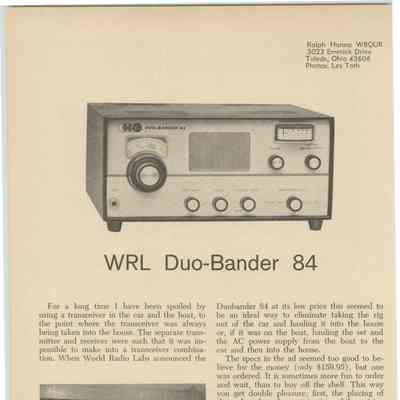
The World Radio Laboratories (WRL) Duo-Bander 84 is a factory-wired, compact amateur radio transceiver designed for single-sideband (SSB) operation on the 80- and 40-meter bands (specifically covering 3.8–4.0 MHz and 7.1–7.3 MHz, lower sideband). Marketed as a low-cost, high-power rig suitable for mobile or fixed station setup, it offered 300 Watts PEP input using a pair of 6HF5 final amplifier tubes.
The unit features a compact form factor and was supplied with a built-in speaker and a gimbal mounting bracket.
The Duo-Bander 84 utilizes a hybrid tube and transistor circuit design. It features a zener-regulated, solid-state VFO paired with a balanced modulator. VFO tuning is driven by a dual-rate vernier mechanism offering 12:1 slow and 2:1 fast gear ratios, paired with an illuminated dial marked in 2 kHz increments.
The receiver section incorporates a separate, relay-switched tuned RF stage providing 1.5 microvolt sensitivity at a 10 dB signal-to-noise ratio, along with built-in automatic volume control (AVC) and 1 Watt of audio output to the internal speaker. Selectivity for both transmit and receive modes is established by a 4-crystal filter providing a 2.5 kHz bandwidth at 6 dB down, achieving 40 dB of carrier and unwanted sideband suppression.
The Duo-Bander II as a minor update that made a few circuit changes and changed the finals from 6HF5s to 6BL6s, increasing the input power from 300 to 400 watts.
Specifications
– Frequency Coverage: 75-meter and 40-meter US SSB phone bands.
– IF Frequency: 5.55 MHz.
– VFO Range: 1.55 MHz to 1.75 MHz (generates lower sideband on 75m via difference, and on 40m via sum).
– Power & Operating Ratings
Input Power: (Duo-Bander) 300 Watts PEP input at full mic gain.
Input Power: (Duo-Bander II) 400 Watts PEP input at full mic gain.
– Output Load Impedance: Fixed Pi-network matched to a 50-Ohm non-reactive load.
– External Control Jack Rating: Rear "EXT" phono jack maximum rating is 70V AC/DC at 200 mA.
Power Supply Requirements
Requires external power supply delivering:
High B+: 900 VDC at 445 mA peak (10% regulation from 80 to 445 mA).
Low B+: 325 to 350 VDC at 200 mA (10% regulation).
Bias: Negative 100 VDC at 30 mA.
DC Low Voltage: 12 VDC at 200 mA.
Filament Voltage: 12 VAC/DC at 5 Amps.
Vacuum Tube & Transistor Lineup (Duo-Bander II)
– (2) 6BL6 in parallel. Final Amplifier
– 12BY7A Transmitter Driver
– 6EJ7 Transmitting Mixer
– 6HG8 Receiving Mixer
– (2) 12BA6. IF Amplifiers
– 6GX6 Carrier Oscillator & Product Detector
– 6JV8 Audio Output & S-Meter Amplifier
– (7) 2N2926 Audio & Balanced Modulator Circuitry
Power Supply Options
The unit was offered at an introductory price of $159.95 (wired, not a kit) and operated using separate external power supplies:
AC48: 250 Watt economy AC power supply ($49.95).
AC384: 300 Watt deluxe AC power supply ($79.95).
DC384: 300 Watt 12 VDC power supply for mobile installations ($89.95).
References
Review: CQ, Sep 1966, p. 26.
Review. 73, Oct 1966, p. 74.
Short review: Popular Electronics, Oct 1966, p. 91.