Note
QST, Apr 1974, p. 4. ("new" FRS-101S)
QST, Oct 1974, p.4. (a few details)
QST, Jan 1975, p. 143.
QST, Feb 1976, p.128
QST, Sep 1975, p. 169. (FR-101)
QST, Oct 1975, p. 153. (FR-101S)
QST, Mar 1976, p. 132. (FR-101S)
"Close out": QST, May 1979, p. 192.
Matches the FL-101 transmitter.
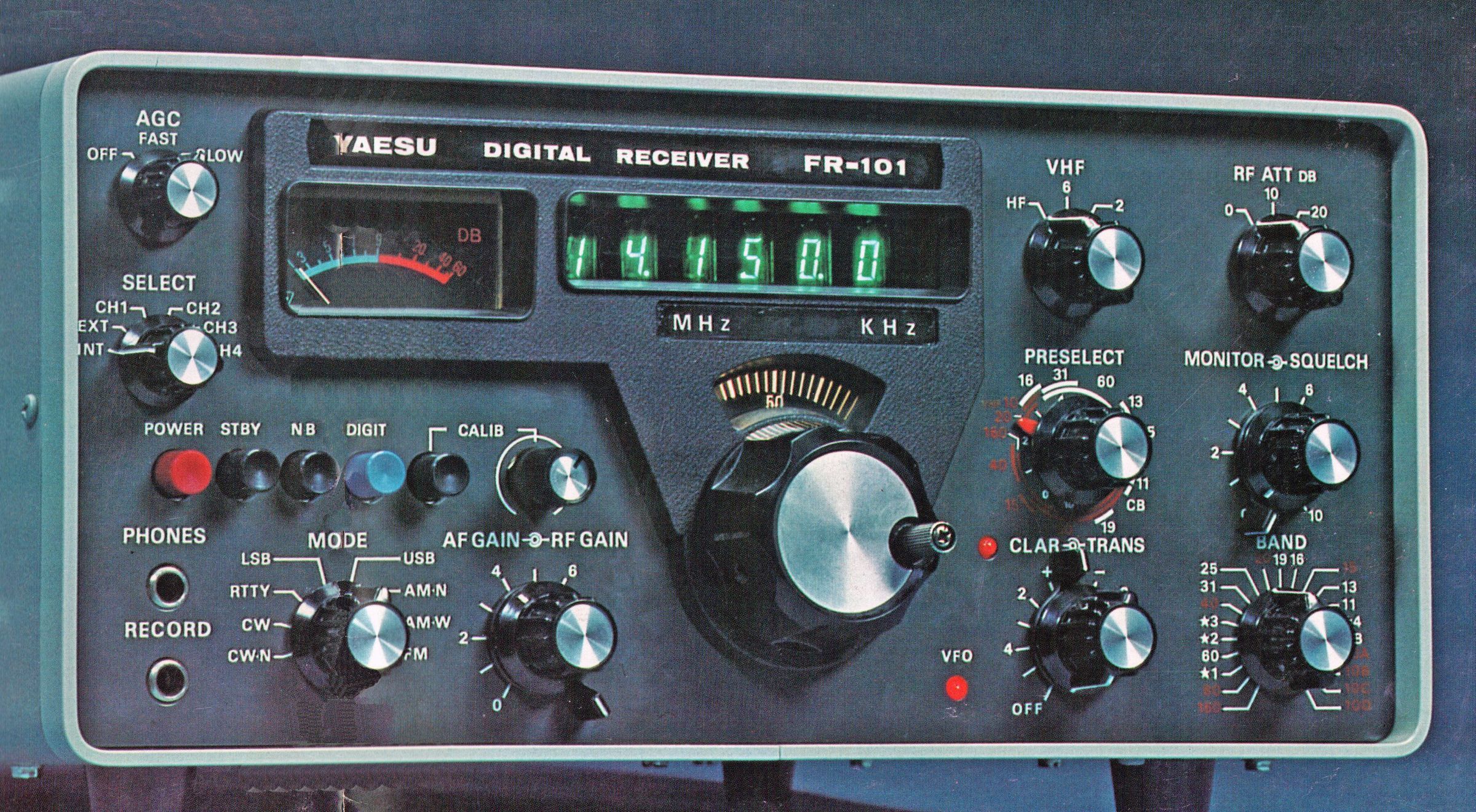
The FR-101SD uses a digital display, but is otherwise the same.
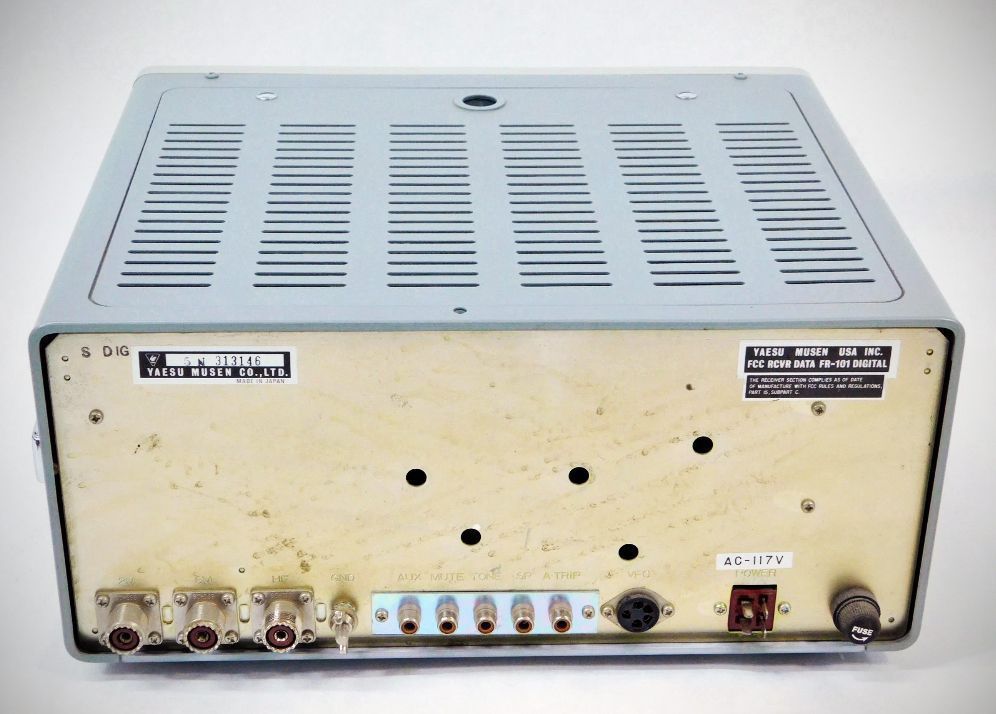
Note that FR-101 and FR-101S are often used interchangeably in advertising, and that the front panel is only marked as FR-101. The term "FR-101 series" is also seen occasionally seen in advertising. The "S" may be construed to be "standard", as opposed to the later "SD" version, which means it uses a digital frequency display.
Out of the box, the receiver covers 160, 80, 40, 20, 15, and parts of the 10 meter band ("10A" and "10B"). With optional crystals, it will also cover the 60, 31, 25, 19, 16, 13, 11, 10C, 10D, meter bands, as well as CB. Note that 11 meters and CB are separate bands. With addition of optional converts and crystals, the FR-101 will also cover 6 and 2 meters.
The receiver comes with filters for 2.4 kHz, 4.0 kHz and 0.6 kHz. Optional filters are available for 1.5 kHz, 12 kHz and 45 kHz .
Reception of FM requires an optional FM detector.
A doubly-balanced mixer, offer excellent rejection of cross-modulation and intermodulation interference. The FR-101 has less than 100 Hz drift in any 30-minute period after warmup.
Sensitivity is 0.5 uV for 10 dB signal-to-noise ratio on SSB and CW, 1.0 uV for 10-dB signal-to-noise ratio on AM, and 12 dB SINAD on FM. Image rejection is 60 dB minimum and audio output is 2 watts into 4 ohms.