Note
QST, Jul 1976, inside back cover.
QST, Jul 1977, inside back cover.
QST, Apr 1981, p. 158.
QST, Jan 1982, p. 162.
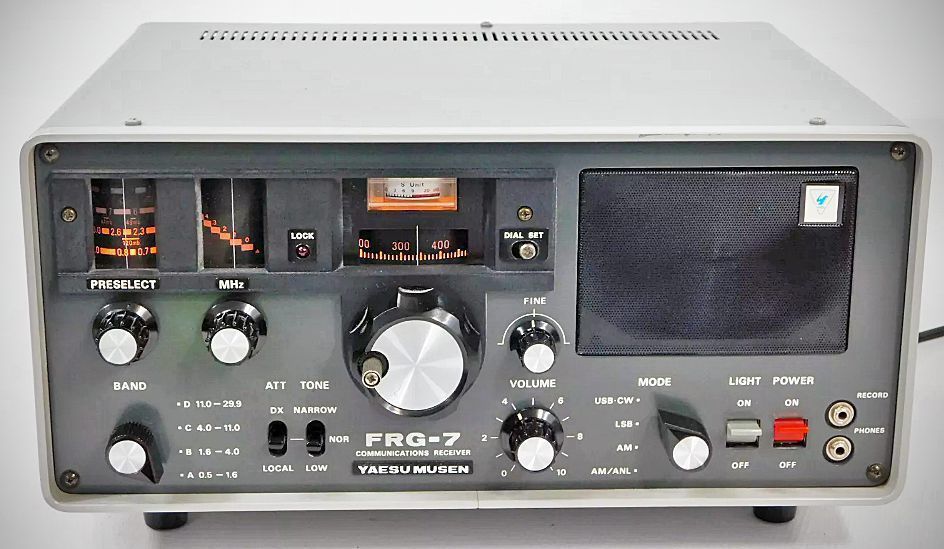
The Yaesu FRG-7 (sometimes called the "Frog 7") is a general coverage receiver introduced by Yaesu Musen in 1976. Known for its good performance, interesting mechanical design, and simple operation, it became one of the most popular general-coverage desktop receivers of the late 1970s and 1980s among shortwave listeners.
Features & Architecture
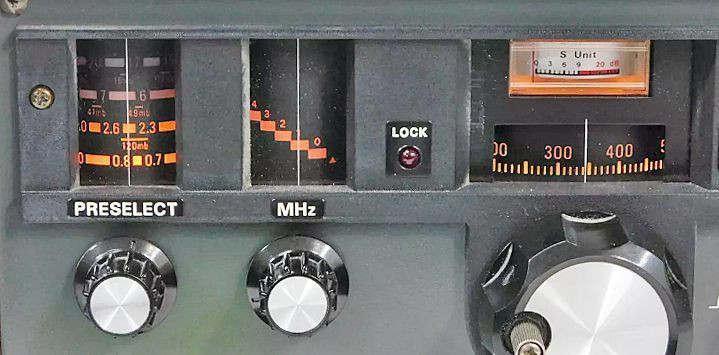
Wadley-Loop Drift-Free Tuning System: The defining feature of the FRG-7 is its implementation of the Wadley-Loop circuit architecture. Developed by South African engineer Trevor Wadley, this triple-conversion superheterodyne design cancels out local oscillator drift by utilizing harmonic mixings derived from a master 1 MHz quartz crystal oscillator.
When selecting a 1 MHz segment with the MHz dial, a red "LOCK" indicator light glows until the internal harmonic synthesizer locks into place. Once locked, the main analog VFO dial tunes smoothly across that 1 MHz range (0 to 1000 kHz) with exceptional frequency stability.
– Frequency Coverage: Covers 500 kHz to 29.9 MHz continuously across four sub-bands (A: 0.5–1.6 MHz, B: 1.6–4.0 MHz, C: 4.0–11.0 MHz, D: 11.0–29.9 MHz), allowing full access to medium wave (AM broadcast), major international shortwave broadcasting bands, and all HF amateur radio bands.
– Modes: AM, USB, LSB, CW
– Manual Preselector : Features a dedicated front-panel Preselector knob that tunes the receiver’s RF front end to match the operating frequency. Peaking the preselector maximizes sensitivity and image rejection while attenuating off-frequency signals.
– Fine Tuning: Later production models added a dedicated Fine Tuning knob to make resolve SSB and CW transmissions easier.
– RF Attenuator
– Noise Suppression Circuit
– 5 kHz Direct Dial Readout
– Ceramic IF Filters
– AC-DC or Internal Battery
– Triple Conversion
– Built-in Front Mounted Speaker
– Recording output jack
– 3-Position Audio Range Selector
Normal (Broad)
Narrow (Hi & Low Cut Off)
Low (Hi Cut Off)
Specifications
– Frequency Range: 0.5 MHz – 29.9 MHz
– Type of Emission: AM, SSB (USB or LSB), CW
– Sensitivity:
SSB/CW: Better than 0.7 uV at S/N 10 dB
AM: Better than 2 uV at S/N 10 dB
– Selectivity: ±3 kHz at -6 dB, ±7 kHz at -50 dB
– Stability: Less than ±500 Hz at any 30 minutes after warm up
– Antenna Impedance:
High impedance for 0.5 MHz to 1.6 MHz
50 ohm unbalanced for 1.6 MHz to 29.9 MHz
– Speaker Impedance: 4 ohms
– Audio Output: 2 watts
Semiconductors
ICs
AN-214: 1
SN76514: 1
FETs:
3SK-40: 3
2SK19: 6
Transistors:
2SC372: 8
2SC784: 4
2SD313: 1
Diodes:
1N60AM: 9
V06B: 2
1S1555: 3
Zener Diodes:
WZ-110: 1
BZ091: 1
Power Options
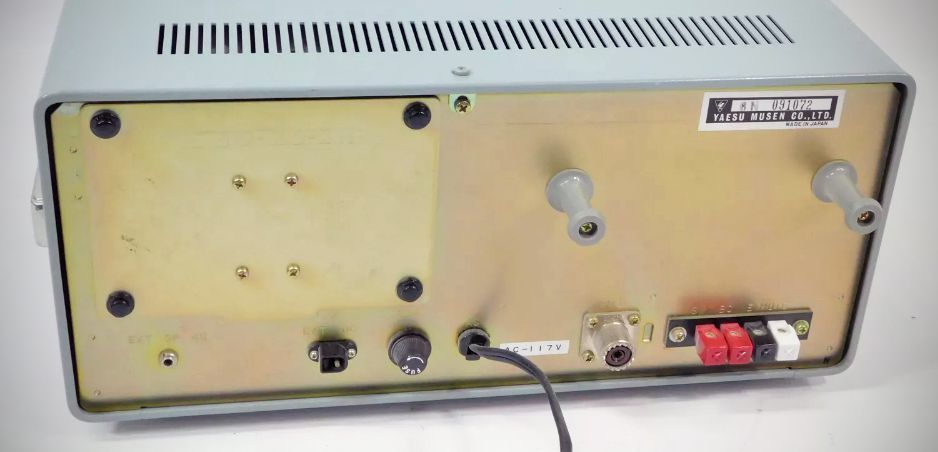
Internal AC mains transformer (110/120/220/240 VAC).
External 12–13.8 VDC supply input jack.
Internal battery compartment accessible via the rear panel holding eight D-cell batteries, which automatically pick up power if AC line power fails. Dial lamps can be switched off to conserve battery power.
Variant & Rebrand History
– Sears 412.36380700: Sold under the Sears brand in the United States as a lower-cost alternative.
– Sommerkamp FRG-7: Distributed across Europe under the Sommerkamp brand label.
References
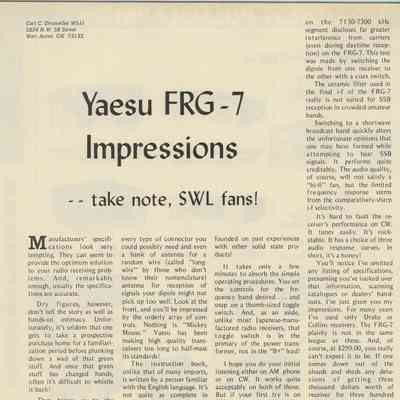
Review. Popular Electronics, Jun 1977, p. 95.